
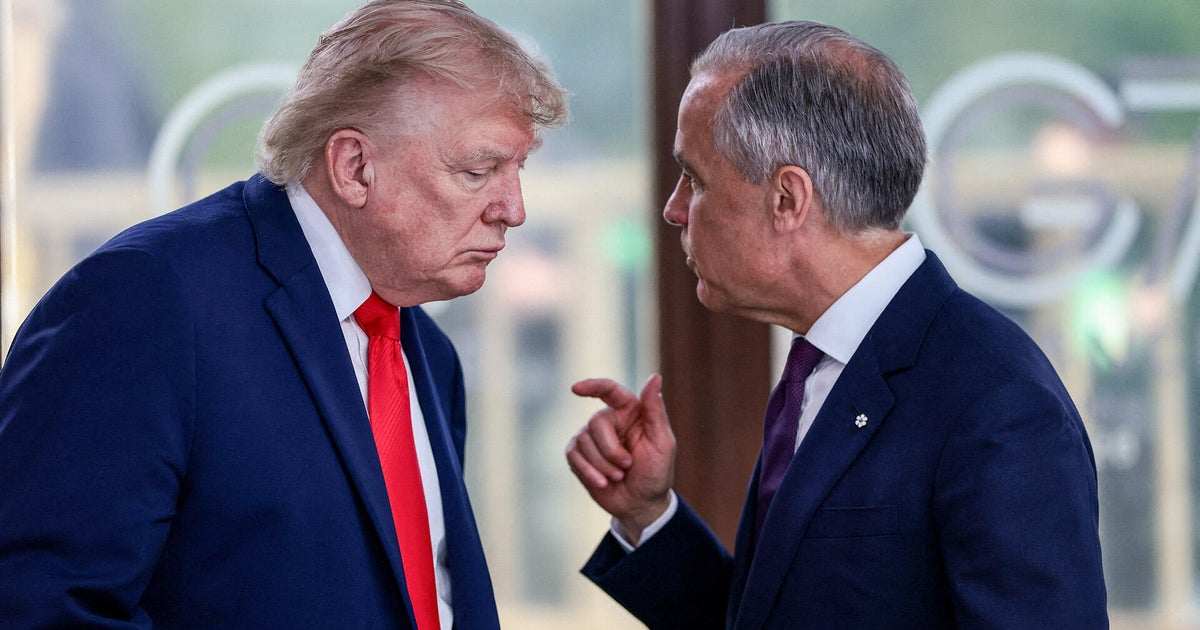
Washington — U.S.-Canada relations, already tense, are likely to deteriorate further after the United States went ahead early Tuesday with a decision to ban nearly $1 billion worth of Canadian imports, including alcoholic beverages, dairy products and motorcycles.
The ban amounts to barely a ripple in $880 billion worth of a two-way annual trade between the two northern neighbors, but marks another ratcheting up of President Trump’s second-term trade war with America’s longtime ally and trading partner.
The import ban “certainly won’t do anything to help the trade tensions between the United States and Canada,” said trade attorney Patrick Childress, a partner at Holland & Knight and a former U.S. trade official.
The latest sparring began over the summer when Mr. Trump reached back to a Great Depression law to impose 50% tariffs on about $20 billion worth of Canadian imports, charging that Canada discriminates against U.S. dairy, auto and alcoholic beverage producers. Canada promptly counterpunched with tariffs of 15%, 25% or 50%, matching U.S. imports dollar for dollar.
To punish Canada for retaliating against his tariffs, Mr. Trump decided to ban a list of Canadian products, effective 12:01 a.m. Eastern time Tuesday.
The economic impact is likely to be minimal. Childress noted that the products on the banned list were already facing Mr. Trump’s tariffs. “For a lot of these goods, the 50% was already acting as a de facto ban by making importation from Canada into the United States uneconomical,″ he said.
Jacob Jensen, director of trade policy at the center-right American Action Forum think tank, calculates that the ban would cover $967 million worth of Canadian imports, based on 2025 numbers. Of that, 87% would be alcoholic beverages that the U.S. targeted because of some Canadian provinces responding to Mr. Trump’s provocations by banning U.S. booze from store shelves.
Those beverages include beer, many types of liquor, sparkling wine, brandy and sake.
Also banned are some dairy products, including the milk byproduct whey. The two countries have long clashed over Canada’s attempts to protect its dairy industry from foreign competition by imposing hefty tariffs once dairy imports have exceeded a quota.
The ban also covers motorcycles. Bombardier Recreational Products in Quebec (BRP) confirmed that its three-wheel Can-Am Spyder and Canyon motorcycles “will be excluded from importation into the U.S.” But BRP said the impact likely won’t be felt until next year because it has completed most production and shipments for the current season.
“This marks yet another escalation in the trade war that may result in further retaliation on the Canadian side,” Jensen said. He expects Canadian exporters and U.S. importers “impacted by these bans will be highly motivated” to demand that trade officials on both sides find some way to reach a “resolution of this whole ordeal.”
The impasse imperils efforts to renew the U.S.-Mexico-Canada Agreement, a North American trade pact Mr. Trump pressured America’s neighbors into accepting in his first term and which he once declared “the most modern, up-to-date, and balanced trade agreement in the history of our country.”
The deal allowed most goods to cross North American borders duty free. But since returning to the White House last year, Trump has announced a series of tariffs that have clouded the future of trade in the region.
Mr. Trump has directed most of his ire at Canada. He is openly seeking to pull Canadian manufacturing south. And he has inflamed public opinion in Canada by repeatedly suggesting that the country become America’s 51st state.
Canadian Prime Minister Mark Carney came to power last year on a promise to stand up to Mr. Trump. In addition to retaliating against the Trump tariffs — China is the only other country to do so, with very different results — Carney has sought to reduce Canada’s reliance on the United States, which last year accounted for more than 70% of Canadian exports.
“There is now a price to be paid for access to the United States market,” Carney said earlier this month. The Canadian prime minister wants to double Canada’s non-U.S. trade over the next decade.
Carney has embraced the prospect of Canada becoming the European Union’s first associate member.
And he said last week that trade negotiations with India are making “good progress” and that the two countries are aiming to conclude talks by the G20 summit in mid-December.
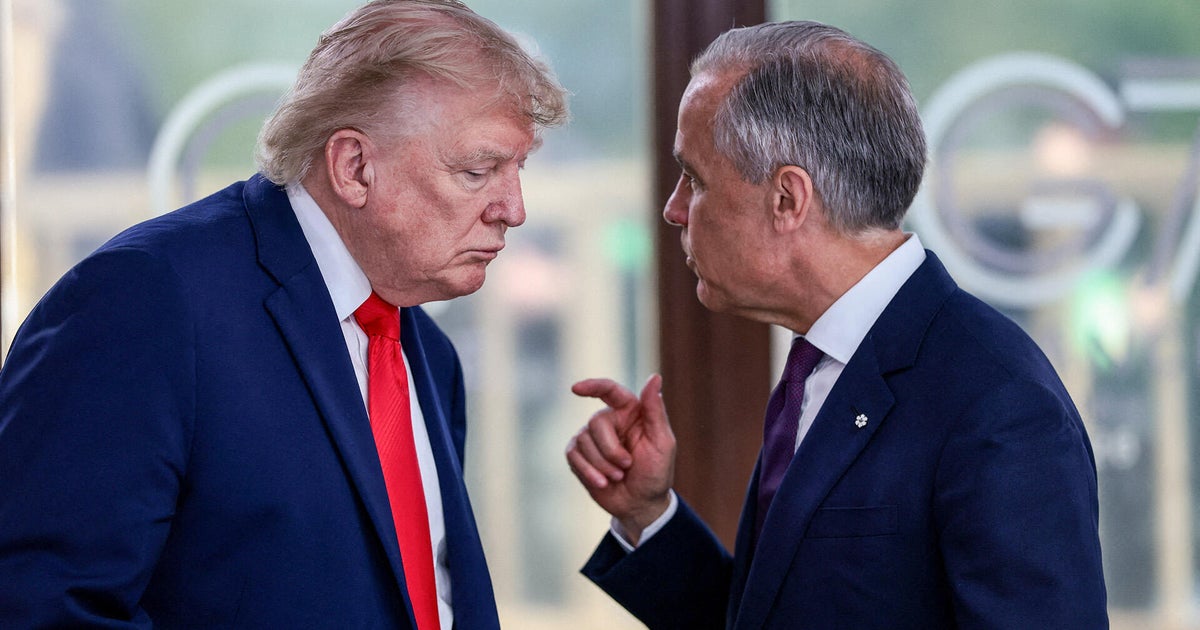
President Trump speaks with Canadian Prime Minister Mark Carney at the G7 summit in Evian, France, on June 16, 2026.
Evelyn Hockstein/POOL/AFP via Getty Images
Carney also broke with the U.S. earlier this year, striking a deal with China to allow a limited number of Chinese electric vehicles into Canada at a sharply reduced tariff in exchange for China lowering tariffs on Canadian canola.
“We take note of the coming into force of the Administration’s previously announced trade measures,” said Gabriel Brunet, a spokesman for Canada-U.S. Trade Minister Dominic LeBlanc. “Our first priority remains on protecting and supporting Canadian workers, farmers, families, and businesses from these unjustified actions. Our core focus is on what we can control: building strength at home, diversifying our partnerships abroad, and building Canada strong for all Canadians.”
Mr. Trump expressed confidence that the Canadians would cave in.
“They’re gonna come in and they’re gonna say, ‘Sir, we are sorry,'” he told reporters at the White House Monday. “They’ve treated the United States very, very badly. I think a deal will be made but it’s gonna be fair.”
“The problem is that they’ve treated the United States very unfairly. They have been one of the worst countries in the entire world,” the president said.
Trade attorney Childress said the standoff is likely to continue for months, not weeks. The import bans and the tariffs so far “probably won’t cause enough economic upheaval to force either party back to the negotiating table,” he said.
More from CBS News
Go deeper with The Free Press