
Burnham’s conference speech – snap verdict
Party conference speeches by a leader are rather weird and antiquated constructions. There is almost no other time in the year when a PM, or an opposition leader, gives a speech uninterrupted for an hour or so. Some are great, some are mediocre, but normally even the better speakers tend to lose the audience halfway through as they rattle through second-order issues included to keep an interest group happy.
Andy Burnham’s speech today was a rare exception. Because it was emotionally engaging, because it was laced with anger and it felt like a speech 15 years in the making, because it had a coherent argument, because it was quite colloquial, and perhaps because Burnham was not standing at a lectern, this was much more interesting and watchable than these speeches usually are. Normally, 40 minutes in, you are desperate for it to end. I would have happily listened to Burnham for another half an hour.
On substance, it was strong – but perhaps not quite as bold as Burnham maintains. His ambitions on social care are in the best traditions of “Go Big” (see 8.40am) and Burnham has shown himself to be a politician confident of his ability to turn public opinion on a big, difficult issue (getting rid of the triple lock). It was bold and inspiring. But whether it turns out to be effective remains to be seen, and if Burnham fails to win this argument, he has got time to trim, or back down.
On PR and Europe, he also staked out brave positions that will attract considerable opposition – not just out in the country, but from some in Labour too. But here he was a bit less specific than on social care and pensions. He implied PR would be in the Labour manifesto, but he just said he would fight the election on a proposal “to change the electoral system so that everyone’s vote counts”, which implied something less ambitious than PR – the alternative vote, perhaps, or PR for an elected Lords? – might end up to be the only option he thinks he can sell to the PLP.
And, on Europe, Burnham implied that he will open a conversation on rejoining. But he was not explicit about that, and then he started talking about “consensus” – which sounded naive because there no subject in British life on which consensus seems less possible than Brexit. One colleague has a theory that Burnham wrote the speech planning to end with a flourish saying rejoining would be an option (like Keir Starmer saying “nobody is ruling out remain” in his 2018 speech) – only to drop the wording at the last minute. There was definitely a bit of a hiatus at the end where the speech had been building up to a big reveal.
Still, this speech was daring, moving and – potentially – transformational. Burnham has had a good week, and today it got better.
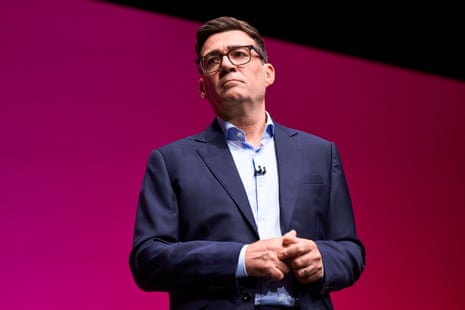 Andy Burnham giving his speech. Photograph: Christopher Thomond/The GuardianShare
Key events
Andy Burnham and his wife Marie-France Van Heel (left) meeting delegates after the speech. Photograph: Stefan Rousseau/ReutersShareBurnham’s conference speech – snap verdict
Party conference speeches by a leader are rather weird and antiquated constructions. There is almost no other time in the year when a PM, or an opposition leader, gives a speech uninterrupted for an hour or so. Some are great, some are mediocre, but normally even the better speakers tend to lose the audience halfway through as they rattle through second-order issues included to keep an interest group happy.
Andy Burnham’s speech today was a rare exception. Because it was emotionally engaging, because it was laced with anger and it felt like a speech 15 years in the making, because it had a coherent argument, because it was quite colloquial, and perhaps because Burnham was not standing at a lectern, this was much more interesting and watchable than these speeches usually are. Normally, 40 minutes in, you are desperate for it to end. I would have happily listened to Burnham for another half an hour.
On substance, it was strong – but perhaps not quite as bold as Burnham maintains. His ambitions on social care are in the best traditions of “Go Big” (see 8.40am) and Burnham has shown himself to be a politician confident of his ability to turn public opinion on a big, difficult issue (getting rid of the triple lock). It was bold and inspiring. But whether it turns out to be effective remains to be seen, and if Burnham fails to win this argument, he has got time to trim, or back down.
On PR and Europe, he also staked out brave positions that will attract considerable opposition – not just out in the country, but from some in Labour too. But here he was a bit less specific than on social care and pensions. He implied PR would be in the Labour manifesto, but he just said he would fight the election on a proposal “to change the electoral system so that everyone’s vote counts”, which implied something less ambitious than PR – the alternative vote, perhaps, or PR for an elected Lords? – might end up to be the only option he thinks he can sell to the PLP.
And, on Europe, Burnham implied that he will open a conversation on rejoining. But he was not explicit about that, and then he started talking about “consensus” – which sounded naive because there no subject in British life on which consensus seems less possible than Brexit. One colleague has a theory that Burnham wrote the speech planning to end with a flourish saying rejoining would be an option (like Keir Starmer saying “nobody is ruling out remain” in his 2018 speech) – only to drop the wording at the last minute. There was definitely a bit of a hiatus at the end where the speech had been building up to a big reveal.
Still, this speech was daring, moving and – potentially – transformational. Burnham has had a good week, and today it got better.
Andy Burnham giving his speech. Photograph: Christopher Thomond/The GuardianShare
Burnham is now on his peroration.
double quotation markI know to want to make a direct appeal to you.
If you agree with enough of what I’ve said get behind this plan.
It’s time to draw a line, to move beyond a decade of drift and division, to bring a spirit of unity and positivity back to our country, to unlock that working class aspiration that is still there in every postcode.
ShareBurnham says Brexit has done ‘more harm than good’, and he will look for consensus on new approach
Burnham is now talking about Brexit.
double quotation markLater this year that will be a UK EU summit, where one of the issues of the agenda will be how we best work together on immigration.
Beyond that, we will work to secure gains for our British industries most harmed by Brexit.
These are important concrete steps but they are not enough.
We will not give Britain the clear path we need into the rest of this century until we decide on a long term relationship with what is still our largest market.
I cannot say to you truthfully that where we are is good enough. Brexit has done more harm than good.
We need to restore a higher level of growth and prosperity for Britain.
So I will take the opportunity around the summit to lay out to you, to lay out to the country, what I believe the different options are for Britain’s long term relationship with our European partners.
And there are different options.
And I will see if we can find consensus around one which will give us clarity about our position and the future of the continent that we live in.
Andy Burnham giving his speech. Photograph: Christopher Thomond/The GuardianShare
Updated at 10.59 EDT
Burnham says he is ‘utterly determined’ to ensure UK stays united – as he pays moving tribute to his father
Burnham says John Swinney said he was to be the last PM of the UK. It happened on the day his father died.
He did not respond at the time, and his father would have defended Swinney’s right to say that.
He goes on:
double quotation markBecause I want you to know how it made me feel – utterly determined to prove him wrong.
Whatever its flaws, this country gave my dad a good life.
And he has given his sons opportunities he didn’t get for himself. He recognised that and was grateful for it, and so proud of what Nick, John and I did with them.
If only, if only he had been able to appreciate that moment of the family in Downing Street. The son of a man who failed his 11 plus becoming prime minister.
Burnham is every emotional at this point. At one point he stops for a very long pause. At another he seems to be crying.
Going back to the theme of the union, he says the union may not be perfect, “but it still stands for something worth saving, worth fighting for.”
Updated at 10.51 EDT
Burnham says he is setting up commission on PR, and electoral reform will be in Labour’s manifesto
Burnham announces a commission on electoral reform.
double quotation markThere is one final thing we need to change if our plan for Britain is to succeed – our politics.
Westminster prizes point scoring over problem solving and that is why so many things have gone unfixed for so long.
If we want to change Britain, we need to change ourselves.
I will work as hard as I can to get as much cross-party support for our plan for Britain.
If we can ensure that it will project a message of confidence and stability to markets and the world about Britain’s future direction.
Burnham says the Labour party conference has twice voted for PR. He agrees.
double quotation markAnd so I am announcing a new national commission on electoral reform.
I invite all the political parties to be part of its work.
We will contest the next election with a manifesto commitment to change the electoral system so that everyone’s vote counts and everyone’s voice is heard.
Updated at 10.37 EDT
Burnham says he has a theory of growth.
double quotation markI have a theory of growth.
It starts by retaking control of the essentials that make a place work or not.
You’ve got to have that control over the fundamental things that everybody needs.
And from there, you devolve more power to places, to put them in charge and decide their own destiny.
And then in doing those things, we optimise the conditions for businesses to grow and making. We support our people, so they’re there for our businesses to employ.
ShareBurnham says welfare reform will make Britain ‘more resilient’
Burnham gives more details of his welfare plans.
double quotation markWe will need a fundamental rethink of the welfare system …
We will require people to take up the help [offered them] not leaving those out of work and losing confidence in connection.
This is a different approach to welfare. It is based on a philosophy of social security, a country which invests in people success rather than abandoning them and paying for failure.
A country like that will be much more resilient to the shocks we will undoubtedly face in the rest of this century, and more able to meet its later obligations on defence.
Burnham turns to young people.
double quotation markPoliticians fail to give people young people, the support they need as they grow up in a tougher world, and then threaten them in their 20s that they will strip away what they’re left with.
How is that fair? How does that build a strong society?
We have a choice, conference.
Either we invest in our young people or we pay for failure through the benefits system.
Truthfully, we can’t afford to do both.
My choice is to invest in them.
This implies that, when the Milburn report on Neets is published, its recommendations will lead to the government investing more in measures to get young people into work, including people who are ill, but imposing tougher conditions on benefits.
ShareBurnham insists his plans are ‘good deal’ for pensioners and older people
Summing up his care and pension plans, Burnham says:
double quotation markPension that rises every year, no care charges and a high quality National Care Service to give peace of mind in later life.
Conference I aren’t going to go out and argue for that a good deal for our pensioners and for older people in the 21st century.
ShareBurnham confirms low-income pensioners won’t have to pay income tax in this parliament
Burnham says he can also assure pensioners they won’t have to pay income tax if they are just on the state pension during this parliament.
double quotation markI can also confirm today our commitment to ensure that the low-income pensioners won’t be dragged into paying income tax in this parliament.