
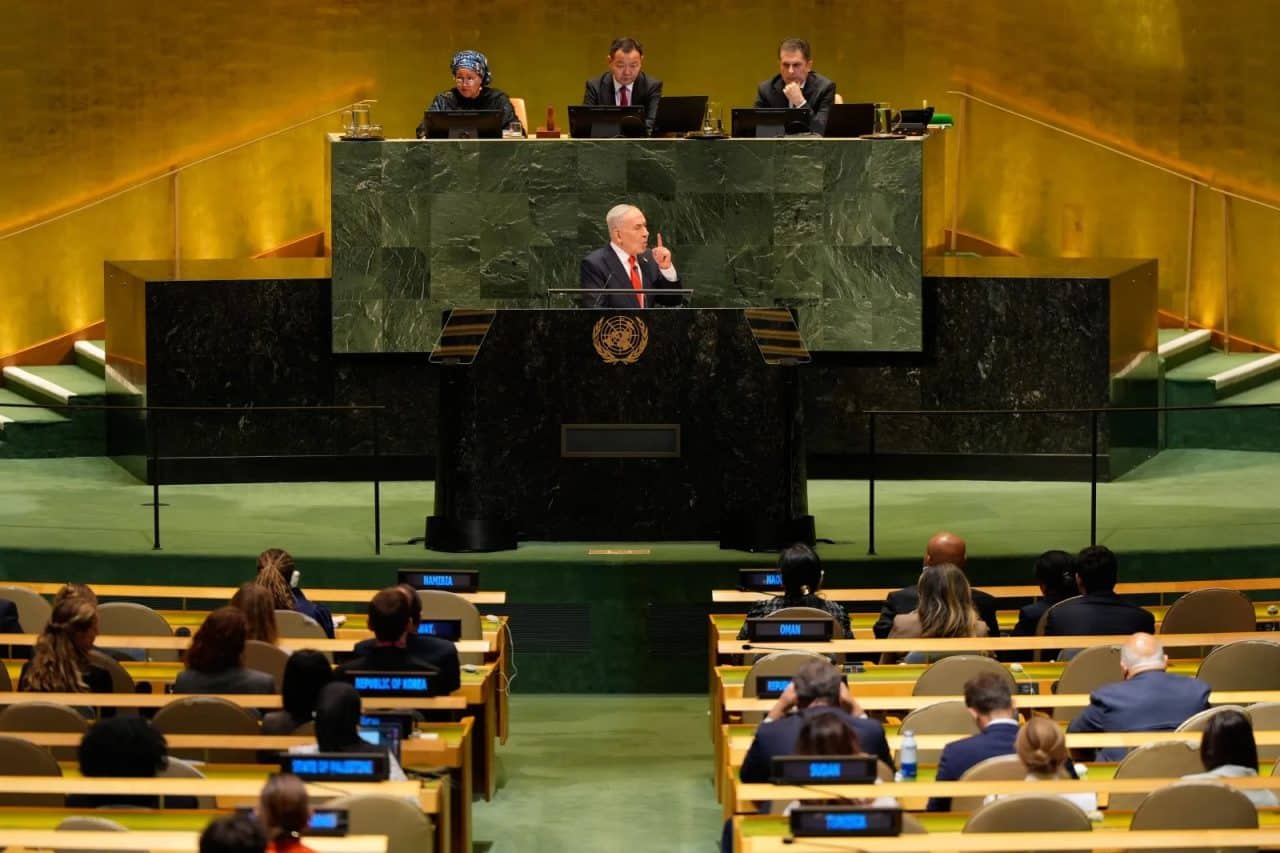
Benjamin Netanyahu’s address to the United Nations General Assembly last week sounded more like a speech marking the end of an era than one opening a new chapter. Perhaps behind it was an awareness that this could be the last time he stands on that podium as Israel’s Prime Minister.
With the approach of Israel’s elections, set for October 27, Netanyahu’s political future has become inseparable from the way he addresses Israelis and the world. Yet his speech appeared directed primarily at his electoral audience at home, with little regard for the international community.
Netanyahu did not come to New York to offer a new political vision, propose a way out of the war, or present a vision for the region’s future. He came above all to defend his standing in Israel and his conduct of the war, while recasting Israel from a state facing growing international criticism into a purported victim confronting a hostile world. The question was thus turned on its head: instead of asking what Israel was doing to Palestinians and to the region, the focus became what the world was doing to Israel.
The sight of dozens of delegations walking out of the hall as he entered provided a striking image of the very predicament Netanyahu sought to deny. Rather than treating it as a sign of growing political isolation, however, he incorporated it into a narrative of “heroism”. The more others walked out, the more steadfast he appeared in his own telling. And the louder the criticism became, the more determined he was to present himself as the leader who stands alone but refuses to bend.
Israelis united against the world
When political options narrow, military force and confrontational rhetoric can serve as substitutes for a political way forward. The aim was less to convince the world that Netanyahu had a plan to end the conflict than to demonstrate that he could still defy the world and reject its demands — and ultimately settle the conflict by force.
At the same time, the speech was clearly directed at Israelis. Netanyahu spoke of unity, resilience, and courage, of Israel standing against its enemies, invoking the image of a leader who protects his people and knows how to confront the world. This is what led some analysts to describe it as an electoral speech rather than a diplomatic one.
Netanyahu was not trying to convince the world that Israel had changed; he was trying to convince Israelis that Israel did not need to change. The speech sought to move the narrative from accusation to victimhood, from isolation to heroism, and from accountability to persecution.
But the image of a united Israel he presented sits uneasily with the country’s internal reality. Israel’s divisions did not begin on October 7. The war was preceded by a profound crisis over the nature of the state, democracy, the judiciary, religion, society, and identity. These divisions have deepened around Netanyahu’s project and that of his allies. Presenting himself as the leader who unites Israelis against the world, therefore, overlooks the fact that his own policies have been part of the internal struggle that has divided Israeli society.
This is the deeper political meaning of the false heroism in the speech: an attempt to turn isolation into evidence of strength, the absence of a political solution into proof of steadfastness, and the world’s rejection of Israeli policies into evidence that those policies are justified.
What should Palestinians take from this?
Simply, that force may impose new realities, but it cannot by itself turn them into lasting legitimacy. Palestinians should not compete with Israel over power, but consolidate their existence and national rights as a political and legal reality grounded in self-determination, freedom, and equality. That requires moving beyond reaction, strengthening unified national institutions and resilience, and speaking to Israelis and the world in a language aimed at ending the conflict rather than denying the other side.
Between the end of Netanyahu and a new image of Israel
Perhaps the absence of a meeting between Netanyahu and Donald Trump during this visit was more than a matter of protocol. The meeting was not on the U.S. president’s schedule at a time when Netanyahu is fighting an electoral battle and facing growing international isolation. It would be an exaggeration to turn that absence alone into a judgment about his political future. But the question remains legitimate: did it reinforce Netanyahu’s sense that his political era is approaching its end, and that Israel itself is paying the price for conflating the state with his government and its policies?
Netanyahu has increasingly blurred, in both his rhetoric and political practice, the distinction between the Israel he claims to represent and himself as the person who represents it. At this moment, the new Israel exposed by war and international isolation appears more starkly before the world: a state attempting to protect its old image through force, even as the gap widens between that image and what the world sees in its policies — occupation, settlement expansion, genocidal war, ethnic cleansing, and the denial of Palestinian rights. The construction of ever more “iron walls” may not be enough to conceal this image forever.
If this was indeed Netanyahu’s final address to the General Assembly as prime minister, he wanted to leave the podium with the image he had chosen for himself: a leader standing alone but refusing to bend, confronting the world while insisting that his people stand united behind him.
Yet his speech revealed another image: a leader trying to turn isolation into heroism, force into a substitute for politics, and the denial of the Palestinian people’s rights into a reality imposed through brute power. Perhaps this is the clearest irony of all: he sought to present himself as the leader whom the world could not isolate, yet, unwillingly, he may have contributed to deepening Israel’s isolation.