
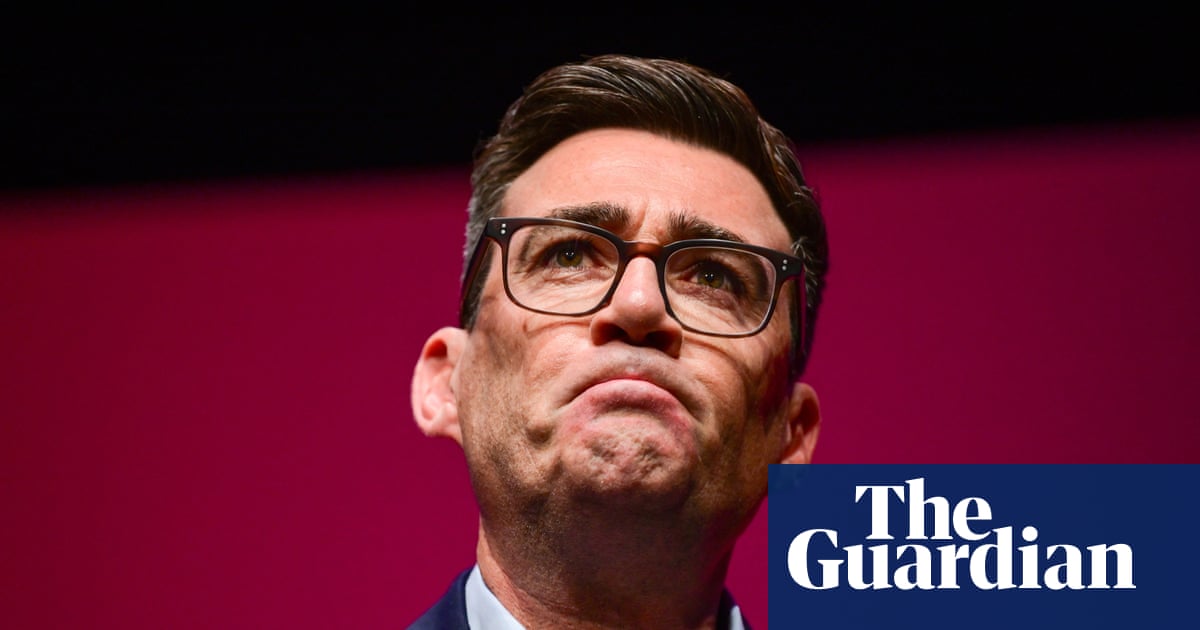
Andy Burnham has staked his future on a gamble that the public will back radical progressive policies on social care, electoral reform and Europe, telling voters that his agenda will break the mould of the last 40 years and “allow us to rise again”.
In a deeply personal speech at Labour’s conference, Burnham began building his next general election manifesto, acknowledging that he may end up paying the price for creating sharp new dividing lines in politics.
“I won’t pretend some of this won’t be difficult,” he said. “I accept I may pay a political price. But someone has to go through the pain barrier and rip the plaster off.”
However, while the prime minister said he would try to give people some “breathing space” on the cost of living, he admitted his ambitious policy prospectus would have to wait until after the next election because of the state of the public finances.
“These things are not everything, but I hope you will see it as a sign – a strong one – of our intent to get your bills and fares down as you wait for the bigger changes to come,” he told Labour activists.
 Burnham’s triple lock gamble | Politics Weekly
“I would love to go quicker, but I have to be honest about what the country can afford. I will stick to our fiscal rules to get borrowing and debt down. The approach I am outlining today is the responsible one.”
With global economic storm clouds gathering and Labour dropping behind Reform UK in one poll this week, Burnham was determined to leave his audience in the conference hall in Liverpool, and at home, some hope.
During his hour-long speech, in which he paused several times after being overcome with emotion at mentioning the death of his father, he said he wanted to show the UK was “something worth saving, worth fighting for”.
He said: “I believe the plan I have outlined today will not just hold us together, it will allow us to rise again.”
Burnham promised to be unflinchingly honest with the public about where, in his view, the country had gone wrong, saying it was time to admit “Brexit hasn’t given us control” and that it was a handbrake on growth.
In his strongest hint yet that he would look again at the UK’s membership of EU, he said he would set out plans for a longer-term relationship with the bloc at the reset summit this autumn.
Options could include trading relationships along the lines that Norway, Switzerland or Canada have with the EU, the customs union or single market, or even reversing Brexit in its entirety.
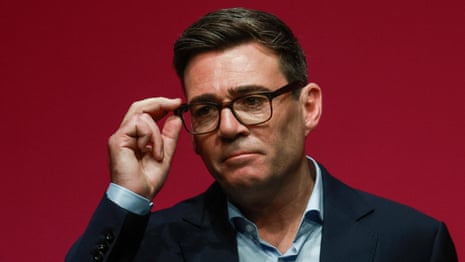 Andy Burnham fights tears as he speaks of his dad at Labour conference – video
“We will not give Britain the clear path we need into the rest of this century until we decide on a long-term relationship with what is still our largest market,” he said. “I cannot say to you truthfully that where we are is good enough. Brexit has done more harm than good. We need to restore a high level of growth and prosperity for Britain.”
While public attitudes towards leaving the EU have shifted over time, Burnham’s shift away from Keir Starmer’s manifesto red lines will still be a big political gamble in seats such as his own, Makerfield, which voted for Brexit.
Burnham confirmed he would end the pensions triple lock should Labour win the next election and use the savings to fund a national care service in England that would be free at the point of use.
He plans to break the link between wage growth and pensions and promised instead a rise based on inflation or 2.5%, whichever is higher, which he claimed would still leave millions of pensioners better off.
He said pensioners would benefit from the new care system – which would be expected to follow the Scottish system in covering care costs but not accommodation – and a promise to exempt them from income tax.
Burnham suggested that care workers were “invisible to the political class” but he told them: “You are not invisible to me. I see you. I thank you. And I am sorry that my profession has let down yours for so long.”
As well as a promise to fix the broken system, the prime minister’s words will be interpreted as a sign he is preparing to carve out migrant care workers from Shabana Mahmood’s immigration measures.
Members of the cabinet watch Burnham’s speech. Photograph: Adam Vaughan/EPA
In another commitment to a long-held belief, Burnham also confirmed he would put electoral reform in Labour’s next manifesto, announcing a cross-party national commission to consider options to replace first past the post with a form of proportional representation.
“We can’t succeed in the eyes of the world if we continue with the levels of political turbulence we have seen in recent times,” he said. “It is always in my mind that I’m the seventh prime minister in 10 years. It is why I want to underpin our plan for Britain with a new politics.
“We will all have failed in our public duties if we carry on as we are and open the door of No 10 to a divisive government on 30% of the vote or less.”
Burnham said it was the drive of his government for every person to feel greater control over the basics of life and renew faith that systems could work for them.
He said the common wealth of Britain, its homes, energy, water and care, had been stripped out and sold for profit. “The wealth we had created for the many was seen as an opportunity for the few,” he said.
“The British right talk about taking back control. Never let them forget, they are the ones that gave it away in the first place,” he said in remarks that drew a standing ovation.
Burnham promised two new pieces of legislation later this year, including a leasehold reform bill that would put curbs on charges for homes.
“The days of you being squeezed for every penny are coming to an end,” he said. “This is the break we are making with the flawed thinking of the last 40 years. Not seeing housing only as a market with winners and losers, but as an essential everyone needs for a good life.”
Burnham addresses his audience in Liverpool. Photograph: Zeynep Demir Aslim/Zuma Press/Shutterstock
He said a water bill would repeal Margaret Thatcher’s ban on state-owned water companies, which was a “symbol of what had gone wrong with Britain”. There will be new curbs on bosses and pay and new powers for mayors over water systems.
He also confirmed the creation of GB Grid, which will use money previously allocated to Great British Energy to compete with privately owned companies such as National Grid, while ministers will speed up the breaking of the link between energy prices and the international gas market.
The Tory leader, Kemi Badenoch, said: “Burnham wants to take Britain back to the 1970s – a time of more government control, more trade union control and no economic growth. There is a reason our country took a different course after that decade.
“Nothing Burnham announced today will do anything to fix Britain’s long-term problems. He had no plan to fix our stagnant economy. No plan to fund defence. No plan to sort out the spiralling welfare bill beyond more government schemes.”
Reform UK’s Nigel Farage said: “By potentially scrapping the triple lock, Andy Burnham will abdicate his responsibility to British pensioners. Instead of cutting our bloated benefits bill, stopping migrants from accessing benefits, or slashing foreign aid, he’s considering launching an offensive against our elderly.”
Labour MPs responded with relief and enthusiasm to Burnham’s conference address, which the prime minister wrote almost entirely alone, with more than one describing it as the speech of their political lifetimes.
However, there were words of caution from some ministers and Downing Street insiders, who will be more interested in how the speech goes down with the wider public at home than in the room.
“I don’t want to be negative, but we’ve got to be realistic,” one cabinet minister said. “We just don’t know what’s going to happen with the economic headwinds. But if anybody can get us through it, Andy can.”