
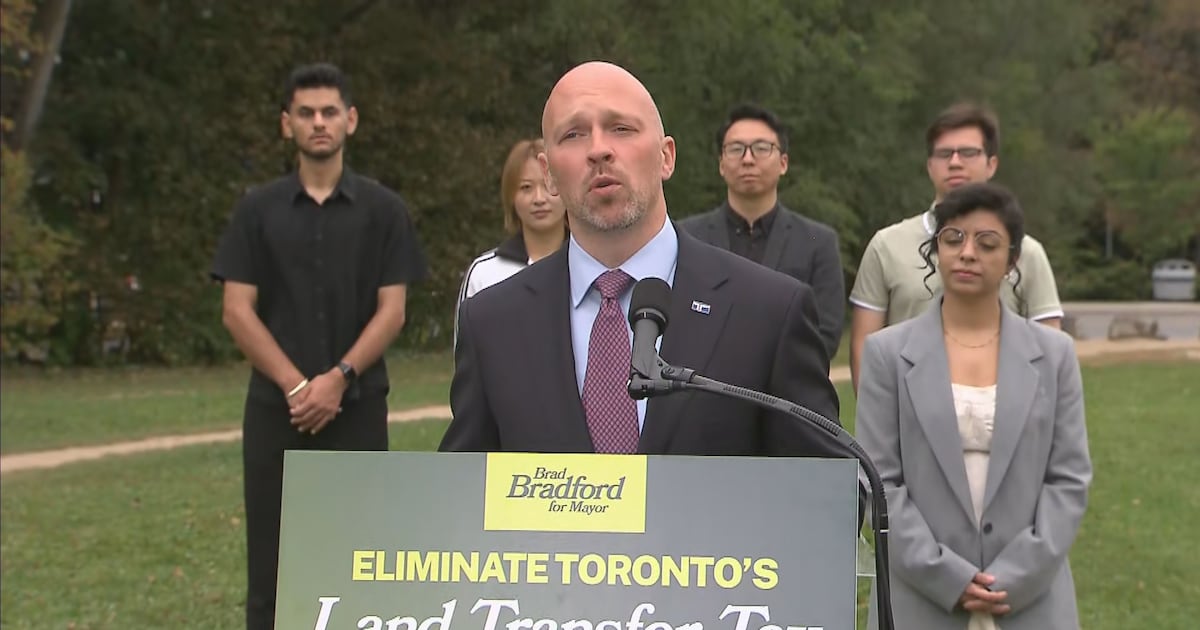
Brad Bradford has announced that he will waive the municipal land transfer tax on the first $1.1 million of the value of homes purchased in Toronto if elected.
Brad Bradford has announced that he will waive the municipal land transfer tax on the first $1.1 million of the value of homes purchased in Toronto if elected mayor but Olivia Chow is warning that doing so would inevitably result in service cuts.
The move could save home buyers approximately $18,000 when purchasing a $1.1 million home as a principal residence in the city, he said.
Buyers would still be on the hook for the provincial land transfer tax, which is taxed at roughly the same rate.
Bradford said he also wants to expand the first-time home buyers rebate in Toronto — which can currently only be applied to the first $400,000 of the purchase price — to the previous year’s average home sale price, which would then move with the market every year following.
The average home price across all property types in the City of Toronto was $979,684 in August, according to data from the Toronto Regional Real Estate Board (TRREB).
“The first-time buyer rebate was set at $400,000 in 2008 and hasn’t been touched since. Back then it covered most homes in the city. Today it fully exempts only 2.6 per cent of them. Bradford’s plan takes that from 2.6 per cent of homes to as many as two thirds,” his team said in a news release announcing the plan.
Former mayor Rob Ford promised to eliminate the municipal land transfer tax entirely during the 2010 election campaign, but failed to deliver on the pledge.
In 2013, staff advised against a potential 10 per cent cut to the municipal land transfer tax rate, writing at the time that the tax had become “a key sustainable own-source city revenue since its 2008 inception” and that any reductions would only “increase operating budget pressures.”
Ford later proposed a smaller five per cent cut but that was also defeated by city council.
Bradford’s plan is subject to council approval. Asked if he would use so-called strong mayor powers to push the plan forward, Bradford said, “Yes.”
The tax cut would apply to any homes purchased on or after Sept. 29, 2026, he said.
Bradford underscored that investors and landlords who own more than one property in Toronto, who he said makes up about 29 percent of purchases, will not qualify for the tax break.
He said that existing tax rates on property values above $1.1 million and $3 million will stay in place.
The mayoral candidate said the plan would cost the city roughly $300 million annually.
How would the city pay for this?
Asked how exactly the city would pay for the plan, Bradford pointed to an announcement he made Monday about making Toronto Water a public utility.
“We think that the municipal water utility, publicly owned, will produce a dividend. So part of that dividend would go to offset this,” he said.
Bradford added that changes to amortize capital projects over their useful life instead of funding them from the current year’s operating budget would also help to offset the cost.
Toronto’s municipal land transfer tax goes directly to the city’s operating budget. Toronto brought in $805 million in land transfer tax revenue in 2025. In 2026, the city’s budget forecasted $850 million in land transfer tax revenue.
Bradford said that “not one” city service will be cut to pay for the plan.
Chow responds
At her own news conference, incumbent Olivia Chow threw water on Bradford’s plan, and questioned how the city could afford it.
“Councillor Bradford will say anything during election time, and finding those multi-million dollars of funding means that service has to be cut. I will not slash public services people rely on. I am focusing on making life more affordable, and certainly making life so much more healthier and connected for seniors and living well-that’s my focus.”
She went on to criticize Bradford’s pitch for making Toronto Water a public utility, saying that the move would effectively put control of the utility in the hands of “someone else.”
“It needs to belong to us. It belongs to the residents of Toronto. We’re not going to give it away.”
Chow unveiled Tuesday a plan to create a more “senior-friendly city,” which aims to support older residents who want age at home.
The plan will make available free homemaking services to 5,000 seniors for cleaning, laundry, meal prep, and household basics.
Her plan also includes the expansion of mobile dental and primary care clinics, which she expects can help 8,000 seniors stay healthy near their homes.
Alexander questions Bradford’s math
In a statement released by candidate Chris Alexander’s campaign, the former federal cabinet minister questioned how Bradford will pay for the promise.
“Three hundred million dollars a year, every year, from a city that is already more than a billion dollars short. There are only three ways to cover it: raise taxes, cut a service, or borrow. Which one is he choosing? He has to say.”
Alexander went on to say that while he too wants to reduce the land transfer tax, Bradford’s proposal is not the way to do it, as the city is already anticipating a roughly $1.1 billion shortfall heading into 2027.
“The other two candidates keep coming with feel-good discounts and no solutions attached,” he said. “Both of the other campaigns are built on a series of very rich promises they cannot justify. It is no wonder we are where we are.”
TRREB welcomes announcement
In a news release published following Bradford’s announcement, the Toronto Regional Real Estate Board said it was encouraged by the proposal.
The group pointed out that, after the municipal land transfer tax was first introduced in 2008, a first-time home buyer was not required to pay the tax after applying the rebate due to the relatively low property values at that time.
Now, combined with the provincial land transfer tax, non-first-time homeowners are paying roughly $36,000 on an average-priced Toronto home as an upfront closing cost.
“After almost 18 years, the Toronto Land Transfer Tax has not made our City more affordable. Reforming the MLTT to provide relief to all homebuyers will help first-time buyers, individuals, growing families, and seniors looking to right-size and stay within the community they have called home for decades,” TRREB President Daniel Steinfeld said in a statement.