
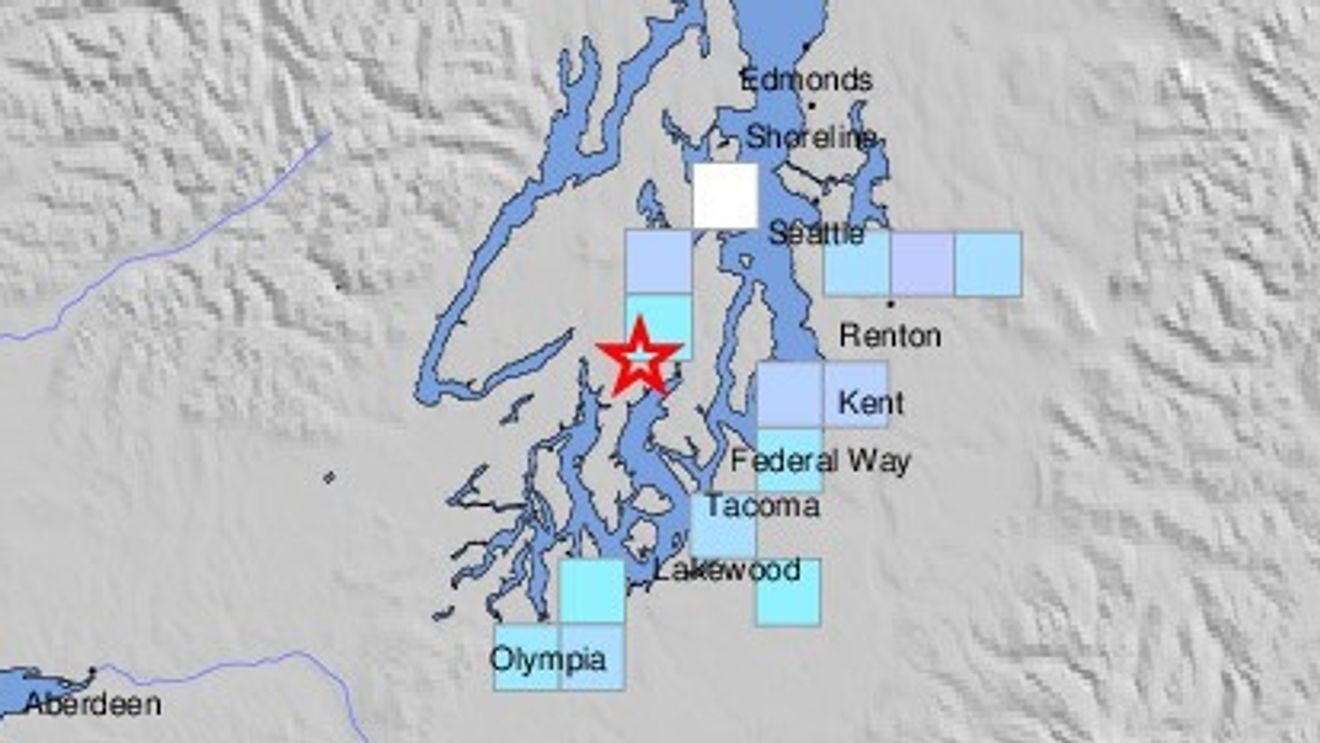
SEATTLE — A preliminary magnitude 4.2 earthquake struck the Puget Sound region Tuesday afternoon, according to initial earthquake reports.
The quake was recorded at 2:05 p.m. near the epicenter and was centered about 3.4 miles west-northwest of Wauna, Washington, according to the U.S. Geological Survey (USGS).
It occurred at a depth of about 26 kilometers, or 16 miles.
The preliminary location was about 8.3 miles north-northwest of Artondale, nearly 10 miles south-southwest of Port Orchard and about 12 miles south-southwest of Bremerton.
It was also about 27 miles north-northeast of Olympia.
The reports did not immediately provide information about injuries or damage, but no tsunami threat was reported.
Sound Transit reported that 1 Line trains would share one track at Angle Lake Station until further notice due to seismic activity.
Sound Transit also asked riders to board all trains on the Federal Way Downtown platform.
PREVIOUS | EARTHQUAKES IN WASHINGTON STATE
Some people felt weak shaking throughout areas in Seattle, Tacoma, Olympia, and Bremerton, according to the Pacific Northwest Seismic Network (PNSN).
The ShakeAlert Earthquake Early Warning System automatically detected the earthquake and (correctly) deemed it too small to trigger alerts through cell phones, the PNSN reported.
Within a half hour of the earthquake, thousands of people submitted Did You Feel It? reports to the US Geological Survey, PNSN said.
What does an earthquake feel like?
A large earthquake nearby will feel like a sudden large jolt followed quickly by strong shaking that can last from a few seconds to a few minutes, according to the U.S. Geological Survey (USGS).
If you felt this earthquake, submit a report here.
“The shaking will feel violent, and it will be difficult to stand up,” the USGS said on its website. “The contents of your house will be a mess.”
If you are far from a large earthquake, the USGS said the feeling will be more similar to a gentle bump and then stronger, rolling shaking. The shaking may also feel sharp for a little while.
If you are close to the epicenter of a small earthquake, the USGS said it will feel like a smaller sharp jolt followed by a couple of stronger sharp shakes that quickly pass.
The USGS said that if you’re far from a small quake, you most likely won’t feel it.
Does the ground below you affect how the earthquake feels?
The short answer is yes.
Both the type of crustal material and structure can impact what you feel, the USGS said.