
Over the past two months, Iran International has published three separate reports naming the trustees — oil brokers trusted by the Islamic Republic to sell Iran’s sanctioned oil — who have failed to return billions of dollars in oil proceeds to the country.
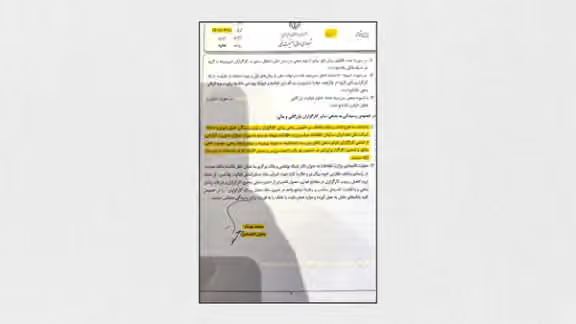
On September 28, Judiciary Chief Gholamhossein Mohseni-Ejei criticized delays in handling cases involving trustees with outstanding debts and called for swift rulings. Iran International has obtained a confidential Supreme National Security Council document in which the council’s deputy for economic affairs confirms that oversight bodies alter the trustees’ debt figures according to their own interests, inflating some debts and understating others.
The council’s deputy has asked the Ministry of Intelligence and the IRGC Intelligence Organization to report on the missing funds. The letter makes it easier for IRGC Intelligence, the principal organization implicated in the corruption surrounding oil sales, to gain access to the case.
Trustees’ case returns to IRGC Intelligence
Two informed sources in the Oil Ministry and an oversight body told Iran International that the Supreme Audit Court and the General Inspection Organization are currently pursuing the trustees’ cases. But through the maneuvering of a senior security official and an order from the Supreme National Security Council, the case has effectively returned to the IRGC Intelligence Organization.
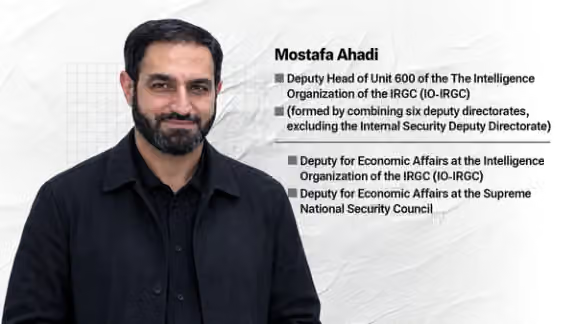
That senior security official, whose photograph Iran International is publishing for the first time, is Mostafa Ahadi. He is now deputy head of Unit 600 of the IRGC Intelligence Organization, having previously served as its deputy for economic affairs. Through his positions in IRGC Intelligence and the Supreme National Security Council over the past decade, Ahadi has had a firm grip on Iran’s oil sales.
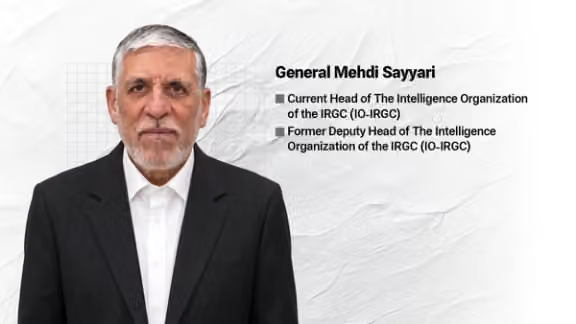
Several months ago, Brigadier General Mehdi Sayyari appointed Ahadi deputy head of Unit 600. Sayyari served for years as deputy head of the IRGC Intelligence Organization and became acting head of one of the country’s most important security organizations following the killing of Majid Khademi.
In the late 2010s, when responsibility for selling oil under sanctions was assigned to the Supreme National Security Council, Ahadi joined the council as deputy for economic affairs. Without his security background becoming known to international organizations, he attended two BRICS summits, in Russia and Brazil.
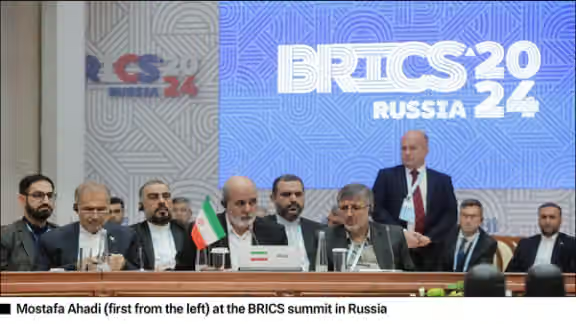
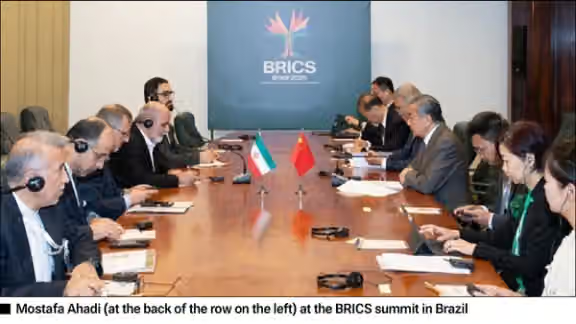
His involvement in Iran’s oil trade is so extensive that he even accompanies Oil Ministry officials on visits to oil terminals on Kharg Island.
While serving on the Supreme National Security Council, Ahadi sent his former deputy, Mohammad Javad Bavand, to the council’s cover committee as a representative of IRGC Intelligence, ostensibly to oversee sanctioned oil sales. His principal responsibility, however, was to secure profits from corruption in the oil trade for the IRGC Intelligence network.
Bavand, who served as a special assistant to the oil minister for oil sales during Ebrahim Raisi’s administration, returned to the role about four months ago. According to a General Inspection Organization document first published by Iran International, he assigned the sale of a large 86-million-barrel oil consignment to four trustees with outstanding debts, including Mohammad Hadi Momenin.
Bavand’s close ties to Mohammad Hadi Momenin
Iran International has obtained exclusive information indicating that the relationship between the two extends well beyond this corruption case.
A General Inspection Organization document published by Iran International revealed that the sale of 86 million barrels of Iran’s oil had been assigned to four trustees with outstanding debts.
Six years ago, Mohammad Hadi Momenin was arrested on suspicion of disrupting the foreign exchange system. He had received hundreds of millions of dollars in preferential foreign currency to import machinery for the paper industry and had failed to return the funds. At the time, Mohammad Javad Bavand used his influence to have the case closed. Momenin, who was a shareholder in Mahan Industries and Mines Development Holding, then appointed Bavand to a management position as his representative. Gardeshgari Bank is the holding company’s principal shareholder.
On Monday, September 28, Hadi Ghavami, the parliamentary representative for Esfarayen, told a plenary session: “The trustees who took oil out of the country also stole $300 million, equivalent to 69 trillion tomans, from Gardeshgari Bank, and under these circumstances, the Central Bank has given them a credit line with a 45 percent penalty.”
In June 2020, Momenin was arrested again on allegations of financial corruption and disrupting the foreign exchange system, but his case was once more closed with Bavand’s help. An investigator’s report quoted Momenin as saying that he had used his employees to register numerous shell companies in China, Taiwan, Singapore and the United Arab Emirates. The companies existed for between three and 14 months.
Another part of the case revealed that Momenin’s holding company had received large loans from Mellat Bank, Refah Bank, Karafarin Bank, Bank of Industry and Mine, Saman Bank and Middle East Bank, yet none of the banks had filed a complaint against him.
In July, the Central Bank published a list of major bank debtors showing that Mohammad Hadi Momenin owed Karafarin Bank 743 billion tomans.
Two informed sources in the Oil Ministry and an oversight body told Iran International that Ahmad Baharvandi, who became Karafarin Bank’s chief executive five years ago, was in fact an associate of Bavand within IRGC Intelligence. Both men studied at Imam Sadiq University. Mostafa Ahadi also studied there and was a member of the university’s student Basij organization.
At Bavand’s request, Baharvandi did not pursue Momenin’s 743-billion-toman debt. In turn, Momenin took Bavand on a trip to China.
Mohammad Hadi Momenin was a member of the Ministry of Intelligence’s oil sales corruption network known as Shayan, which failed to return $2 billion in oil proceeds.
Secret IRGC meeting held to counter reporting on trustee corruption
After Bavand returned to the Oil Ministry, Momenin became his trusted trustee for oil sales despite a warning from the General Inspection Organization. Over the past month, following the publication of investigative reports, Momenin and Bavand have found themselves back in the headlines against their wishes.
Mostafa Ahadi, the godfather of the IRGC Intelligence corruption network, used his new position to address the problem. Two informed sources in the Oil Ministry and an oversight body told Iran International that a secret meeting was held two weeks ago at the IRGC’s media headquarters. Those present included Abdullah Zeighami, also known as Brigadier General Moshfegh, Bavand and Ahadi.
The meeting’s objective was to prevent media coverage of trustee corruption. One result was the removal of reports about the scandal from Mehr News Agency, which is affiliated with the Islamic Propagation Organization, and Hamshahri, a newspaper owned by Tehran Municipality.
At the same time, Ahadi used the Supreme National Security Council to return responsibility for the trustees’ cases to IRGC Intelligence so that the security organization’s cycle of profits from oil sales would continue.