

Want to bookmark your favourite articles and stories to read or reference later? Start your Independent Membership today.
Already a member?
Log in
Your support helps us to tell the story
From reproductive rights to climate change to Big Tech, The Independent is on the ground when the story is developing. Whether it’s investigating the financials of Elon Musk’s pro-Trump PAC or producing our latest documentary, ‘The A Word’, which shines a light on the American women fighting for reproductive rights, we know how important it is to parse out the facts from the messaging.
At such a critical moment in US history, we need reporters on the ground. Your donation allows us to keep sending journalists to speak to both sides of the story.
The Independent is trusted by Americans across the entire political spectrum. And unlike many other quality news outlets, we choose not to lock Americans out of our reporting and analysis with paywalls. We believe quality journalism should be available to everyone, paid for by those who can afford it.
Your support makes all the difference.Read more
Two North Korean soldiers captured fighting for Russia against Ukraine are now in South Korea.
The move has raised questions over how they will be investigated, protected and resettled, and the legal basis for their transfer.
The soldiers are expected to undergo questioning and security screening before the South Korean authorities decide whether to grant them protection and begin the resettlement process.
Seoul‘s Unification Ministry said on Monday their cases would be reviewed under relevant laws and past practices, suggesting that the North Korean Defectors Protection and Settlement Support Act would apply.
Under the law, the National Intelligence Service (NIS) investigates applicants in temporary protective custody, verifying their identities, reasons for leaving North Korea and security-related matters.
The investigation and temporary protection may last up to 90 days, with a possible extension in unavoidable circumstances.
The soldiers’ military backgrounds and firsthand knowledge of North Korea’s deployment to Russia could result in more extensive debriefing.
Those granted protection usually receive resettlement training before entering South Korean society.
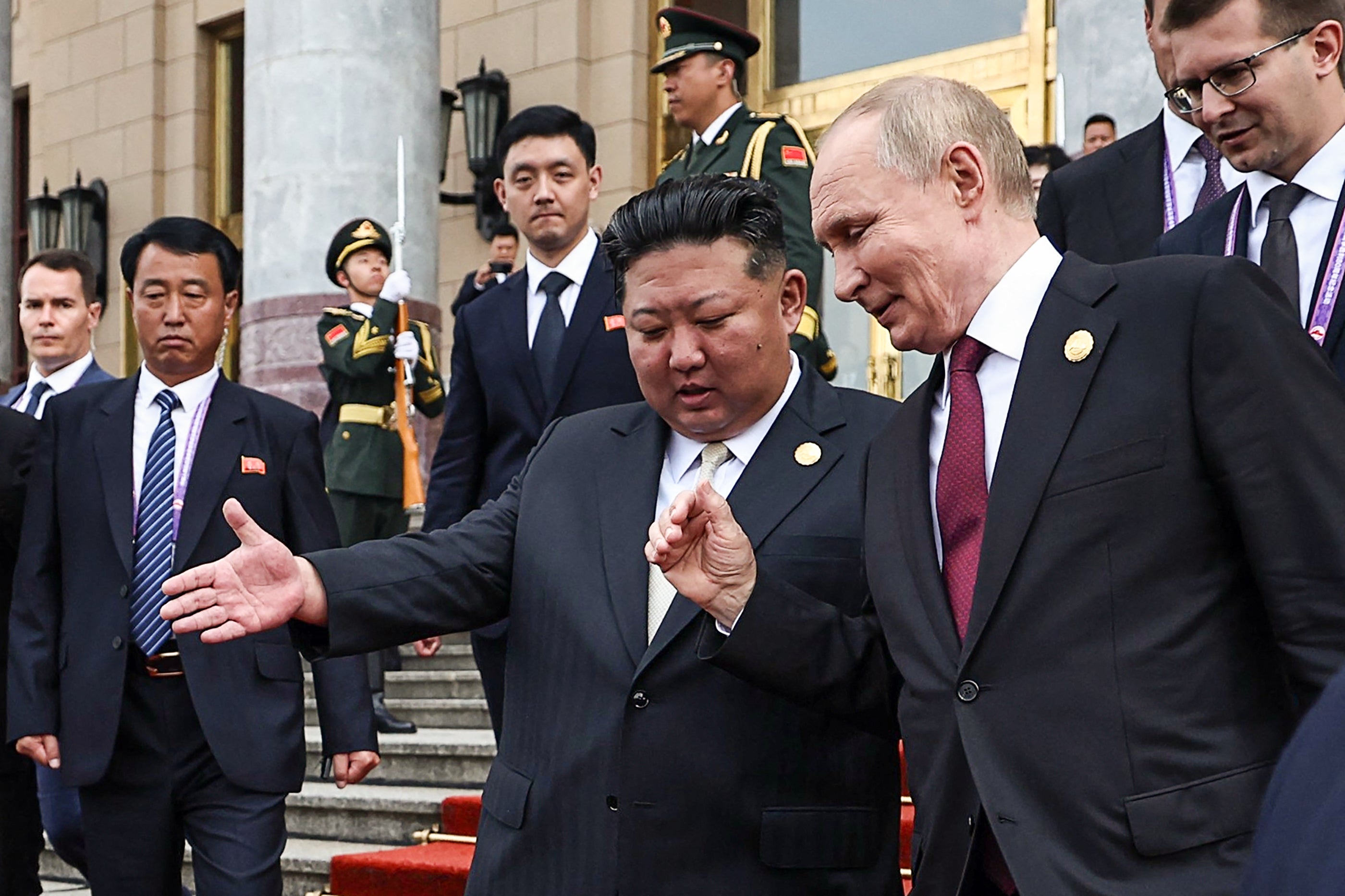 Russia’s President Vladimir Putin (R) and North Korea’s leader Kim Jong Un (C) leave after their meeting in Beijing on September 3, 2025 (AFP/Getty)
Yu Yong-weon, an opposition lawmaker who met the soldiers in Ukraine in February 2025, said they had served in North Korean special forces and could provide information on Pyongyang‘s training, military capabilities and participation in the war.
Do they receive protection?
The unification minister normally determines whether a North Korean arrival qualifies for protection, although the NIS director can make the decision on national security grounds.
Yu told Reuters the sensitivity of the case could also keep them out of public view longer than other North Korean arrivals.
Their physical and psychological condition is also likely to be assessed.
Yu said when he met them they were being held separately at a Ukrainian detention facility and the prolonged isolation and uncertainty may have affected their mental health.
Did Ukraine have the right to transfer them?
The Third Geneva Convention requires prisoners of war to be released and repatriated without delay after active hostilities end. That does not necessarily prohibit earlier release or transfer to a third country.
South Korea and Ukraine have not disclosed the legal basis for their transfer, including whether it formally ends the soldiers’ POW status.
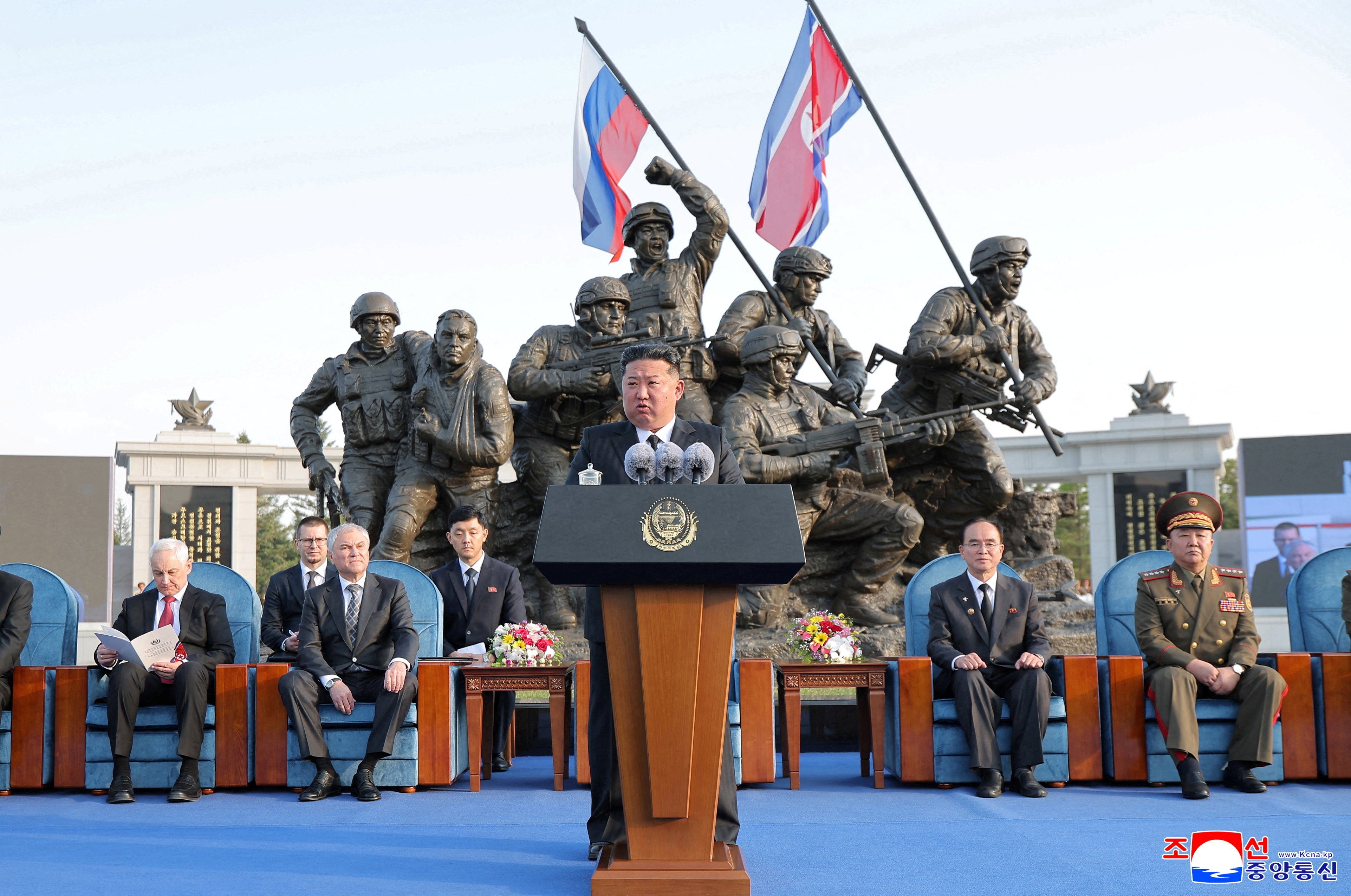 North Korean leader Kim Jong Un speaks during the opening ceremony of the Memorial Museum of Combat Feats at the Overseas Military Operations honouring North Korean troops killed while fighting for Russia in the war against Ukraine, in Pyongyang, North Korea (Reuters)
Peter Ward, a research fellow at the Sejong Institute, said repatriation was a basic principle governing POWs but should not apply where it could damage their welfare or human rights.
“There is ample basis under humanitarian and human rights law for these POWs to be transferred to a third country of their choice so long as that third country of their choice is prepared to take them,” Ward said.
Lee Shin-wha, a Korea University professor and former envoy for North Korean human rights, said the transfer could still generate legal and diplomatic friction because international law treats North Korea as a separate state, while South Korea considers North Koreans as its citizens.
Their stated wish to come to the South and the risks they could face in the North provide grounds for accepting them, she said.
Could they have been returned to North Korea?
International human rights law would weigh against returning the soldiers if they faced a real risk of torture, persecution or other serious mistreatment.
The principle of non-refoulement prohibits sending people to a country where they face such risks.
Lee said repatriation was the general rule for POWs, but international practice also recognised voluntary repatriation and barred returns that could lead to persecution or torture.
North Korean leader Kim Jong Un has praised soldiers who committed suicide while fighting against Ukrainian forces in Russia’s Kursk region where the pair were captured.
The two men repeatedly expressed a desire to go to South Korea, including in media interviews and during a meeting with Yu.
Ward said North Korea had little basis under international law to demand their return.
How has South Korea responded?
South Korea, which is a major arms producer, has faced pressure from some Western countries and Kyiv to provide Ukraine with lethal weapons but has so far focused on non-lethal aid including demining equipment.
President Lee Jae Myung announced a $100 million support package for Ukraine at a NATO summit in July, while his government reiterated that lethal weapons were excluded. Seoul also pledged continued humanitarian assistance and support for reconstruction.
At their July summit, Lee and Ukraine’s President Volodymyr Zelenskiy agreed that the North Korean POW issue should be handled in accordance with the soldiers’ free will, international law and humanitarian principles.
South Korea demanded an apology from Ukraine after Zelenskiy disclosed the transfer at the UN General Assembly last week, saying Kyiv had breached an agreement to keep it confidential.
Seoul said confidentiality was necessary to protect the soldiers and relatives in North Korea.
Kyiv has said no secrecy agreement existed.