
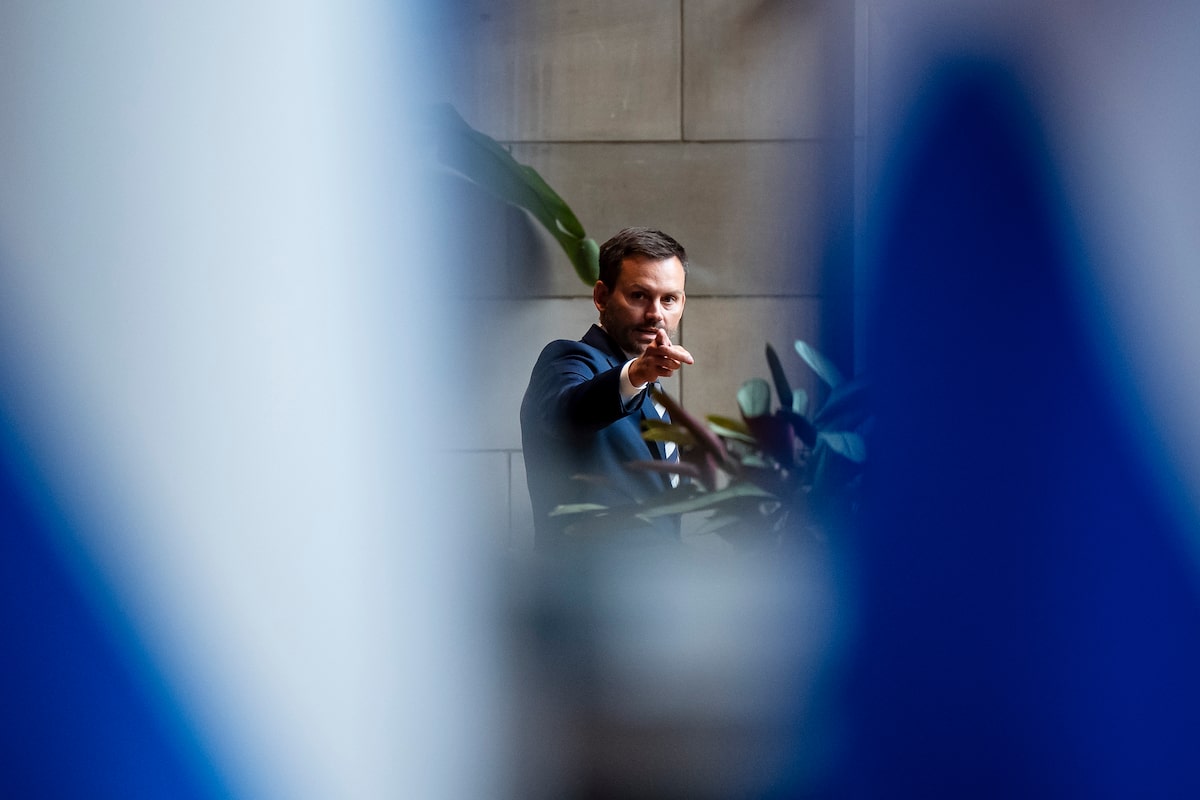
When he was a teenager, Paul St-Pierre Plamondon went to Denmark and organized a referendum.
Another exchange student might have preferred to blend into the background at a foreign upper-secondary school thousands of kilometres from home. But at 17 years old, almost as a joke, Paul ran for class president.
He didn’t speak Danish at the time, though he took pains to learn the language that year, said Nikolaj Callesen, who was a year ahead of him in school. And though his foray into politics may have started as a gag, he took the job seriously. He eventually became student body president and proposed a plebiscite on smoking at the school.
Smoking bans were unheard-of in Denmark at the time, according to Mr. Callesen, a member of the family that hosted Paul that year. A self-described hippie with long hair and a heavy smoking habit, he was “very opposed” to the idea, he added.
But Paul defied the odds and the ban passed. “No one knew him,” said Mr. Callesen. “And the next day, everyone knew Paul.”
Paul St-Pierre Plamondon, debating Coalition Avenir Québec Leader Christine Fréchette, seeks to bring his Parti Québécois to electoral victory this fall.Graham Hughes/AFP via Getty Images
Mr. St-Pierre Plamondon, now 49 and leading the Parti Québécois into a provincial election Oct. 5, told the story of his time in Denmark during a speech in Montreal earlier this year, mostly for the laughs.
But in that teenage stunt, it’s hard not to see the outline of the ambitious political operator he would become.
After returning home and voting for independence in the 1995 referendum, Mr. St-Pierre Plamondon spent years in search of a vehicle for his talents, taking a winding path that would see him disavow sovereignty before readopting the cause.
Along the way, he authored books, rubbed shoulders with the federal Liberals and considered the possibility of creating a new political party.
Few who knew him as a young man would have guessed he would eventually settle on the sovereigntist PQ as his vessel.
There are 127 seats up for grabs in Quebec’s National Assembly, which last met for Question Period in June. A party needs 64 seats to achieve majority. Mr. St-Pierre Plamondon’s PQ had seven seats at dissolution.Jacques Boissinot/The Canadian Press
Thirty years after his victory in Denmark, Mr. St-Pierre Plamondon – commonly known as PSPP – has defied the odds once again.
Days ahead of the election, he seems destined to become Quebec’s 34th premier, and could eke out a majority win that would pave the way for him to hold the third referendum on independence he has promised since taking over the party.
It is an unlikely redemption for the PQ, which was facing annihilation four years ago. Though sovereignty remains broadly unpopular in Quebec, the force of Mr. St-Pierre Plamondon’s conviction – however newly discovered – has helped to pull his moribund party back from the brink.
The pugnacious PQ Leader has built his brand on his own integrity, promising to organize a vote on secession no matter its odds of success. But he has deftly managed to turn the focus of the campaign away from independence, in part by promising not to hold a referendum while U.S. President Donald Trump is in office.
Mr. St-Pierre Plamondon, who declined an interview request from The Globe and Mail, has not inspired new sovereigntist fervour beyond his base of loyal supporters. But he has proven to be a shrewd tactician, and he has benefited from a divided landscape in which his opponents have inspired even less.
It may just be enough. Improbably, Quebec may be about to give Paul St-Pierre Plamondon the power to hold a referendum that most of its people do not want.
Quebec City’s historic buildings are a long way from Copenhagen’s, but both hold meaning for Mr. St-Pierre Plamondon. His exchange studies in Denmark helped shape his politics as a young man, he says.
Ritzau Scanpix/Sebastian Elias Uth via Reuters; Tom Little/Reuters
Scandinavia left a mark on Mr. St-Pierre Plamondon.
He was impressed by the Danish social democracy, which boasted free university and low income inequality.
He also admired his host father, a Lutheran pastor named Povl Callesen. He would later write that Povl was socially progressive but culturally conservative, with great respect for Danish history and traditions.
Nikolaj Callesen, Povl’s son, said his former schoolmate still calls every year at Christmas, and travelled to Denmark with his wife and three children in June to celebrate Povl’s 80th birthday.
Back in 1995, the young exchange student finished his school year in Denmark in time to return to Quebec and cast a ballot in another referendum. He was 18 years old, and his vote in favour of independence was the first of his adult life. He has said he was the only person in his family to vote “yes,” and when the “no” side won, narrowly, it felt like history had slipped through his fingers.
But if Denmark’s progressive politics coupled with a strong national identity held a lasting appeal for Mr. St-Pierre Plamondon, his interest in Quebec sovereignty appeared to wane after his teenage years.
Mr. St-Pierre Plamondon studied at McGill’s law school and served in its student government.Christopher Katsarov/The Canadian Press
Starting in 1997, he attended law school at McGill University, where former classmates remember him as affable and adept in English. In his third year, he again sought elected office and was named VP internal of the law students’ association, responsible for social activities.
The role of party planner seemed to suit him. Jonathan Kalles, who went on to serve as an adviser to former prime minister Justin Trudeau, recalled that he and Mr. St-Pierre Plamondon once went from class to class singing and dancing to an ABBA song to encourage students to sign up for an extracurricular tournament.
Allen Mendelsohn, another former classmate, said he had “no indication whatsoever” of Mr. St-Pierre Plamondon displaying political leanings during his time at McGill, even if he was a good organizer. The only thing that suggested a future career in politics, he added, was a certain “glad-handsiness.”
Mr. St-Pierre Plamondon graduated in 2001 and went on to work at the law firm Stikeman Elliott for several years, also completing a one-year MBA at Oxford University.
During his time at the firm, he met another young lawyer, Benoit Duclos. Mr. Duclos said the two became friends when they were briefly recruited to a group of up-and-comers created by the Laurier Club, a collection of high-level donors to the Liberal Party of Canada. “They were trying to attract young leaders of the next generation,” he said.
At Stikeman, Mr. St-Pierre Plamondon also worked on the team that represented Le Groupe Polygone, a Montreal advertising firm that received around $40-million in funding to boost the visibility of the federal government in Quebec after the 1995 referendum – one of several firms accused of misusing funds in what became known as the sponsorship scandal.
As a junior lawyer, Mr. St-Pierre Plamondon was involved in an effort by the company to uncover the identity of the confidential source used by the Globe reporter who broke the story of the scandal. He would later say that this episode, which gave him an inside look at the federal government’s post-referendum manoeuvring, “reignited the passion for independence” he’d had as a teen.
The federal sponsorship scandal, investigated by John Gomery’s royal commission in the 2000s, would be an important moment in Mr. St-Pierre Plamondon’s legal career.Bill Grimshaw/The Globe and Mail
Yet in the years he spent at the firm, Mr. St-Pierre Plamondon donated several times to the Liberal Party of Canada. Donation records show he gave more than $2,300 between 2004 and 2008.
In an e-mailed statement, PQ spokesperson Emmanuel Renaud said Mr. St-Pierre Plamondon attended fundraising events while working at Stikeman Elliot. “The fact that he made donations at that time was either part of the standard practice at fundraising events held by law firms or due to his connections with people in the party,” he said.
In the late 2000s, Mr. St-Pierre Plamondon co-founded a think tank called Génération d’idées (Generation of Ideas) with two other ambitious young leaders, including future Liberal minister Mélanie Joly. In his first book, Des jeunes et l’avenir du Québec (Young People and the Future of Quebec), published in 2009, he described the venture as an attempt to “dispel an unhealthy cynicism” his generation felt for politics, and to encourage young people to engage in civic life. He pitched himself as scrupulously non-partisan.
Unfortunately, Génération d’idées didn’t have very many ideas, according to Frédéric Bérard, a constitutional lawyer and prominent critic of Mr. St-Pierre Plamondon. “It was just to put themselves on the map.”
Mélanie Joly, now the federal Industry Minister, was once in a think tank with Mr. St-Pierre Plamondon.Spencer Colby/The Canadian Press
By his early 30s, the young lawyer had built something of a name for himself, and became a regular political commentator on a Quebec television show. “PSPP was the figure you would invite if you wanted a young person, but a person who was still trying to be part of the system,” said Marc André Bodet, a professor of political science at Université Laval.
In 2014, he left Génération d’idées for a new project. That year, he published a second book, Les orphelins politiques (Political Orphans), in which he again voiced his dissatisfaction with the offerings of mainstream political parties. In April, 2016, he launched a group of the same name that toyed with the idea of creating a new political party. “He seemed to be a guy looking for a platform,” observed his McGill classmate, Mr. Kalles.
But by this time, Mr. St-Pierre Plamondon appeared to have identified the Parti Québécois, which had pioneered major social programs including pharmacare and subsidized child care, as most closely aligned with his own social-democratic values. He was galled by the party’s willingness to sacrifice progressive votes by insisting on a referendum most Quebeckers didn’t want.
At the time, the centre-right Quebec Liberals had just won a majority government after less than two years of a PQ minority, preceded by nearly a decade of Liberal rule.
“Your obsession with holding and winning a referendum is harmful to progressivism and comes across as psychological harassment to the majority of the population,” he wrote, addressing sovereigntists.
“Why should they have to undergo a third referendum when 65 per cent of the population doesn’t want one?”
First-time voters in 2026 are too young to remember the last referendum, but they can find its vintage merch at Montreal’s Club Pays. The Globe spoke with some of the sovereigntist café’s Gen Z regulars, and some were conflicted about voting for the Parti Québécois.
Andrej Ivanov/The Globe and Mail
When Mr. St-Pierre Plamondon decided, in 2016, to seek the leadership of the Parti Québécois, even those close to him were caught off-guard.
“I was dumbfounded,” said Marie-France Perreault, a lawyer and long-time friend.
Ms. Perreault learned of her friend’s plans when he invited her for coffee one day to ask for her help. She was doubtful at first, but he was convincing. When the political orphan announced his campaign that June, he pitched it as an attempt to rebuild Quebec as a viable social democracy.
Soon, Ms. Perreault was part of a small team of Mr. St-Pierre Plamondon’s family and friends, none of whom had political experience, working on what she called an “artisanal” campaign. She described organizing press conferences in Montreal that no reporters would attend. As in Denmark two decades before, Mr. St-Pierre Plamondon was an outsider launching an ambitious – and unlikely – bid for the top job.
Mr. St-Pierre Plamondon announced his candidacy for the PQ leadership on June 3, 2016, to the surprise of many people close to him.The Canadian Press
The would-be leader later recounted sleeping in his father-in-law’s camper van in the Walmart parking lot of a far-flung town, where he’d travelled to gather signatures, and wondering what he’d done with his life.
Mr. St-Pierre Plamondon’s candidacy was viewed with skepticism within the party, not least because of his timid position on sovereignty. When he entered the race, he described himself as a “disappointed federalist.” He promised there would be no referendum in a first mandate, and a vote after that would only be held if Quebeckers clearly wanted one.
“He was the least enthusiastic supporter of independence among all the candidates,” said Martine Ouellet, a former PQ minister who also ran for the leadership that year.
Her 39-year-old competitor finished last in that race, but earned nearly seven per cent of the vote – a victory, according to Ms. Perreault, who said the point was simply to get his ideas out there. Once again, Mr. St-Pierre Plamondon had put himself on the radar.
But the following years would not be easy on the novice péquiste, who was named a special adviser by the new leader, Jean-François Lisée, in the weeks after the vote.
Tasked by Mr. Lisée with surveying Quebeckers on their opinion of the party, Mr. St-Pierre Plamondon produced a report that found a political brand once known for its innovation was now viewed as “stagnant, conservative and aging.”
It was more candour than the membership seemed to want, and for a while, he was persona non grata within the party. But he persevered, later writing that the PQ cause was “more important than anything else.”
Jean-François Lisée, on the campaign trail in 2018, would step down as PQ leader after a poor result in that election.Paul Chiasson/The Canadian Press
At 41, he ran for his first seat in the 2018 election, but he was no match for the tidal wave that swept the Coalition Avenir Québec into power on a promise to set aside the decades-old debate on secession. Mr. Lisée, who had promised not to hold a referendum in a first mandate, saw his caucus reduced to just 10 seats and immediately resigned amid speculation that the party had been permanently sidelined.
It was a crushing defeat for Mr. St-Pierre Plamondon, prompting him to return briefly to his career in law. He took a job at a firm in Gatineau alongside his old friend, Benoit Duclos.
But his exit would be short-lived. The allure of politics was too strong. When he told Mr. Duclos he was planning a second bid for the leadership in 2020, his colleague wasn’t surprised. “He came to see me and he said, ‘If I don’t do it, I’m going to regret it,’” Mr. Duclos said. “It was a bit like a fish saying, ‘I’m going back to the water.’”
The current incarnation of Paul St-Pierre Plamondon emerged that year. Gone was the younger man who argued Quebec had more pressing concerns than separation, replaced by a full-fledged sovereigntist promising a referendum within four years of forming government. His campaign slogan was “Oui.”
While the pandemic sent CAQ premier François Legault into crisis management mode, the PQ put off its leadership vote, and Mr. St-Pierre Plamondon used the time to publicize his new ideas.Ryan Remiorz/The Canadian Press
The PQ leadership campaign was delayed by the COVID-19 pandemic, so Mr. St-Pierre Plamondon wrote a third book, Rebâtir le camp du Oui (Rebuilding the Yes Camp) explaining his new philosophy, which seemed motivated as much by strategy as conviction.
Where the goal before had been to unseat the federalist Liberals, he felt it would now be impossible for the PQ to defeat the nationalist CAQ without “what makes its supporters’ hearts beat.”
“You don’t win by acting like a wet blanket,” he wrote. “The only way for the PQ to regain power is to restore the legitimacy of the independence project.”
Mr. Renaud, the party spokesperson, said in a statement that several factors contributed to Mr. St-Pierre Plamondon’s new “sense of urgency” around independence. Those included Mr. Trudeau’s federal immigration policies, which he said caused a “deliberate and rapid decline of the French language in Quebec.”
Regardless, it seemed like an about-face, and a risky position on an issue that had little support outside the PQ base. But perversely, that may have been part of his appeal. “Because it was so unpopular, people gave him some credit because he was being authentic, supposedly,” said Mr. Kalles, the former law student.
It was enough to clinch the leadership for Mr. St-Pierre Plamondon, then 43. Due to pandemic restrictions, he delivered his October, 2020, victory speech to a camera in a mostly empty room. It was an inauspicious start to what Ms. Perreault, who became his first chief of staff, described as a “very, very, very difficult” time.
Mr. St-Pierre Plamondon had inherited a party on the verge of extinction in the middle of a pandemic that made it nearly impossible to get attention. When he was interviewed, Ms. Perreault recalled, “He was consistently asked: ‘Does it worry you to be possibly the last leader of the Parti Québécois? Are you going to cause the party to die?’ ”
In the 2022 election, the CAQ grew its majority and Mr. St-Pierre Plamondon led his party to its worst-ever result, claiming just three seats. But he managed to get himself elected.
Ms. Perreault, who left before the campaign, said she was certain the rest would be history now that her friend finally had a spot in the legislature. “I knew he was going to rebuild the party.”
Right away, it was clear the PQ leader relished the limelight.
His opening act at Quebec’s National Assembly, in December, 2022, was to get himself denied entry after refusing to swear allegiance to King Charles. Days later, the government unanimously passed a law stating that only an oath of allegiance to the Quebec people would henceforth be required.
But he was also moving the Parti Québécois in a new direction that seemed at odds with the progressive brand of politics he had often espoused. In the 2022 campaign, he had promised to slash immigration targets so as not to overwhelm services or threaten the French language. It was another proposal that seemed to echo politics in Denmark, whose centre-left government has passed some of Europe’s most restrictive immigration policies – ostensibly to protect its welfare state.
Ms. Ouellet, who now leads a small provincial party focused on sovereignty and fighting climate change, said the move struck her as an “opportunistic” bid to win back CAQ voters, and a significant shift for a party that had always been “extremely open.”
Mr. St-Pierre Plamondon has also sought to one-up the government’s secularism policies, which include restrictions to religious symbols and limits to public prayer. Back in 2014, he criticized the previous PQ government for a proposed “charter of values” that would have banned religious symbols for many public servants, saying the party had “once again chosen to subtract rather than add.” But now he says he would ban conspicuous religious symbols for elementary school students.
Mr. St-Pierre Plamondon was a critic of the PQ’s secularist vision when it proposed a ‘charter of values’ in 2013. Now, he supports restrictions on symbols of faith.Graham Hughes/The Canadian Press
The PQ leader has condemned “wokeism” and called for a parliamentary committee to investigate whether “radical left” gender ideology is seeping into schools. Earlier this year, he gave an hour-long interview to the right-wing outlet Rebel News.
The shift has confounded some who’ve tracked his career. Mr. Bérard, the constitutional lawyer, said it’s frustrating to watch Mr. St-Pierre Plamondon target minorities, apparently for political gain. “He really decided to veer right,” he said. “It’s sad, because those who knew him before know this isn’t him.”
“Maybe they feel like it’s a good strategy to attract mostly baby boomers who voted for the CAQ for the last two elections,” said Prof. Bodet. “I’m not even sure that he’s convinced that this is the right thing to do.”
Whatever his personal convictions, Mr. St-Pierre Plamondon emerged as a sharp and articulate politician. When the CAQ’s star began to fade in late 2023, while the provincial Liberals were without a permanent leader, he embraced the role of de facto voice of the opposition.
“He made a decision very clearly to take a swing at absolutely everything,” said Mr. Kalles, his former law school classmate. “It got him a lot of attention at airtime.”
Critics argue that sometimes he swings a little too hard. Earlier this year, Prime Minister Mark Carney made a widely panned speech describing the 1759 Battle of the Plains of Abraham, which led to the surrender of Quebec to the British, as the start of a partnership.
Mr. St-Pierre Plamondon quickly responded with an indignant speech of his own invoking Mahatma Gandhi and Nelson Mandela, and was derided in the press for overplaying his hand. He has more recently alleged, without presenting evidence, that the federal government is spying on his party, and accused Ottawa of interfering in Quebec’s election with a series of recent announcements featuring Mr. Carney and Premier Christine Fréchette.
“What he wants is a spotlight on his face,” said Mr. Bérard. “If he has a spotlight, he’s happy.”
Mr. St-Pierre Plamondon relishes public attention, says Frédéric Bérard, a lawyer and critic of the PQ leader.Christinne Muschi/The Canadian Press
Under Mr. St-Pierre Plamondon, the PQ has made a remarkable recovery, leading in the polls for the better part of three years and winning a series of by-elections. Next week, he could steer the party he resuscitated to form government for the first time in more than a decade.
If he does, Mr. St-Pierre Plamondon will owe his victory in large part to the sovereigntist base his pledge has galvanized. Only about 30 per cent of voters say they want a PQ government – roughly the same proportion that want independence.
With five parties dividing the electorate, that will likely be enough to put the PQ Leader first across the finish line. Recent polling shows the CAQ, which seemed to be making a comeback early in the campaign, has lost ground and could be fighting for survival, while the opposition Liberals remain unpopular among francophone voters. The Quebec Conservatives and the left-leaning Québec Solidaire are both projected to win a handful of seats, but are not contenders to form government.
Still, a win at 30 per cent would hardly be a resounding vote of confidence. Paradoxically, Mr. St-Pierre Plamondon’s commitment to a referendum could cost him the majority he likely needs to make it happen.
Yet he has not wavered.
Possibly, this is because he’s a true believer, convinced as he was at 18 that Quebec will fare better on its own, like the Scandinavian nation he so admires. “He’s incorruptible,” said Mr. Duclos, his friend. “He’s a very, very frank and honest person.”
Possibly, he hasn’t walked away from a referendum because political strategy dictates he can’t. “Most of his grassroots supporters are sovereigntists above all,” said Mr. Bérard. “So if he were to back down on his promise right before the election, he would lose his base.”
Either way, when he told voters in August that he wouldn’t launch a referendum until after the Trump presidency ends in 2029, Mr. St-Pierre Plamondon appeared to bend as far as he could. He has barely mentioned sovereignty during the campaign, instead pitching himself and his party as the best choice to steer Quebec’s economy through turbulent waters. After six years of talking about independence, he has tried – for now – to stop.
The man who bent his Danish classmates to his will has yet to persuade his own people.
With a report from Marieke Walsh
Christopher Katsarov/The Canadian Press
Quebec votes: More from The Globe and MailThe Decibel podcast
How do today’s young Quebec sovereigntists differ from other generations since the Quiet Revolution? Reporter Maura Forrest spoke with The Decibel about how age and ideology shape Quebec politics, and could decide this year’s provincial election. Subscribe for more episodes.
From our Quebec reporters
Five takeaways from the Quebec leaders’ debate