
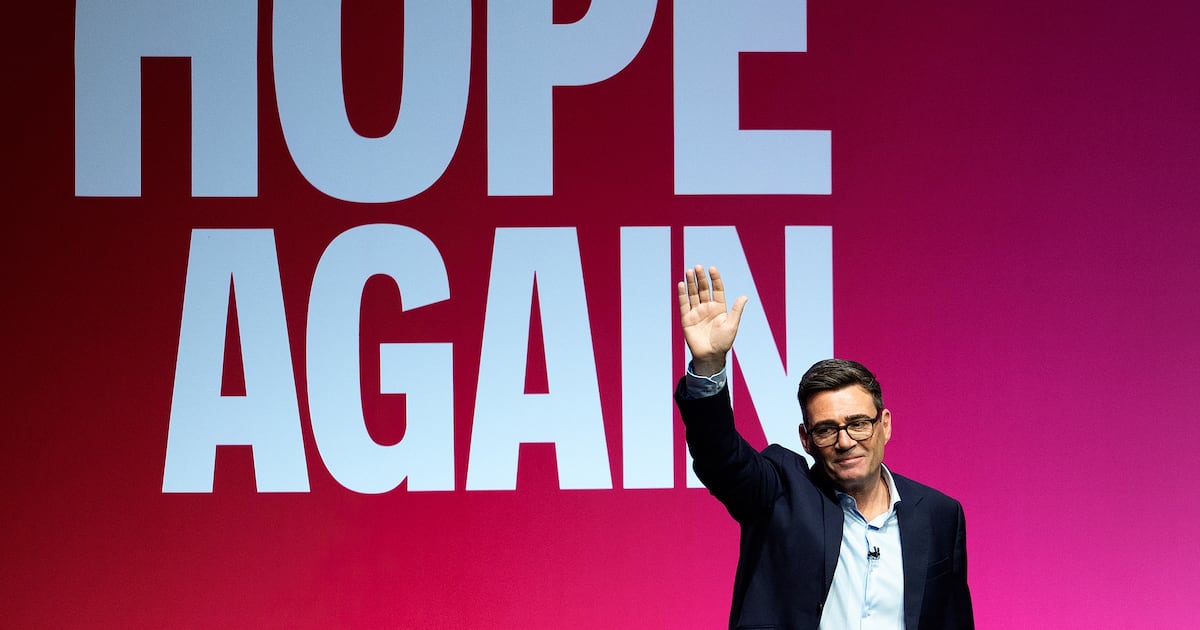
British prime minister Andy Burnham has opened the door to rejoining the European Union after the UK’s next general election.
In comments to the BBC released on Wednesday, he gave more detail of his plans outlined at the UK Labour Party’s annual conference for a “new relationship” with the bloc later this year.
Burnham said all options were on the table from “stay as we are” up to “all the way”.
Burnham said he would try to “find consensus” in the country on one option to clarify the UK’s long-term position, although did not offer further detail of how this would be measured.
Asked what the options might look like, Burnham told BBC Radio 4’s Today programme: “We could stay as we are. That’s definitely an option, if people think this is the right place to stay.”
[ Was Burnham’s speech to Labour Party conference a turning point on Brexit?Opens in new window ]
“We could look at what [former Chancellor] George Osborne has said about a customs union, we could look at what the Liberal Democrats said at their conference about the single market, or we could go all the way.”
“So there are clearly options that need to be considered, and we have to look at what is doable and what would be the pros and cons of each,” he adds.
The UK prime minister told Labour’s conference on Tuesday that he would set out “different options” later this year to coincide with a meeting with EU leaders.
That summit had been scheduled for July but was postposed following the resignation of Keir Starmer. A new date has not been set.
At the conference on Tuesday, he said he wanted to explore a more radical approach to rebuilding the UK’s relationship with the EU by trying to find consensus around what the country wanted.
Burnham told party members that the Brexit vote in 2016 had left the country weaker and failed to allow Britain to “take back control” of its borders and rules, as promised by the Leave campaign.
“Brexit has done more harm than good,” said Burnham. “We’ve lost some of the control we had over our economy, as a decade of low growth has put us in a weaker position, and we’ve lost some of our control over immigration.”
The remarks towards the end of a speech that lasted more than an hour showed how the new premier, in office for just over two months, is preparing to tackle some of the country’s thorniest challenges.
On the EU, he confirmed that a long-awaited summit between Britain and the bloc would happen before the end of the year, having been delayed by the resignation of his predecessor, Keir Starmer.
But he added that the UK wouldn’t be on a “clear path” until “we decide on a long-term relationship with what is still our largest market. I will take the opportunity around the summit to lay out to you, to lay out to the country, what I believe the different options are for Britain’s long-term relationship with our European partners. And I will see if we can find consensus around one.”
Neither Burnham nor his spokesman spelled out what options he would look at, though they’re likely to include rejoining the bloc’s single market, customs union, or both.
There may be another model to look at in Canada’s relationship to the EU, after European Commission president Ursula von der Leyen earlier this month proposed Canada could become the first associate member of the bloc.
Analysis by Bloomberg Economics found that Brexit may have cost the UK between 2 per cent and 4 per cent of GDP, with the central 2.5 per cent case equating to lost tax revenues of £30 billion (€35 billion).
The research considered three different options for future relations with the EU: rejoining the single market for goods, a bespoke package of interlocking trade agreements, and rejoining the EU customs union.
Starting from a baseline that the long-run cost of the current arrangement will be 2.5 per cent of GDP, the analysis points to closer ties delivering a prize of between 0.4 percentage points and 1.2 percentage points of recovered economic output.
The prospect of reopening a discussion on Brexit could derail the government’s ongoing negotiations with the EU to improve the current trade relationship between the two sides.
Brussels officials have indicated a reluctance to engage in detailed talks with London while it lacks a settled policy on its approach to the bloc.
While the commitment to explore options with the EU may help Burnham win back centrist and left-wing voters who had shifted to the Green Party or Liberal Democrats, it prompted criticism from Nigel Farage’s populist right-wing party Reform UK, which until recently led Labour in the polls.
“Andy Burnham has barely been prime minister five minutes and he’s already trying to sneak us back into Brussels via the back door,” deputy Reform leader Richard Tice said in a statement.
“He says Brexit has done more harm than good, but what’s done real harm is a Labour government that can’t deliver growth, can’t control migration and now wants to outsource the job to Brussels.”
Burnham, however, used his speech to criticise the political right – including the main opposition Conservative party – for its record over the past four decades, slamming Brexit, Tory privatisations in the 1980s and Conservative austerity policies in the 2010s.
“The British right talk about taking back control,” Burnham said. “Never let them forget. They are the ones that gave it away in the first place. Economic control diminished by selling off essentials. Political control corroded by the hollowing out of councils. Immigration control weakened by Brexit.” – Bloomberg