
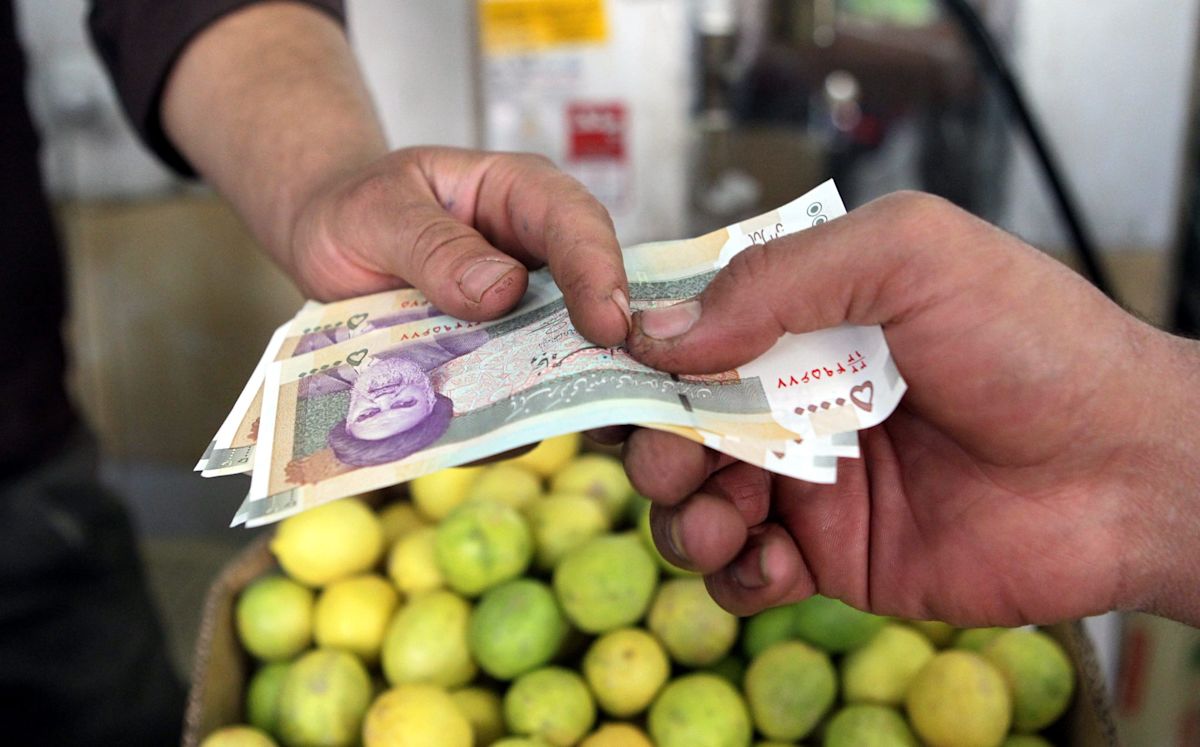
Hadi, a civil servant in Tehran, may have a secure job but can no longer make ends meet.
He has held his position for 18 years, but as a father of two, he no longer enjoys the reliable income and middle-class lifestyle. He needs three jobs to sustain his family from month to month.
Each day, Hadi says goodbye to his boys and commutes from Andisheh, 50 kilometres west of Tehran, to work.
He has long since been unable to afford the rent in the capital. Once his shift ends, his second working day begins, working as a manager at a swimming pool until almost midnight.
If that doesn’t bring in enough money, then he drives a taxi at the weekends.
“All this work is barely enough to cover our basic living costs,” he says.
His family has long been unable to save anything at all. A better life has moved out of reach.
“I’ve cut out many expenses that might once have been quite normal for our family life.” Travel, eating out and even family outings have almost completely disappeared from their daily lives, he says.
Anger in Iran also directed at Trump
Hadi is no exception. In Iran, even a steady income is barely enough for many people to make ends meet. Prices are rising, the currency is losing value, and housing is becoming increasingly expensive.
Now, the war with the US is making the situation even worse. For months, the military conflict unleashed by Washington has been fuelling economic uncertainty. With new sanctions and a naval blockade, US President Donald Trump again aims to put further pressure on Tehran.
Many Iranians are angry, particularly at their own government. Back in January, mass protests sparked by the economic crisis were brutally suppressed. Thousands of demonstrators were killed.
But now, the anger is also increasingly directed at the US government. Many Iranians argue that the new sanctions are disproportionately hurting ordinary people, while the country’s leaders remain relatively insulated from their effects.
Hospitals stretched as patients abandon private care
The economic crisis is affecting everyone, from the wealthy to those struggling to make ends meet. Sara is a doctor in charge of the emergency department at a state-run hospital near Tehran.
Above all, she says, she is exhausted. Even after long shifts, she finds herself at home worrying about money and how to cover the following month’s expenses.
“The economic situation is also affecting my colleagues,” says Sara. Many doctors have already left the country, she says, while others are considering doing the same.
At the hospital, the pressure is also mounting. In recent months, significantly more patients have been coming to the emergency department, Sara says.
Many can no longer afford treatment in private hospitals and are turning to state-run facilities instead. These are already short-staffed and frequently face shortages of medicines.
“Sometimes the situation is very tense,” says Sara. When patients have to wait for hours, arguments with relatives repeatedly break out.
Headscarf crackdown returns as economic anger grows
Economic pressure continues to mount. According to Iran’s ILNA news agency, which focuses on economic affairs, the average inflation rate over the past 12 months reached almost 70% in August.
On average, food and drink cost more than twice as much as a year ago.
Against this backdrop, many women in Iran’s major cities are frustrated that the authorities are once again cracking down on violations of the compulsory headscarf rule, after security forces had temporarily eased enforcement when the war began.
As Sara works at a state-run hospital, she is subject to strict dress codes. But even outside the workplace, violating the rules can have consequences.
“We even have to be careful about which photos of ourselves we post on social media,” she says. “For me and many working women, this concern has become part of the daily pressure.”
Iranian society has changed
Leila, too, noticed that the security authorities were less strict about enforcing the headscarf rule during the first few months of the war.
She works in the media sector and does not believe that the developments of recent years can simply be reversed. “The crucial point is that society itself has changed,” she says.
Younger women in particular are much more aware of how they want to live their lives. Leila finds it hard to imagine them bowing to state pressure again.
For Leila, the headscarf has long since become a symbol of a wider debate, about how people want to live and how far the state should be allowed to dictate that.
And the economic crisis is further intensifying this debate. Many families have to work out anew every month whether they have enough money for rent, food and other expenses, making it all the harder to understand why the authorities are again focusing more on women’s clothing.
“People want to feel that their fundamental problems are being addressed,” says Leila.
Civil servant Hadi has stopped thinking in broad terms. What concerns him most is the future of his two sons.
“If your entire income is spent on daily expenses and there’s nothing left to save, you lose the chance to build a better future for yourself.”

FILE PHOTO – A near-empty shopping mall on the island of Qeshm in southern Iran. Iranians are working multiple jobs just to survive as soaring inflation, US sanctions and a military conflict push the country’s middle class to a breaking point. Ordinary life is becoming increasingly unaffordable. Farshid-M. Bina/dpa

FILE PHOTO – Iranians are working multiple jobs just to survive as soaring inflation, US sanctions and a military conflict push the country’s middle class to a breaking point. Arne Immanuel Bänsch/dpa

A woman and a man are standing at night in northern Tehran against a backdrop of an illuminated cityscape. —/dpa