
President Donald Trump’s shifting timeline for victory in Iran—which has gone from a few weeks, to months, now to after the midterms—has exposed his administration’s various miscalculations as it entered the conflict alongside Israel back in February.
The Iranian regime has largely held together. Its ability to disrupt energy flows through the Strait of Hormuz was underappreciated. The overwhelming might of the American and Israeli militaries was not enough alone to secure a rapid win.
But there are several signs that Trump is on the cusp of victory, albeit months delayed.
Read More on Analysis
The new open letter to Americans from Iran’s Islamic Revolutionary Guard Corps (IRGC), claiming victory over the U.S. while also appealing directly to midterm voters to turn against Trump, was telling on itself.
Here, Newsweek unpacks five signs that Iran’s defeat is finally arriving.
1. The Main Tool of Iranian Leverage Is Weakening
Iran’s chokehold on the Strait of Hormuz, its strongest card since the fighting started, is loosening.
Gulf crude exports hit a wartime high in September, tanker tracker Kpler says, not far off where non-Iranian volumes were before February 28. Volumes remain below normal, but Saudi supertankers are again running the strait under U.S. protection.
Iran still fires on tankers, though less so in recent days according to the U.K. Maritime Trade Operations (UKMTO), but they keep coming. Even hard-line Iranian state TV conceded that at least 7 million barrels of crude a day are getting through.
That may be why Tehran sounds more pliable, whatever its foreign minister insists. Its latest offer would reopen Hormuz within seven days in exchange for an end to the U.S. blockade, sanctions relief, and access to frozen funds, among other terms.
Trump has publicly rejected it, and said he is considering a return to strikes, cranking up the pressure on Tehran to compromise further.
Iranian President Masoud Pezeshkian talked up diplomacy at the U.N. and then, in a Fox News interview, offered to dilute Iran’s enriched uranium: “It’s not a big deal.”
A country confident in its leverage doesn’t rush to trade it.
2. Iran Is Approaching a Full Economic Crisis
The rial sank to a fresh record low this week, with a dollar fetching around 2.5 million rials, up from 2.2 million at the start of September.
Because so much of what Iranians buy, from food to medicine, tracks the dollar, prices are climbing by the week. Iranians have described to Reuters being unable to cover rent or afford medicine, as private-sector jobs vanish.
Much of this squeeze is by design, though the Iranian economy has long suffered under the weight of regime-targeted Western sanctions.
Oil revenues are an essential lifeline for Iran, giving it access to hard foreign currency so it can pay public salaries, fund services, and so on.
The U.S. naval blockade has all but halted Iran’s crude exports since mid-July, according to energy analytics firm Vortexa, with August loadings down to about 210,000 barrels a day—a sliver of prewar levels.
Chinese buyers are living off Iranian oil stockpiled at sea before the blockade, a cushion that is running down, as the U.S. says Beijing is pulling back from its support for Iran. Treasury Secretary Scott Bessent calls it “economic asphyxiation.”
The longer it lasts, the harder it tests a regime that, in January, killed thousands of protesters angered by economic distress. Does it want to risk a sequel, in the new context of a society brought to its knees by war?
3. The IRGC Letter Shows Desperation, Not Strength
The IRGC’s letter to Americans is less the victory lap it appears than a plea for help.
Released five weeks before the midterms, it urges Americans to take back control from their politicians, arguing: “Now is the time, as the American political system is at its weakest.”
The letter even insists “Death to America” targets the White House, not ordinary Americans.
But a military that believed its own claims of victory would not need to go over Trump’s head to his voters. The letter’s real target is a new Congress that might tie the president’s hands—Tehran’s last realistic hope of better terms.
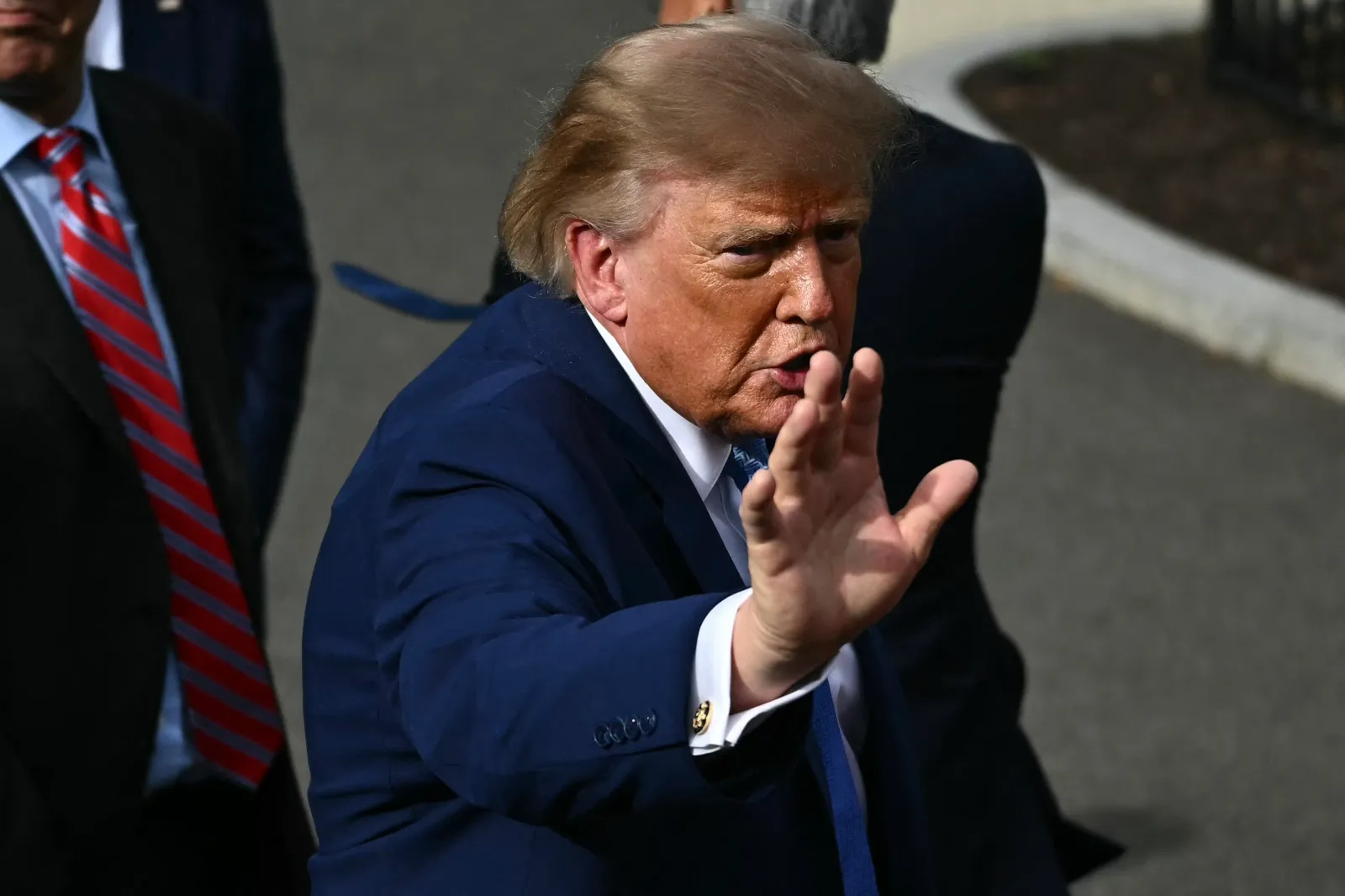
Iran’s president is sending the same signal from the other direction. Pezeshkian told reporters in New York he wants Washington back to the June ceasefire framework before the midterms: “We don’t want it to get to the midterm elections.”
Officials in Tehran reportedly fear Trump will escalate once the votes are counted. If Republicans outperform expectations, the president will feel vindicated. And if Democrats triumph, he has nothing left to lose.
Iran is watching the calendar and doesn’t like what it sees.
4. Iran Faces a Growing Replenishment Problem
Iran’s missile program has survived the war, but rebuilding it is another matter.
U.S. assessments in April found more than 80 percent of the plants making its missiles and solid-fuel rocket motors had been damaged.
Tehran is still assembling weapons from stockpiled parts in underground sites, but it needs components whose “production sites or supply chains were damaged or disrupted,” Freddy Khoueiry, global security and geopolitical analyst at the risk-intelligence firm RANE, told Forbes.
With the blockade on, those stockpiles won’t last forever. Tehran’s boasts of rebuilt factories have little public evidence behind them. They retain some capacity, but it is depleted, and depleting further still.
People are harder to replace than parts. U.S. and Israeli strikes have killed the supreme leader, the IRGC’s commander, its navy chief, and its intelligence chief.
The replacements named in August are mostly old hands: Mohsen Rezaei, who led the IRGC through most of the Iran-Iraq War, is now secretary of Iran’s top security body at 71.
Some analysts see a regime running short of trusted successors rather than grooming new ones.
5. Iran Is Failing to Push the US Navy Out
Related to the first sign, but still distinct, is that Iran plainly cannot break the U.S. naval blockade by force.
On September 5, the IRGC fired ballistic missiles at an American aircraft carrier and a destroyer enforcing it. Neither was hit, U.S. Central Command said.
Washington answered by disabling or destroying Iranian oil tankers—10 in a week, by one count—as Defense Secretary Pete Hegseth scoffed that Iran “has no navy or air force.”
Iran can still draw blood, certainly. Eight Marines were injured in an Iranian anti-ship missile attack on September 14, according to an NBC News report, and Tehran claims U.S. warships have pulled farther out to sea. The incident reportedly did not involve a navy ship.
But the blockade holds nonetheless, intensifying the pressures inside Iran and increasingly so as time wears on. Bessent says Iran cannot export its own oil, leaving it only about 15 million barrels already afloat to sell.
Iran is in check. The regime can make Hormuz dangerous for everyone else—though less so than before, as oil flows show—but it can’t make the strait work for itself.
The Case Against
This reading of the signs could still prove premature, much like Trump’s earlier timelines.
Economic pain rarely topples a regime prepared to kill its own people, and Tehran proved once again in January that it is. The Iranians whom Reuters interviewed said they were too preoccupied with surviving to think about protesting.
Nor is Iran’s arsenal entirely spent. Reports say it has resumed missile production from stockpiled parts in hardened underground sites, with Russian help on new cruise missiles.
Each salvo also drains scarce American interceptors. U.S. forces fired 60 to 70 Patriots and more than a dozen THAADs to fend off roughly 20 missiles aimed at bases in Jordan this month. Those need to be replenished too; easier for the U.S. than Iran, but not easy.
Moreover, Iran’s leverage may be migrating rather than vanishing.
In September, the Houthis, reportedly with IRGC help, seized much of Yemen’s Red Sea coast, putting the Bab al-Mandeb strait under the threat of a close Iranian ally. An Iranian-linked faction in Iraq was also blamed for striking Saudi Arabia’s pipeline around Hormuz.
The Strait of Hormuz itself remains far from normal. Estimates of its oil traffic range from roughly a third to three-quarters of prewar volumes, which is possible only because the U.S. is there to support shipping.
The risk is driving up premiums and so costs for traders. Supply remains lower, particularly as hardly any Iranian oil is getting through to the market, which is keeping market prices high. That causes inflationary pain all over the world.
Tehran is also betting on American impatience. Just 31 percent of Americans support the war, per a Reuters/Ipsos poll, as the cost of living increases from higher energy prices cause financial pain for voters.
The International Crisis Group’s consulting senior Iran analyst Hamidreza Azizi expects Iran to stay “calibrated, but increasingly aggressive” to prove its leverage isn’t fading.
What Comes Next
None of this guarantees a clean ending. The regime will call any deal a win, and its survival is how Tehran defines victory. But the direction of travel is hard to ignore. Iran’s leverage is shrinking, its economy is buckling, and its leaders are openly shopping for an exit.
We’ll see soon enough whether Tehran will agree to put its nuclear program on the table before the blockade lifts, and tankers keep clearing Hormuz despite Iranian fire.
Signs pointing in the other direction would be a successful strike on a U.S. warship, or an escalation before the midterms, or a Houthi squeeze on the Red Sea that hands Iran a new chokehold to use as leverage.
Wars like this rarely end with a signing ceremony on a battleship. They end when one side runs out of cards to play.
Iran is down to its best remaining one, and it has already offered to trade it.