
Sept. 29, 2026, 5:24 p.m. ET
|
5 min read
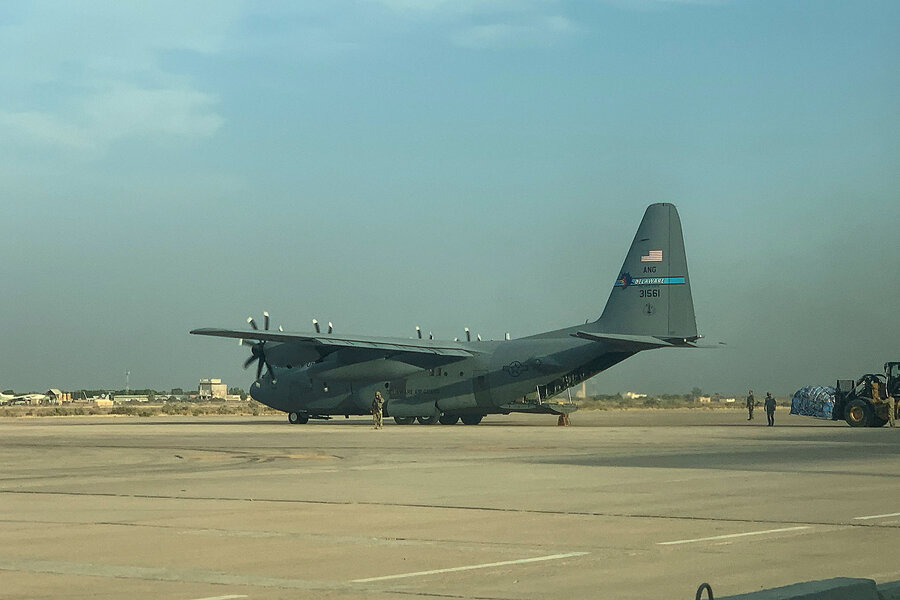
The last U.S. troops pulled out of Iraq Wednesday, highlighting a shifting – and shrinking – American military footprint in the Middle East.
That footprint is expected to become even smaller as Pentagon officials, surveying extensive damage to U.S. bases in the Persian Gulf caused by the war in Iran, are reportedly considering shuttering some of those installations.
From Tehran’s perspective, these are exciting developments. It’s just what its leaders have been hoping for, and demanding, for decades. That doesn’t necessarily make the U.S. base closures a bad idea, some analysts say.
“Sure, Iran wants the U.S. to pull back, but that doesn’t mean it’s the wrong strategic choice,” says Jennifer Kavanagh, director of military analysis at the Defense Priorities think tank in Washington, D.C., which advocates for a restrained U.S. national security strategy.
Still, the optics of drawing down U.S. forces in the Middle East aren’t great. This is particularly true given Sunday’s arrest of five men suspected of plotting a terror attack on an English air base. The facility, used by the U.S. for the war in Iran, had already been the target of specific Iranian threats.
Closures, some analysts add, could read as retreat.
There remain concerns, too, that they could further open the door to Chinese and Russian influence and stir doubts about the strength of U.S. deterrence there.
Yet approaching eight months into the war, it is clear that American military bases – which once offered safety to Gulf nations – have instead made these U.S. allies targets.
The bases are “huge” vulnerabilities for the United States as well, Dr. Kavanagh says. There has also been talk of moving U.S. troops and infrastructure into Jordan, Saudi Arabia, or Israel, which could make a smaller U.S. Gulf footprint more feasible.
As to whether they have helped bring peace and stability to the region, she argues, “I just can’t find any evidence that U.S. military presence in the Middle East has been beneficial to the Middle East.”
A Pentagon report on the costs of the conflict, released in mid-September, offered a window into the damage inflicted by Tehran on U.S. installations in the Middle East since the war began in February.
“Iranian strikes damaged and destroyed hundreds of buildings and structures at U.S. bases in Kuwait, Bahrain, Qatar, the United Arab Emirates, Saudi Arabia, Iraq, Oman, and Jordan during the conflict,” the congressionally-mandated Pentagon Inspector General’s report concludes.
Top American military commanders, who once relied on these bases, appear to be concluding that they are a liability.
Master Sgt. Joshua Strang/U.S. Air Force/AP
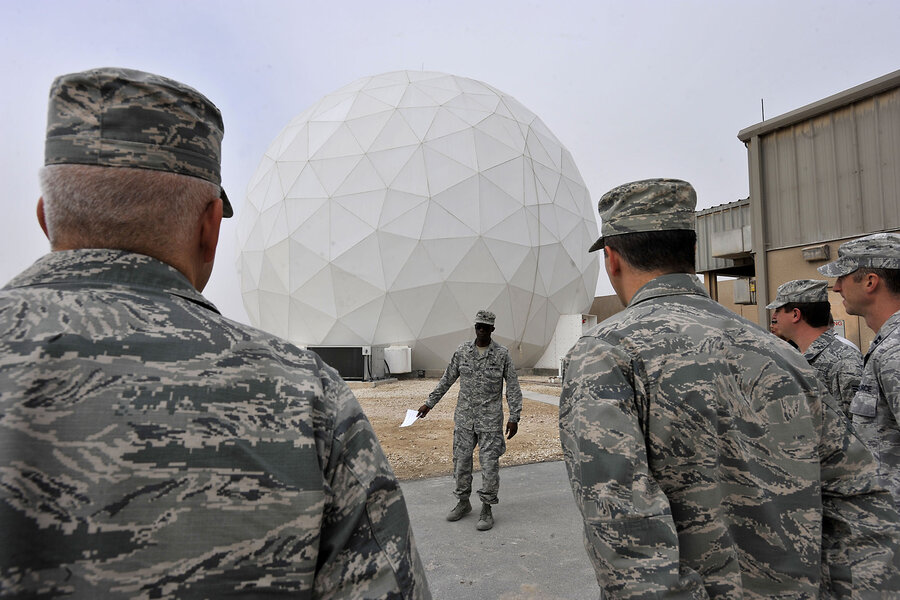
This handout photo from the U.S. Air Force shows Lt. Col. Carlos Alford, 379th Expeditionary Communications Squadron commander, in front of the Modernized Enterprise Terminal at Al Udeid Air Base, Qatar, Jan. 21, 2016. The base has been a primary U.S. military hub in the Middle East, though its operations have fluctuated due to regional conflicts and repeated Iranian missile threats.
At a Navy town hall that allowed troops to pose questions to leadership, the first query came from a sailor who wondered when she might be able to get household goods back after an Iranian attack on her base in Bahrain, home to the U.S. Fifth Fleet.
“We’re not getting back there anytime soon,” Adm. Daryl Caudle, the Navy’s top officer, told the sailor. “I just want to be completely honest with that.”
In a podcast last month, Retired Gen. David Petraeus, who served as CIA director from 2011 to 2012, called U.S. bases in the region “no longer viable.”
Qatar had built a “beautiful” forward headquarters for U.S. Central Command, he said, which runs U.S. operations in the Middle East. As of 2026, the largest U.S. base in the Middle East, Al Udeid, housed 10,000 U.S. personnel.
“I cut the ribbon,” Mr. Petraeus recalled. Now, after Iranian attacks, “It’s got a few holes in the roof.”
Mr. Petraeus added that Iran’s growing tech capabilities — likely aided by China and Russia — include extended range for its missiles and an increased supply of drones, which make American bases in the region even more vulnerable.
When the U.S. came to Kuwait’s aid after its invasion by Iraq in 1990, which launched the first Gulf War, “the idea among Gulf countries [was] that the U.S. would provide security” in the region, says Allison Minor, the National Security Council’s director for Arabian Peninsula affairs during the first Trump administration.
Following Kuwait’s liberation in 1991, the U.S. entered long-term military agreements with several Gulf states to establish permanent and semipermanent bases. These installations include Al Udeid Air Base in Qatar (the regional headquarters for U.S. Central Command), the U.S. Navy’s Fifth Fleet headquarters in Bahrain, Al Dhafra Air Base in the United Arab Emirates, and Prince Sultan Air Base in Saudi Arabia. In Kuwait, the U.S. maintained a heavy presence across Camp Arifjan, Camp Buehring, and Ali Al Salem Air Base.
For over three decades, these hubs served as effective, though not perfect, deterrents against the sporadic rocket and drone attacks.
When the U.S. and Israel-backed war with Iran ignited this past February, some 10,000 U.S. troops surged into the region, joining the roughly 40,000 service members already stationed there. Since then, Iran’s missile and drone strikes have damaged more than 20 U.S. military sites and shared facilities across the Middle East.
Against that backdrop, analysts are now charting out the strategic implications of potential closures.
Shifting goals, shifting roles
It likely involves a “shift away from this idea of a U.S. security guarantee in the Gulf,” says Ms. Minor, now director of the Atlantic Council’s Project for Middle East Integration.
Before the Iran war, the U.S. had begun “gradually shifting from security guarantor to security integrator,” as a 2024 posture statement from U.S. Central Command put it.
This likely means that, going forward, America might provide military hardware, training, and intelligence sharing, but not U.S. troops to fight regional battles.
Deepen your worldview
with Monitor Highlights.
Politics with respect
Get political stories with respectful analysis.
There‘s a world of new ideas in every
Books newsletter.
There‘s more to life, enrich yours with
Culture & Learning weekly.
Follow humanity‘s discoveries with
Science & Nature stories in your inbox.
Gain a spiritual perspective
from the stories in your inbox.
Want to understand the deeper impact of critical events? Learn the Monitor‘s insight.
Already a subscriber? Log in to hide ads.
The U.S. also brings what is known as “convening power” to the Persian Gulf, rife with regional infighting. “There’s a lot of overt competition and, at times, conflict,” Ms. Minor says. “So these are not countries that would necessarily be comfortable working together or sharing intelligence or radar data.”
The U.S. can help bring them together, though it is an ability that is “not strong right now, frankly,” she adds, “because Gulf countries are frustrated with our policy via Iran.”
ALREADY A SUBSCRIBER? Login
Real news can be honest, hopeful, credible, constructive.
The Christian Science Monitor was founded in 1908 to lift the standard of journalism and uplift humanity. We aim to “speak the truth in love.” Our goal is not to tell you what to think, but to give you the essential knowledge and understanding to come to your own intelligent conclusions. Join us in this mission by subscribing.