
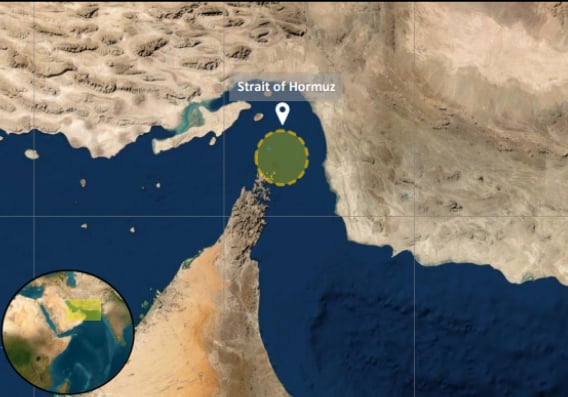
Three vessels reported being struck on Tuesday, September 29, in the area around the Strait of Hormuz as Iran appears to be lashing out to demonstrate that it is still threatening vessels. While it brings the total number of vessels struck to four so far this week, observers point to increasing oil flows and vessel traffic in the region.
UK Maritime Trade Operations reported the incidents, although few details were provided. It said that the information had come from verified sources but was delayed in being transmitted. It was unclear when the strikes took place. It identified all three incidents as involving tankers without details on the extent of the damage, while an unconfirmed report said one of the vessels was an LNG carrier.
Two of the vessels were identified in the tracking by the International Maritime Organization, with both being crude oil tankers flying the Liberian flag and sustaining damage. One VLCC, the Mersin Prosperity (299,319 dwt), is operated by ADNOC. The other tanker appeared to be a smaller vessel, possibly involved in the shuttle operations that have arisen to get oil from the Gulf states to tankers waiting south of the Strait in the Arabian Sea. This tanker was identified as Sinbad (115,949 dwt), and it was last reported at Fujairah. Both tankers appeared to be making the transit dark.
Iran’s Fars News Agency reported that warning shots were fired on Tuesday at vessels violating the Strait of Hormuz. It did not provide details on the incidents but said they accounted for the reports of explosions near Qeshm Island and other points along the coast. At the same time, an IRGC spokesperson, Brigadier General Hossein Mohebbi, repeated the refrain that Iran controls the Strait. The Wana News Agency quotes him saying vessels attempting to transit the Strait without permission either will be targeted or will hit a mine.
Iran continues to make these claims while evidence builds that oil volumes are rising from Saudi Arabia, Kuwait, and Iraq.
“Windward MIOC assesses that Iran is less able to constrain southern-corridor traffic than it was in mid-summer, as rising crude flows continue despite the threat to individual vessels,” writes Windward’s Zane Amundsen, MIOC Middle East Desk Lead. He cites 55 AIS-visible transits from September 16 to 23, while also concluding “the true number of transits is almost certainly higher.”
Most tankers are sailing with their AIS switched off. Windward also notes an increase in pipeline volume while saying transits are happening in the southern corridor, which remains under US CENTCOM air defense and naval support.
Tracking data from Windward shows 17 vessels transited Hormuz on September 29, after 16 vessels the prior day. It notes that roughly two-thirds of the oil volume, however, is moved through ship-to-ship transfers.
Kpler also notes that more than 70 percent of the crude that crossed the Strait of Hormuz in August changed tankers offshore. However, it reports that volumes excluding Iran returned to pre-war levels. It reports that in September volumes reached at least 16.5 mbd.

Stay on Top of the Daily Maritime News
The maritime news
that matters most
Get the latest maritime news delivered to your inbox daily.
Oil volumes in part rebounded not by tanker but by the use of pipelines. Kpler assesses that around 40 percent of crude now leaves without crossing Hormuz, up from 17 percent before the war. It says that Saudi Arabia and the UAE are making greater use of pipeline routes for exports.
Saudi Arabia’s pipeline route to the west and the terminal at Yanbu appear to have been restored after the previous attack by the Houthis. Windward reports that two VLCCs and two Suezmax tankers were loading a total of 6.2 million barrels at Yanbu on September 28, based on Vortexa data, after noting that all seven Yanbu crude berths were occupied on September 27. It notes that this was among the first cargoes leaving Yanbu since the September 10 attack, but that volume is only about two-thirds of the pre-attack pace.