
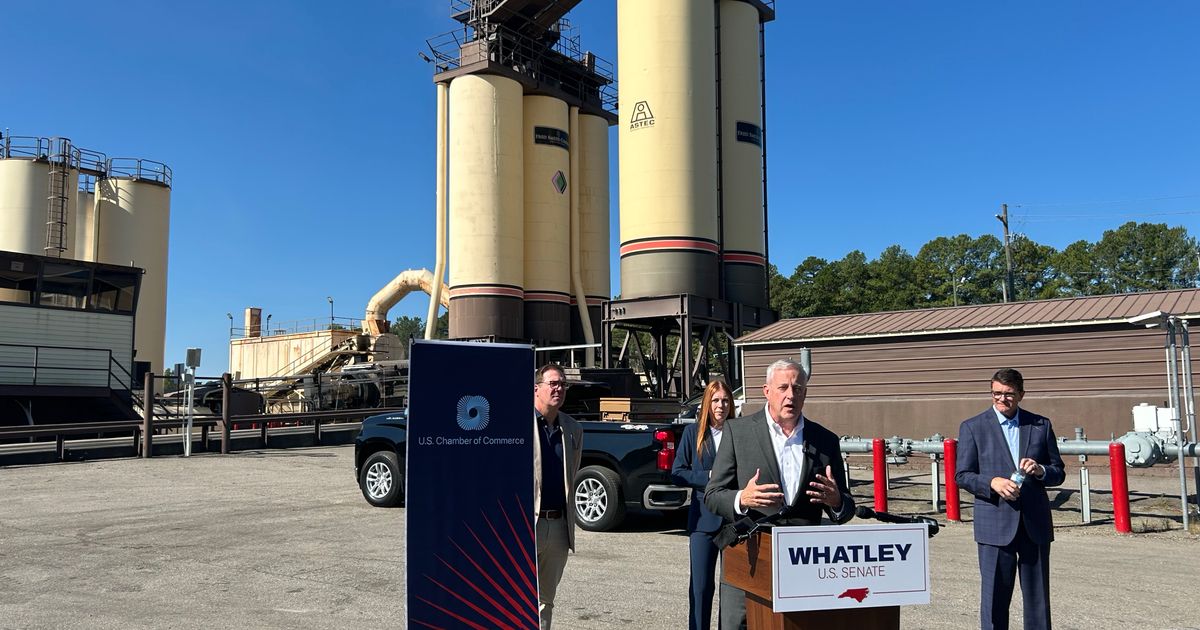
Diesel fumes and the distinct smell of fresh asphalt wafted from a Raleigh industrial plant Wednesday, as leaders from the Chamber of Commerce business lobbying group shouted over the engines of idling dump trucks to announce their support for Republican Michael Whatley in the 2026 U.S. Senate race.
“We appreciate where he stands on the issues that really matter to growth,” said Courtney Felts, a U.S. Chamber of Commerce vice president. “Things like taxes, legal reform, transportation and infrastructure, and more. We know that he will be a strong partner to the business community in Washington.”
The group advocates for policies that help businesses create jobs and grow the economy, lobbying for industry in the Capitol and statehouses across the nation. The endorsement comes at a delicate time for Whatley. He trails in the polls and his support for policies that have led to higher prices for businesses have been amplified by his Democratic opponent, Roy Cooper.
During a news conference on Wednesday, Whatley doubled down on his support for aggressive tariffs imposed on other countries by President Donald Trump, and for the armed conflict in Iran, which economists blame for hiking up the price of gas and diesel fuel — price increases that have trickled down in the form of higher costs to businesses and consumers.
The war is unpopular nationwide and specifically in North Carolina, where several thousand troops from Fort Bragg are currently deployed in the Middle East. An Elon University poll released in April shows that 51% of North Carolina respondents opposed U.S. military involvement in Iran. Two national polls this month reached similar conclusions: A CNN poll found just 26% support for Trump’s handling of Iran. And a Fox News poll found 60% believe Trump made the wrong decision in taking military action against Iran.
While Cooper has questioned Trump’s strategies and called for ending the war, Whatley remains supportive. When asked by reporters what his message was to people and businesses hit by record-high diesel prices, Whatley pointed to the Trump administration’s national-security reasoning. “My message is that Iran cannot have nuclear weapons,” he said.
Whatley also highlighted his support for cutting taxes and eliminating regulations if elected to the Senate — two key priorities for the business community, which the Chamber cited in its endorsement.
“We need to have tax policies that are going to help create jobs,” Whatley said in his prepared remarks outside a Fred Smith Co. asphalt plant. “We need to have regulatory policies that are not going to strangle companies like this.”
Cooper has consistently led Whatley in polls as candidates seek to replace outgoing Republican U.S. Sen. Thom Tillis. Green Party candidate Michael Dublin and Libertarian Shannon Bray are also running.
A Catawba College poll released Wednesday showed Cooper with a double-digit lead over Whatley as Trump’s approval rating continues falling statewide.
Whatley, Cooper on taxes
Tillis voted against Trump’s 2025 budget plan, which supporters called the One Big Beautiful Bill Act. Tillis said its trillion-dollar cut to Medicaid spending — set to go into effect in January after the elections — will siphon billions of dollars out of the North Carolina economy and threaten the closure of rural hospitals.
Whatley has been a staunch supporter of the plan, which used cuts to Medicaid, food stamps and other programs to help pay for income tax cuts that were among the largest ever. Cooper has regularly criticized it, saying nearly all the benefits of the tax cuts are flowing to corporations and the ultra-wealthy.
“On tax policy, Roy Cooper has been wrong every step of the way,” Whatley said. “Roy Cooper raised taxes when he was a legislator. He vetoed six different tax cuts when he was the governor. When he announced that he was running for Senate, he said that he would have voted against the One Big Beautiful Bill.”
In addition to the tax cuts he vetoed as governor, Cooper also signed other tax cuts into law. It was those actions Cooper’s campaign pointed to in response Wednesday.
And while Cooper has opposed the One Big Beautiful Bill as a whole, he has said he does support some individual policies within it — including tax deductions for income from tips, overtime and Social Security.
“Roy Cooper cut taxes for working families and seniors and is running for the U.S. Senate to make stuff cost less,” campaign spokesman Jordan Monaghan said in a written statement Wednesday. “Meanwhile, Washington, D.C., insider Michael Whatley supports the reckless tariffs that are jacking up costs.”
Tariffs and the NC economy
Trump’s new tariffs have been blamed for the loss of thousands of jobs since he returned to office, as well as billions of dollars spent covering the higher prices they mandate, including skyrocketing grocery prices.
Jobs in North Carolina grew by 0.8% last year, buoyed by the healthcare, construction and utilities industries but offset by job losses in agriculture and manufacturing. The conservative John Locke Foundation think tank blamed Trump’s tariffs directly for those job losses. Cooper has piled on the blame, too.
“Farmers have really been taking it on the chin,” Cooper said at a campaign stop last week at a Wilson County tobacco receiving station. “You’ve heard it directly from them. But we know that tariffs are adding to the cost of consumers when they buy products. We know that tariffs are affecting what’s happening in the grocery store.”
Agriculture is North Carolina’s biggest industry. It was also the hardest-hit by job losses after Trump’s return to office last year, government data shows, with about 1 in every 20 agriculture jobs cut statewide.
Many goods farmers need — fertilizer, tractors, tires, storage bins and more — are made in other countries and therefore have been subject to expensive new tariffs since Trump returned to office. Farmers have then passed their higher costs down the chain. Food prices are up 2.7% in the past 12 months according to federal data. Consumer prices rose 3.4% in August compared with a year earlier, the Commerce Department said Wednesday — lower than economist expectations but above the Federal Reserve’s 2% target.
Whatley has tied himself closely to Trump who endorsed him in the GOP primary to replace Tillis. The top issue Whatley presents on his campaign website is to “enact the Trump agenda in the U.S. Senate.” And on Wednesday he again stood by Trump, reiterating support for continued tariffs.
“We need to have trade policies, and obviously tariffs are going to be part of that,” Whatley said. “They are going to help North Carolina companies.”
The job losses and higher costs due to the tariffs have caused some prominent Republicans to break with Trump. Last year when former Vice President Mike Pence came to Raleigh to speak about the economy with GOP megadonors Art Pope and Bob Luddy at a public roundtable, each sharply criticized Trump’s economic strategies, WRAL reported at the time.
“When you interfere with the free market, when you have no idea how it works, you have enormous distortions. All negative,” said Luddy, whose Raleigh-based CaptiveAire Systems makes ventilation and HVAC systems for commercial kitchens.
“It’s going to be Americans that ultimately pay the cost of tariffs in higher prices as well as lower wages and lost jobs,” Pence added at that 2025 event.
Some of Trump’s tariffs were struck down as unconstitutional earlier this year by the U.S. Supreme Court. At the time, the government was ordered to repay businesses — but not individuals — for the costs they paid as a result of the tariffs.
That included $3.5 billion in North Carolina alone according to state Attorney General Jeff Jackson, who had joined with fellow Democratic attorneys general to sue over the tariffs. In a letter Jackson and the other Democratic attorneys general sent to congressional leaders this spring, they estimated the tariffs cost Americans a combined $166 billion.
Whatley on Wednesday expressed confidence the tariffs would be worth it in the long run. “They’re going to help small businesses,” he said. “They’re going to help our farmers. We need to have balanced policies that are going to create job opportunities for us across the country.”