
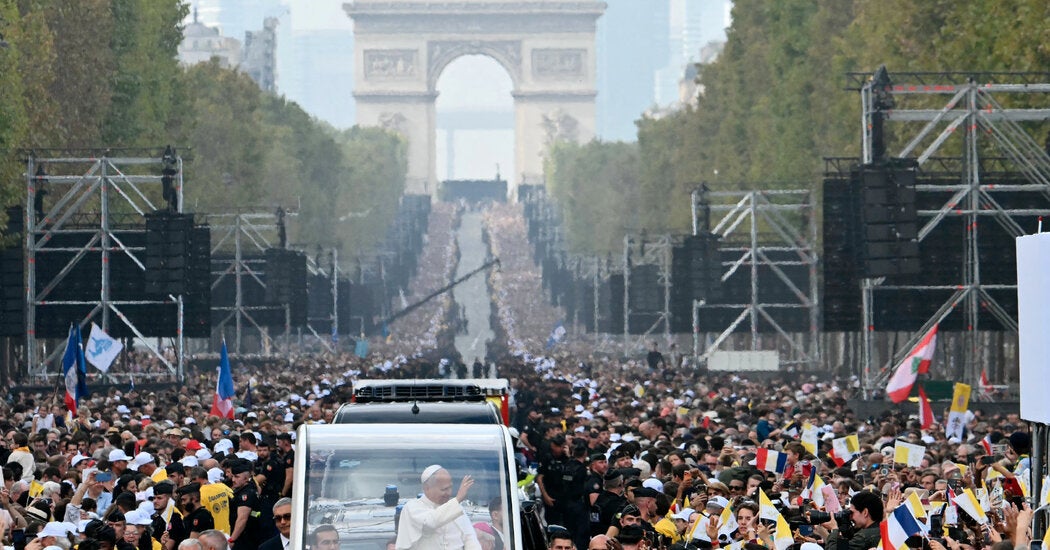
Part of that acceptance, experts said, is rooted in the dwindling role of Catholicism in French society, which makes the church appear less of a threat to the sovereignty of the state. Fewer than half of people in France identify as Catholic, according to polls, while only 5 percent say they go to church regularly.
“Catholicism is seen, on the left, as one minority among others,” Professor Mercier said. “As a minority, they are worthy of respect, consideration, in much the same way as Muslims or other cultural and sexual minorities.”
And parts of the left, he said, have become wary of undiluted secularism, because it can be used as a tool to undermine aspects of Muslim culture in France. Ms. Le Pen, for example, has cited the secular tradition in pledging to ban the wearing of Muslim head scarves in public places.
Historically, Ms. Le Pen kept her distance from conservative Catholic circles. But as she has tried to broaden her party’s appeal, she has begun to emphasize France’s Christian roots. Vincent Bolloré, a media mogul whose outlets give extensive airtime to the National Rally, is a fervent Catholic.
On the far left, which has sometimes been characterized by anticlericalism, some praised Leo’s call for integrating immigrants as well as his recent open letter, or encyclical, on the dangers of artificial intelligence. Jean-Luc Mélenchon, the leader of the far-left party France Unbowed, recommended the 42,300-word encyclical as a remarkable piece of writing for a religious leader.
“It carries a hint of humanism, because humanism positions humanity as a central actor,” Mr. Mélenchon said at a recent political panel, adding, “I respect the spiritual leadership he embodies.”
Ségolène Le Stradic and Giulia Imbert contributed reporting.