
This is Executive Dysfunction, a newsletter that highlights one under-the-radar story about how Trump is changing the law—or how the law is pushing back—and keeps you posted on the latest from Slate’s Jurisprudence team. Click here to receive it in your inbox each week.
Midterm elections are around the corner, and for months, while strategists have predicted a Democratic sweep, the GOP has been throwing everything and the kitchen sink at its base in hopes of mitigating the anticipated blue wave. This past week, those efforts took the form of a series of television ads, each one featuring President Donald Trump and highlighting his administration’s policies while also warning against unspecified threats of communism. The ads themselves, though, were not the most disturbing thing. The most alarming part of the ads is a small disclaimer at the bottom of the screen: “Paid for by the U.S. government.” It appears that Trump was using our taxpayer dollars to fund his midterm political efforts. Using taxpayer dollars for ads that are clearly political is a blatant violation of federal law, but the unfortunate reality is that there may not be a clear-cut way to actually stop the Trump administration from continuing to air them.
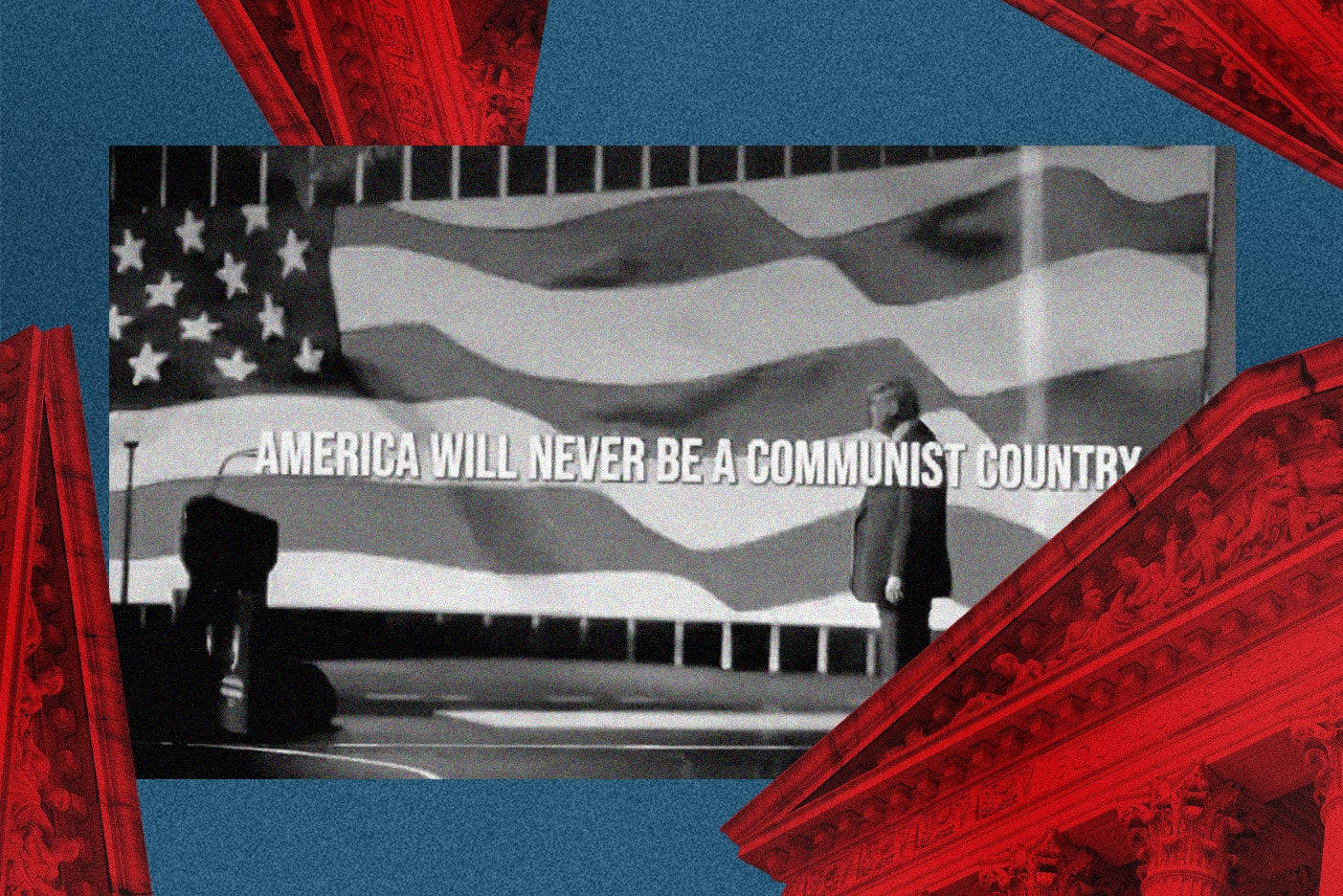
At least three ads began airing over the past week across national and local TV networks, one of them a montage of Trump as president with a voice-over of him saying, “America will never be a communist country,” and the song “Love Me” by JMSN playing. Another ad is nearly identical to one aired during Trump’s 2024 campaign for president, in which he vows to “throw off the sick political class that hates our country” and “rout the fake news media.” Of course, in 2024 that ad was paid for by campaign funds, not taxpayers. By Sunday evening, the Wall Street Journal estimated that the ads had aired nearly 90 times across national TV networks and cost about $337,000. They also ran in local TV stations, with about 2,000 airings estimated to cost $1.4 million. The Journal also reported that the ads were paid for with taxpayer dollars that Congress appropriated to Homeland Security for Customs and Border Protection, an agency that regularly runs ads about immigration policies. Indeed, former DHS Secretary Kristi Noem was fired after she spent $220 million on an ad blitz featuring her on a horse in front of Mount Rushmore.
The White House has insisted these ads are merely public service announcements “reminding Americans to love their country and understand what makes it worth defending, at home, at our borders, and abroad.” However, it’s obvious that these are not PSAs, as they do not attempt to inform anyone of new or relevant information. Not a single mention of a government program that Americans can participate in or a message about a new government policy. No one is featured in these ads besides Trump. Instead, each one simply glorifies Trump, hailing him as a majestic leader of the free world, something no U.S. president has ever done before. And rightfully so, as the ads state they are paid for by the U.S. government, an explicit violation of the Antideficiency Act and the Hatch Act too.
Nearly all appropriations bills that Congress passes include a rider that says none of the money being awarded can be used for publicity or propaganda purposes. The Office of Legal Counsel and the Government Accountability Office have affirmed this, establishing that messages designed to self-aggrandize or extol a government official, or ones that are purely partisan in nature, are not measures that provide the public with information about government programs. “These are ads that are really designed to aggrandize the president, as indeed the ‘Love Me’ song indicates. It’s really about promoting or aggrandizing him as an individual,” Richard Briffault, professor of legislation at Columbia Law School, told me. “Not government programs, and that certainly violates the appropriations riders against publicity or propaganda.”
There are a few actions Congress can take to hold the Trump administration accountable for cutting and airing these ads. The Antideficiency Act prohibits the spending of money beyond what Congress has appropriated it for, and if in fact the White House used DHS funding to produce and distribute the Trump ads, Briffault believes, DHS’s budget “has to be cut” by the equivalent amount spent on the ads. And if Democrats are successful in clawing back a majority in Congress, they could pass a resolution to demand that DHS return the money it spent on the ads and hold public hearings about what went on behind the scenes in deciding to produce the ads and use taxpayer dollars to fund them.
Another option, something Briffault admits is petty but has been done before, is to slash the salaries of people at the agency responsible for the unlawful behavior, or even folks who worked on it.

Shirin Ali
Trump Found a New Horrifying Way to Disappear ICE Detainees
Read More
This Content is Available for Slate Plus members only
The Supreme Court Is Furious at These Defiant Judges. The Justices Should Look in the Dang Mirror.
How Trump’s Big Mouth Sabotaged His Press Ban
There may also be potential Hatch Act violations in the making of the ads; the act bans political activity by federal employees, but, critically, U.S. presidents and vice presidents themselves are exempt from it. White House employees who worked on any part of the ads could be held in violation of the act, but the only way to find out would be for Congress or the Justice Department to initiate an investigation. However, under Attorney General Todd Blanche, it is nearly certain that the DOJ will not look into the lawfulness of Trump’s TV ads, putting the onus on Congress to think about how it can enforce our nation’s laws. But all of this is uncharted territory for Congress, as Briffault explained: “The problem is, the laws have never been significantly enforced because they’ve never been violated in such an egregious way,” he said.
Unfortunately, federal law does not recognize taxpayers’ standing, so average Americans can’t bring a lawsuit against the Trump ads. On Wednesday, Public Citizen, a progressive consumer rights group, filed a complaint to the Federal Communications Commission and the Federal Trade Commission demanding that the ads be pulled from the airwaves, as they appear to violate federal law. However, given that the heads of these agencies are Trump appointees, Briffault is skeptical they will oblige. Individual broadcasters could choose to not air the ads because of their illegality, but the FCC could come after them for not running them.
We hope you learned a thing or two from this edition of Executive Dysfunction. If you enjoyed reading it, please consider supporting our legal journalism by becoming a Slate Plus member!
Elsewhere in Jurisprudence
In this week’s episode of Amicus, Dahlia Lithwick discusses Trump’s White House ban on CNN, Politico, and MS NOW with Jameel Jaffer of the Knight First Amendment Institute. They weigh the First Amendment and due process rights at stake and why the administration’s national security argument failed to hold up in court.
In the Amicus bonus episode, Dahlia and Madiba K. Dennie of Balls & Strikes unpack more lawless behavior by Immigration and Customs Enforcement and how it can directly be traced to the U.S. Supreme Court. They also discuss the recent developments over Missouri’s congressional maps and how the Trump administration is continuing to send people to third countries as a means of removing them from the U.S. as quickly as possible.
Friend of Slate Jay Willis, the editor in chief of Balls & Strikes, writes about the devolution of SCOTUSblog, the go-to outlet for Supreme Court news for nearly a quarter century. The once indispensable resource started to pivot when one of its founders was charged with tax evasion, and last year the outlet was sold to the Dispatch, a company with a conservative tilt.
SCOTUS will begin a new term in October, and Suncor v. Boulder County is expected to deliver a landmark win to the oil industry. James Goodwin and Daniel Walters write in Slate that this case landed a sympathetic audience with the current bench of Supreme Court justices who have demonstrated a pro-fossil-fuel bias.
Last week, the court slapped down an attempt by Missouri Republicans to gerrymander its maps for the midterm elections. Friend of Slate Alexis Romero explains how the Supreme Court’s unsigned order in this case echoes what the Missouri Supreme Court already said, that any last-minute maps cannot be used.
Thank you for reading Executive Dysfunction! We’re thrilled to be in your feeds and will be back with more dysfunction analysis next week.
Copy Link
Share
Gift Story
You have remaining gift available this month. This gift link is valid through .
There was an error with your gift link. Please try again.
Copy link
Link copied!
Only Slate Plus members can gift Slate stories. Become a member to share 10 free articles a month.Become a Plus Member