
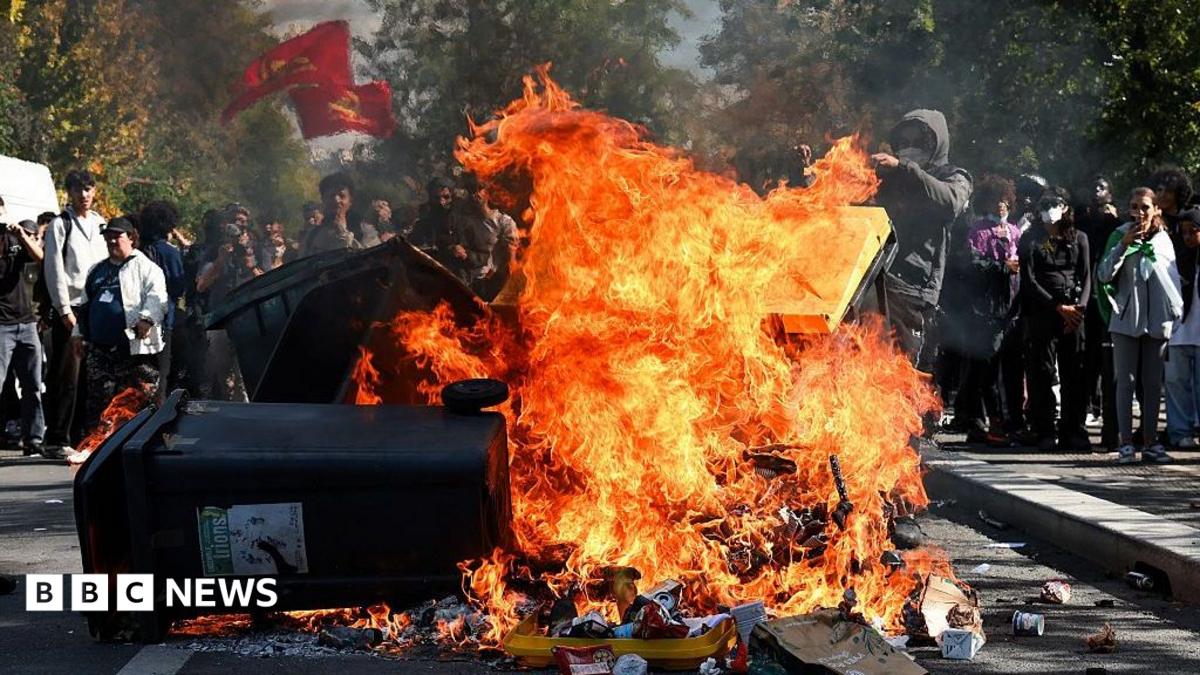
Seventeen-year-old Raphael took part in protests outside a school in Strasbourg, where barriers were used to obstruct nearby tram tracks.
He voiced his frustration at his school’s facilities in an interview with news agency AFP, saying some rooms had leaks and that there were not enough toilets.
“The building is falling apart, the cafeteria is too small. There’s zero budget, zero resources, not enough supervisors,” Raphael said.
While France’s next general election is still months away, the protests and how French authorities are responding to them has been heavily politicised.
The government and hard-right politicians have blamed the hard left for igniting protests, which are being organised by a union representing lycée students.
Bally Bagayoko, the mayor of a Parisian suburb and member of the radical left La France Insoumise (LFI) party defended earlier remarks in which he said violence could be legitimate in some cases – referencing cases in which protesters had allegedly been shot at while not wearing helmets or bulletproof vests.
LFI leader and presidential candidate Jean-Luc Mélenchon, meanwhile, stressed he was in favour of non-violent protests, while arguing that blaming the left would not solve the issues motivating the demonstrations.
Earlier, leader of the hard-right National Rally Marine Le Pen said: “This is no longer about high school student protests. It is about riots organized by professionals and overseen by deputies from La France Insoumise.”
The presidential candidate called for a new anti-rioting law to be passed.
Left-wing mayor of Marseille Benoît Payan condemned the “unacceptable violence” in his city.
While young people were “legitimately concerned” about their future and public services, they must express themselves in a calm fashion, he said.
Eric Ciotti, the Republicans mayor of Nice, said the parents of those found to have damaged school property should be made to pay for the repairs.