
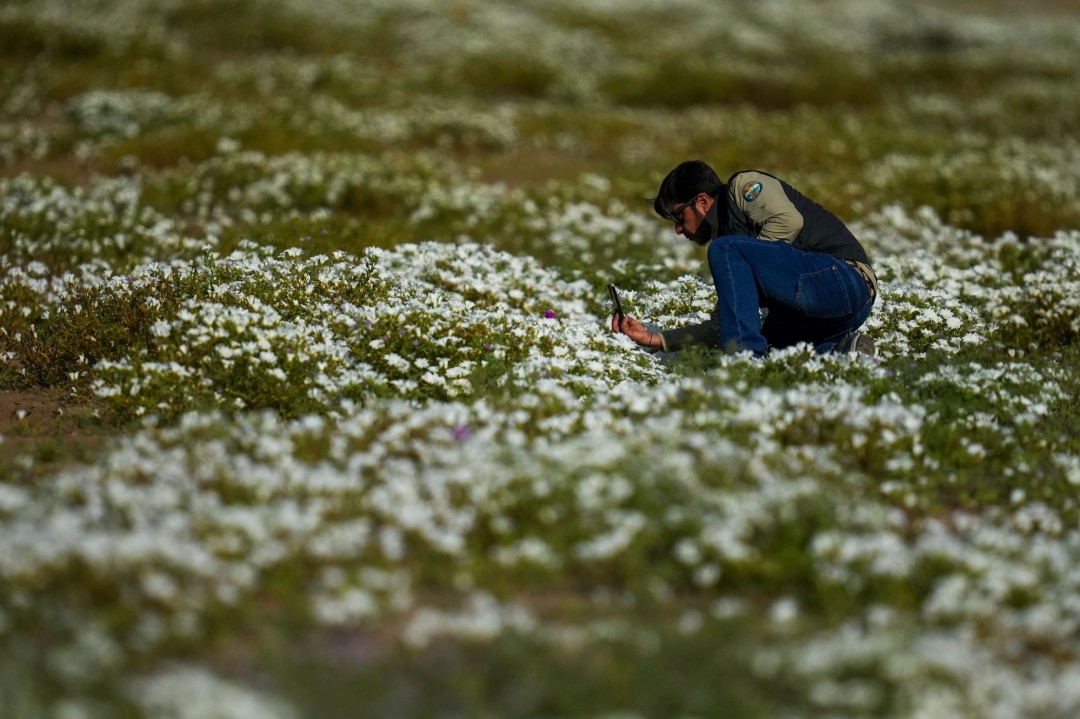
Spring has finally arrived in the Southern Hemisphere and, in Chile, even the desert is blossoming. Known as the driest nonpolar desert on Earth, the Atacama Desert has had a massive portion of it covered in flowers after the El Nino weather pattern brought heavy rains to the region earlier this year. The unusually large amount of water allowed millions of seeds and bulbs to sprout and bloom, many of them after remaining dormant for decades, the AP reports. “It is a unique phenomenon; there are more than 200 plant species,” said Jorge Carabantes, head of the Protected Areas Department at the National Forest Corp. “This is a flowering event that is obviously extraordinary and unusual, very different from other blooms that occur elsewhere on the globe.”
The Atacama lies between the Pacific Ocean and the Andes Mountains, stretching some 1,000 miles all the way down the northern coast of Chile. Although flowering is common during the transition from winter to spring, this year the rocky, brownish dunes that make up the desert’s usual landscape have turned into a vibrant, colorful carpet of wildflowers during a historic Desierto Florido, or flowering desert. “I always thought it was just going to be brown. That’s my image of a desert, just brown,” said Felix Banda, 51, who was born in Chile but has lived his whole life in Australia. “I knew that it had rained a lot, so I was expecting to see some beautiful greenery, but this is an incredible landscape,” he added about his first visit to the Atacama.
Between July and August, Chile recorded record rainfall in several regions, with some levels never seen since measurements began in the 1950s. The heavy precipitation was driven by a super El Nino, a climate phenomenon that causes sharp rises in global temperatures and is becoming increasingly strong. “What has happened now has an origin, and it is called ‘super El Nino,'” said biologist César Pizarro, head of the Biodiversity Conservation Section at CONAF Atacama. The storms have caused flooding, havoc, and devastation in several parts of Chile. In the north, they have also enabled the historic desert bloom, with an estimated coverage of some 6,560 square miles this year.