
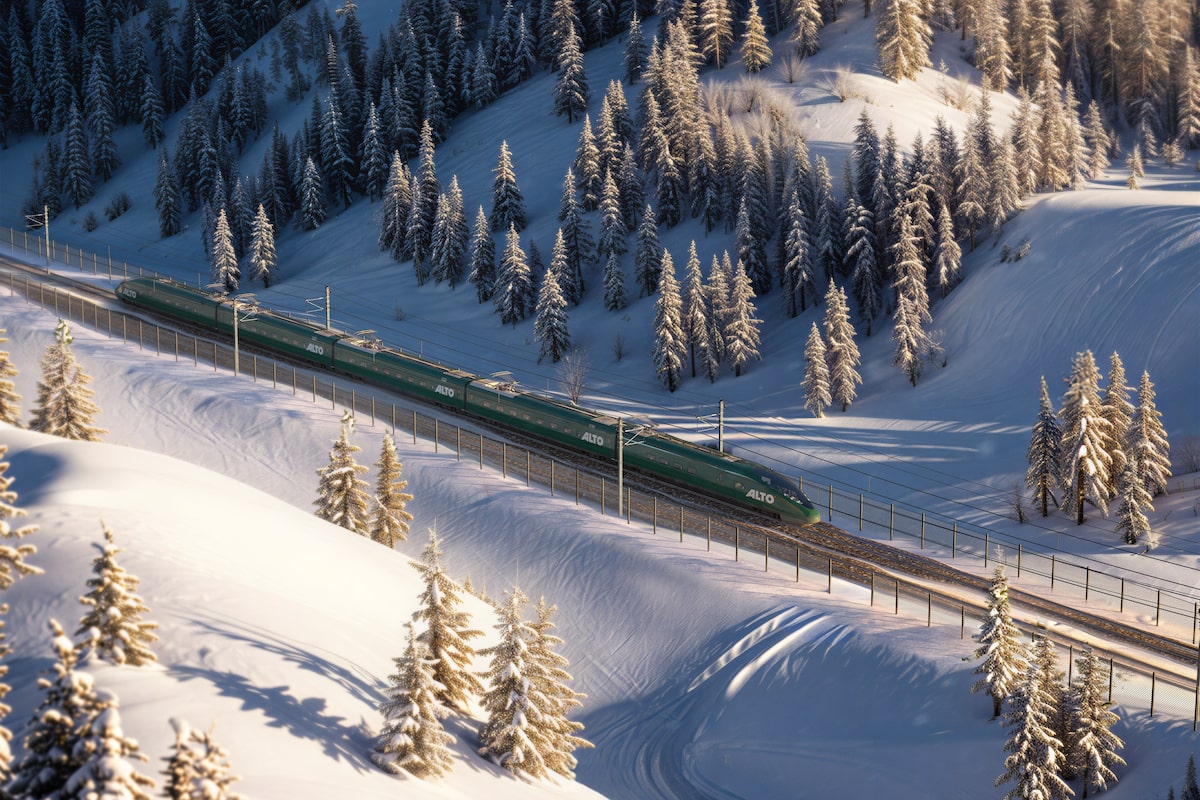
A rendering of the proposed first high-speed rail line between Quebec City and Toronto. The PBO’s analysis does not attempt to estimate the project’s operational cost.Supplied
The construction cost of building a dedicated high-speed rail line between Toronto and Quebec City could be between $75-billion and $113-billion, according to a new report from Parliamentary Budget Officer Annette Ryan.
The PBO’s range is higher than the one regularly cited by Alto, the Crown corporation responsible for the project, which has said construction will cost between $60-billion and $90-billion.
Alto has said its range is a preliminary estimate that will be further refined and updated next year.
The PBO report released Thursday is based on a review of international examples of the per-kilometre cost of building high-speed rail.
Both the PBO’s figures and Alto’s estimates only include the cost of building the new line.
The PBO report does not attempt to estimate the operational cost of the project. It says operational costs and whether the project’s ridership revenue will cover those costs will be addressed in a future report.
The Globe and Mail reported in August on an internal document from 2023 that shows operating and maintaining the line is estimated to cost between $62.6-billion and $67-billion over 40 years. That is in addition to the cost of construction. When construction and operational costs are combined with rolling stock purchases, the internal report said the total price tag over 40 years would be around $150-billion.
That 2023 internal briefing document also said total projected revenue for the high-speed rail system is $105-billion over the 40-year period, meaning ridership revenue would more than cover operational costs and would offset some of the construction cost.
The next PBO report on the high-speed rail project will focus on the issue of ridership revenue and operational costs.
Alto estimates that ridership will reach 24 million passengers a year by 2055 and up to 43 million by 2084.
That would be a significant increase in comparison to current ridership levels on the existing Via Rail service, which have declined from eight million passengers a year in the 1980s to about 4.4 million in 2025, according to Alto.
Via Rail has long said it is hindered from offering faster and more reliable service because it shares track with slower freight traffic, which is given priority.
That is one of the government’s main arguments for why a new line exclusively dedicated to passenger rail is needed in the corridor.
Alto has said the segment between Ottawa and Montreal will be built first, with construction starting as soon as 2029 if the project receives final cabinet approval before then.
Alto is planning to release a more specific proposed route this year for the Ottawa-to-Montreal segment.
While Alto says the project will cover 1,000 kilometres, the PBO analysis uses 850 kilometres for its cost assumptions. The PBO says the driving distance from Toronto to Quebec City via Montreal and Ottawa is less than 850 kilometres and a high-speed rail line is likely to be more direct than driving because such lines require fewer and broader curves.
The PBO report lists parts of the line that will have higher per-kilometre costs. This includes plans for a 15-kilometre tunnel under Mount Royal linking Laval, Que., and downtown Montreal.
The government has not officially decided whether the route between Peterborough, Ont., and Ottawa will run north through the Canadian Shield or south near Kingston.
The PBO said rock blasting through the Canadian Shield is an engineering challenge that would mean higher costs for that portion of the line.
The southern route also presents the potential for more expensive sections, as it could cut through sensitive ecological terrain as well as more densely populated areas. The PBO’s cost estimate does not account for the Kingston option.
Transportation Minister Steven MacKinnon said in June that the southern route serving Kingston is the government’s “strong preference,” but that decision has not been formally confirmed.
The PBO report says recent legislation related to large federal project approvals, such as the Building Canada Act, and the High-Speed Rail Network Act, which deals with expropriation processes, could help accelerate the project and avoid cost overruns experienced in other jurisdictions.
“While Canada’s legislative framework is intended to avoid the major cost-overrun drivers we’ve seen in comparable American and British projects, Canada’s route geography has some significant cost escalators – most notably tunnelling in and around Montreal, and the complexities of the Canadian Shield portion,” Ms. Ryan said in a statement.
She said that the report offers Parliament an independent assessment of the potential costs and economic effects associated with the project, noting it’s “one of the largest infrastructure projects ever proposed in Canada.”
Philippe Archambault, a spokesperson for Alto, said the PBO’s analysis places the construction cost within a range “that is similar to and consistent with Alto’s working estimate,” despite using different methodology.
“This independent report also suggests that some of the more pessimistic scenarios raised in the public debate are not supported by international experience. The development phase is ongoing and will confirm the route, refine cost estimates and finalize a rigorous business case before any final investment decision is made,” he said in a statement.
He said Alto expects to release an initial version of the business case in the first half of 2027.
Conservative MP and Transportation critic Dan Albas said in a statement that his party would cancel the project.
“Canadians are out of money. The Liberals want to blow $113-billion on another Liberal illusion that will come late, go over budget and leave taxpayers stuck with the bill, if it even gets built at all,” he said.