
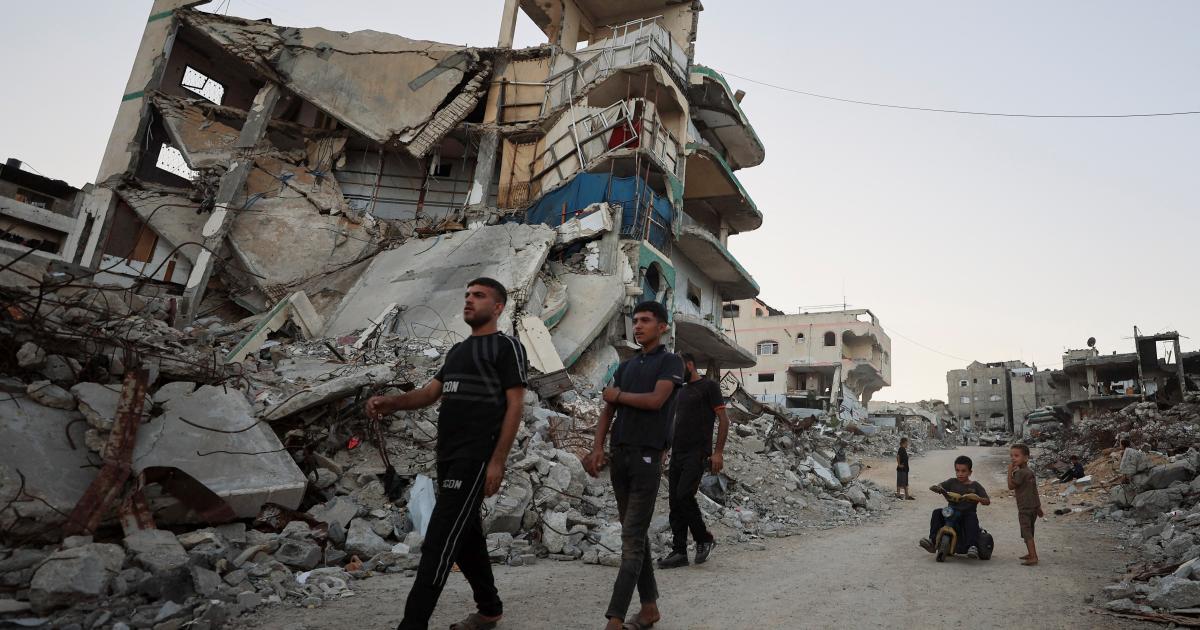
In September 2025, U.S. President Donald Trump unveiled a peace plan to end the war in Gaza, vowing it would not only rebuild the devastated territory but also usher in “eternal peace in the Middle East.” A year later, the plan has stalled. Hamas has not disarmed. Israel still controls more than 60 percent of the strip. A promised technocratic government and international security force has not materialized, and large-scale reconstruction has barely begun; most Gazans still struggle to obtain food, water, and shelter. And as Israel’s October election approaches, the country’s prime minister, Benjamin Netanyahu, has hardened his position, rejecting a U.S.-backed disarmament deal. Although the 25-country Board of Peace—the mechanism Trump established to implement his peace plan—did announce a more detailed reconstruction program this week, high-level officials have told the Times of Israel and other outlets that the group has stopped pressuring Netanyahu to comply with the plan because of the upcoming vote.
This hard-line stance appeals to the majority of Israelis, who do not think that Palestinians are interested in negotiations or diplomacy. Surveys have repeatedly shown that Israelis overwhelmingly believe Palestinians do not want peace at all and, therefore, that Israel has no real negotiating partner. In July of this year, for instance, a Tel Aviv University poll asked Jewish Israelis what they think Palestinians want. Seventy-two percent said they believed Palestinians were “moderately or very opposed” to any peace negotiations, and over 80 percent said they believed Palestinians thought no peace with Israel was achievable.
But this perception completely distorts what most Palestinians believe and are prepared to accept. For two decades, Arab Barometer, a survey project that we help run, has carried out comprehensive polls of Palestinian public opinion in both the West Bank and Gaza. Our most recent broad survey, conducted in October 2025, showed that a majority of Palestinians regard diplomatic negotiations, not armed resistance, as the best way to resolve the Israeli-Palestinian conflict for good; conditions on the ground have not changed in a way that would meaningfully modify these findings, and they are backed up by questions asked this August by the Ramallah-based Palestinian Center for Policy and Survey Research (PCPSR), an Arab Barometer partner.

In fact, many Palestinians have a clear and realistic vision for the future. Far more of them support a two-state option than any other potential resolution. And Gazans, despite having borne the brunt of destruction over the past three years, tend to be the most pragmatic: an even greater proportion of them are open to a two-state solution than are Palestinians living in the West Bank, and half of Gazans would back Arab states’ normalization of diplomatic ties with Israel as long as the process includes tangible progress toward Palestinian self-determination. Palestinians’ confidence in both Hamas and the Palestinian Authority (PA) has also deeply eroded; they judge that neither faction has secured their safety or improved their lives, and they want political renewal. Strikingly, most Gazans express a wish to stay and help rebuild their devastated homeland rather than emigrate.
Gaza’s immediate situation is bleak. The conditions for Palestinians living in the West Bank are deteriorating rapidly. The status quo is not sustainable, despite there being no clear end to conflict in sight. But Palestinians’ own views offer glimmers of hope. Israelis have a chance to choose a new government more committed to negotiation. If such a government and international donors were to pursue a transition that treats Palestinian statehood as a central part of negotiations and recognizes Gazans’ desire for security and legitimate governance, Gazans are ready to compromise, as are many Palestinians in the West Bank. They are willing to work toward a new political order, but it must be just that: new.
PALESTINIAN REALISM
Last October’s Arab Barometer survey revealed just how desperate conditions had become in both Gaza and the West Bank—a security, economic, and humanitarian crisis that has not improved meaningfully since then. The survey polled 855 people in Gaza face-to-face in the respondents’ homes, shelters, or camps, and 800 in the West Bank face-to-face in the respondents’ homes. It began the same day that a formal cease-fire in Gaza was announced, providing a broad picture of the conditions confronting the strip’s rebuilding. Because of the survey’s timing, some questions that were asked in the West Bank and other countries across the Middle East (such as queries about domestic politics and social relations) were not asked in Gaza to make room for questions that would bring to light Gazans’ immediate needs. Since the 2025 Arab Barometer poll, no similar survey has been done to capture Gaza’s humanitarian situation; given the limited aid that has been allowed to enter Gaza and the Board of Peace’s failure to make real progress past the cease-fire’s first phase, the scale of the challenge remains largely unchanged.
In our survey, 85 percent of Gazans indicated that they had been displaced at least once since early October 2023. Among those who had been displaced, 70 percent had been uprooted three or more times. Sixty-one percent of Gazans said that a member of their household had lost employment as a result of the war, and under half said they had eaten every day in the past week. Just over one in five had gone all or most of the past seven days without eating. Education had also been badly disrupted: among households with school-age children, 31 percent said none of their children currently had access to education. Other essential services remained limited. Only nine percent of Gazans had access to electricity and six percent to fuel or cooking gas, crises that have persisted. In early September, the UN Office for the Coordination of Humanitarian Affairs reported that Gaza still had a “near-total absence of reliable electricity,” while prior reports noted that Gazans had to burn trash to cook.
Residents of the West Bank had more access to basic services but reported rapidly deteriorating security. Only 58 percent of Palestinians in the West Bank described their neighborhood as safe, a 16-point decline from the poll completed in October 2023. Two-thirds rated the PA’s provision of security as “bad” or “very bad,” and 24 percent had considered emigrating. We asked those who wanted to leave the West Bank to tell us why, in their own words. Overall, 38 percent included security reasons in their answers, 37 percent included political reasons, and 71 percent included economic reasons. This contrasts with most other countries we survey, where few would-be emigrants cite major motives other than economic ones.
Despite living in horrific circumstances, most Gazans want to remain.
The West Bank’s economic crisis is becoming more deeply felt. Fully 92 percent of respondents described the area’s economic condition as “bad” or “very bad,” an increase of 21 points from two years prior. Hunger is also a major problem. Fifty-one percent of West Bank Palestinians agreed that the statement “the food that we bought did not last and we did not have money to get more” was often or sometimes true over the past 30 days. And 41 percent agreed that they “had to skip a meal” for lack of money or resources over the course of the previous 12 months.
And yet Gazans, in particular, had not become fatalistic. A majority of Gazans told Arab Barometer surveyors that neither they nor their household would “leave Gaza right now if they could.” The percentage of those who said that they, or both they and their household, would leave the strip now if they could—41 percent—resembled the percentage of those who have considered emigrating from other, vastly more peaceful and stable societies (such as Jordan, 44 percent, and Tunisia, 41 percent) in surveys conducted in the fall of 2025 by Arab Barometer. In other words, despite living in horrific circumstances, most Gazans want to remain and rebuild.
One might also assume that, given the scale of devastation in Gaza and settler violence in the West Bank, support for a negotiated settlement to the Israeli-Palestinian conflict might have declined. This was not the case. When respondents in the West Bank were asked which solution they preferred to end the Israeli-Palestinian conflict—two states, one state, a confederation, or “other”—56 percent selected a two-state solution, a rise of seven points from the Arab Barometer survey conducted in 2023. Over the course of two years of devastating conflict, support for a two-state solution had risen even more in Gaza, from 54 percent in early October of 2023 to 64 percent in October 2025. Over the same time frame, support for a confederation increased by ten points in Gaza, to 20 percent; support for one state dropped by four points, to five percent; and support for “other”—a choice that often reflects a preference for armed resistance—fell from 20 percent to seven percent in Gaza.
Notably, the rise in support for a two-state solution was especially large among younger Palestinians. In 2023, Palestinians between the ages of 18 and 29 were nine points less likely to favor the two-state solution than those 30 or older. By the fall of 2025, they were no less likely than those 30 and older to favor this outcome. Meanwhile, among young Palestinians, support for the “other” option had been cut in half by 2025, falling from 27 percent to 14 percent.
Newer polling confirms these views remain solid. A 440-person sample of Gazans conducted by the PCPSR in early August this year found that 61 percent preferred a two-state solution based on 1967 borders over other options such as a single equal state. Sixty-five percent of Gazans agreed that armed resistance had failed to protect Palestinians and had instead brought destruction.
Gazans exhibit particular pragmatism. In Arab Barometer’s October 2025 survey, when respondents in both occupied Palestinian territories were asked whether they supported Arab countries normalizing diplomatic ties with Israel, only 11 percent did. But substantially more Gazans supported such an outcome than did Palestinians living in the West Bank—nearly one in five. In contrast, in Arab Barometer’s October 2023 survey, just ten percent of Gazans favored normalization and five percent of Palestinians living in the West Bank did. In 2025, when respondents were asked whether they supported Arab-Israeli normalization if it were linked to the creation of a Palestinian state (a condition Saudi Arabia, in particular, has recently insisted on), fully half of Gazans and more than a quarter of West Bank Palestinians said yes.
The data was clear: more Gazans support a peace process than favor violent confrontation. The survey results also challenged a widespread misconception. A majority of Gazans prioritize securing independence over seeking revenge on Israel. A key reason Palestinians oppose normalization is the possibility that it proceeds without Palestinian independence. When independence is added, support for the concept increases dramatically.
OUT WITH THE OLD
Palestinians are also firm in their belief that their existing leaders have failed them. For decades, Palestinian politics have revolved around two key factions: Fatah, the party that controls the PA, and Hamas. Analysts have often assumed a decline in support for one translates into gains for the other. A reformed PA would be better than the status quo, but it is clear that a fuller reform of the Palestinian political system is needed. By now, most Palestinians do not support either Hamas or the PA. In the October 2025 Arab Barometer survey, when Palestinians living in the West Bank were asked which political party they felt closest to, 24 percent indicated Hamas and 18 percent indicated Fatah; 51 percent indicated no party, “don’t know,” or refused to provide a response. Just 23 percent said they had confidence in the PA’s governance, barely an improvement from 2023’s 19 percent. Trust in the PA’s president, Mahmoud Abbas, was even lower, at just 19 percent.
In our 2023 survey, only 29 percent of Gazans expressed confidence in their Hamas-led government; 72 percent criticized substantial corruption in government institutions. Although the survey included fewer questions on Palestinians’ broad political outlook in Gaza than it did in the West Bank (to make room for more questions about Gazans’ immediate needs), it was clear that Hamas’s horrific October 7 attack on Israel and the subsequent war did not win it any support in the long run. In the October 2025 survey, roughly the same percentage of Gazans—only a third—expressed confidence in what remains of the territory’s Hamas-led government.
Palestinians simply do not want either Hamas or Fatah to lead them. When they were asked whom they would choose in a hypothetical legislative election featuring the same parties that ran in 2006, 16 percent of Palestinians across both territories selected Fatah, and 19 percent said they would support Hamas’s Change and Reform list. A total of 55 percent said they would either not support any party that had stood in the 2006 elections or not vote at all. The largest bloc in Palestinian politics is not Fatah or Hamas; it is the politically alienated. The August PCPSR survey showed that nearly 40 percent of Palestinians prefer Marwan Barghouti—a leader of the first Palestinian intifada who has been imprisoned in Israel since 2002 and was convicted of murder in 2004—as their presidential candidate, more than double the support garnered by any other figure. But Israel has repeatedly refused to free him in prisoner exchanges, and recent reports suggest that he is in very poor health.
Returning the PA to Gaza, even after a reform process, will not yield a legitimate government. Palestinians do not believe the PA can effectively provide security: majorities of Palestinians in the West Bank distrust both the PA-led National Security Forces, the territory’s closest organization it has to an army, and the PA’s police. (Neither of these organizations operated in Gaza at the time of the survey and still do not.)
One potential path forward would be to create a technocratic government to oversee the transition in Gaza. There is some support among Palestinians for such a concept: according to the August 2026 PCPSR survey, 43 percent in Gaza would prefer the National Committee proposed by the Board of Peace to oversee Gaza in the near term, while 34 percent would favor elections to form a government. (In the West Bank, support for both options is lower, at 24 percent for each.) Although a technocratic government may be a necessary first step to stabilize Gaza and allow for more humanitarian assistance and reconstruction, entrenching such a government in the long term risks further institutionalizing the separation of Gaza from the West Bank. As Salam Fayyad, the Palestinian prime minister from 2007 to 2013, noted in a recent interview with Foreign Affairs, a unified and nonfactional transitional government for both areas is essential.
Although the percentage of West Bank Palestinians who agreed that democracy is the “best system” of governance remained effectively unchanged between our 2023 (78 percent) and 2025 surveys (77 percent), support for a strong leader who “bends the rules if necessary to get things done” rose by ten points during this period, from 41 percent to 51 percent. Two-thirds of respondents agreed that “as long as a government can solve our country’s economic problems, it does not matter what kind of government we have.” Given the destruction in Gaza and the ongoing security crises in the West Bank, Palestinians clearly strongly desire a leader capable of bringing order and stability. But this does not mean that Palestinians do not favor democracy. It is better understood as a symptom of political exhaustion and vulnerability following years of division, economic hardship, and war. Palestinians prefer democracy, but ultimately they want results from their political system.
THE RIGHT PLAN
Palestinians’ own views offer clear directions for efforts to end the Gaza conflict and reconstruct the territory. And any discussion of rebuilding needs to reflect their preferences. After all, although Palestinians’ loss of faith in the PA has a great deal to do with the organization’s corruption, it also reflects the fact that the PA often prioritized meeting Israelis’ security demands even as the expansion of settlements into the West Bank contributed to its delegitimization. The growing impression that the PA functioned as an arm of the Israeli occupation and not a vehicle for authentic Palestinian political representation and expression directly fueled Hamas’s rise in popularity in the middle of the first decade of this century. Such a grave mistake must not be made again.
Simply inserting the PA into Gaza without a plan to address its legitimacy deficit cannot lead to stability. Any proposal premised on a large number of Gazans leaving the territory before reconstruction begins, such as a September 2026 plan unveiled by Israel’s national security minister, Itamar Ben-Gvir, will also be misguided. Gazans want to stay and transform their homeland on their own terms and live side by side with the state of Israel.
More broadly, surveys show that even as Palestinians have withdrawn from their two main political factions, they have not lost interest in policy or policy outcomes. They have a clear vision and are willing to back compromise. But despite their exhaustion, they will not accept any result that simply ends the fighting and keeps their future in limbo.
Gaza’s future cannot be divorced from the West Bank’s. Stabilizing the strip will be challenging enough in a vacuum, and it will be immensely harder while settlements and settler violence expand in the West Bank. Palestinians are also clear that any near-term solution must include a credible route to independent statehood; a Palestinian state must not be treated as a possible reward at the end of a long and uncertain path. Palestinians are far more likely to be willing to respect Israel’s role in the region—as represented by its normalization of ties with other Arab states—when they, too, are allowed self-determination. The question of Palestinian statehood cannot be left for the end of a peace process, and the prospect of it must be credible to ensure Palestinians’ engagement with political renewal.
A PARTNER FOR PALESTINIANS
Palestinians, particularly those in Gaza, have been deeply traumatized. Frustration runs deep, and rebuilding will take years, if not decades. But the Arab Barometer’s findings staunchly contradict any view of Palestinian politics as rigidly ideological, committed to revenge, and supportive of violence. On the contrary, Palestinians are notably pragmatic—especially in Gaza, where one might expect radicalization. They have not rejected the idea of a peaceful settlement with Israel. Despite their disillusionment with the PA, they are not turning toward Hamas or toward violent resistance. Although there is Palestinian opposition to a two-state solution, a growing proportion—now a majority—wants it, and yearns for more capable and responsible leadership that addresses their needs and provides security.
The most serious obstacle to compromise now comes from Israel, and not only from the right wing of the country’s political spectrum. According to an October 2025 poll by Tel Aviv University’s Institute of National Security Studies, nearly 70 percent of Jewish Israelis refuse to contemplate the creation of a Palestinian state “under any circumstances.” Moreover, a broad cross section of the Israeli public asserts that Palestinians are not interested in compromise or peace. A June-July poll conducted by the INSS itself found that 52 percent of West Bank Palestinians believed negotiations were the best way to end the conflict with Israel, a far greater percentage than any other option, such as armed resistance.
Time is of the essence when it comes to improving Palestinians’ situation on the ground. In Gaza, malnutrition, poverty, communicable diseases, a scarcity of clean water, and accumulation of waste and rubble are all burying the strip, while Palestinians living in the West Bank are routinely being forced out of their homes and off their land by Israeli settlers, often with the collaboration of the Israeli military. There is an alternate reality: coexistence. It is notable, perhaps even surprising, that Palestinians living in these conditions remain committed to a two-state solution. The Palestinian public’s readiness for territorial compromise and peace is not new; but it is significant that it has survived, and even grown over the past three years, despite what they have endured.
What they offer is a desire and readiness for a real end to conflict. The ball is in the courts of Israel, the United States, and other members of the Board of Peace. These actors must take meaningful action to push peace forward. Israelis have suffered immensely, too. But the question at hand is not whether Israel has a partner for peace. It is whether the Palestinians have one. The results of Israel’s election on October 27 may go some distance toward answering this question.
Loading…