
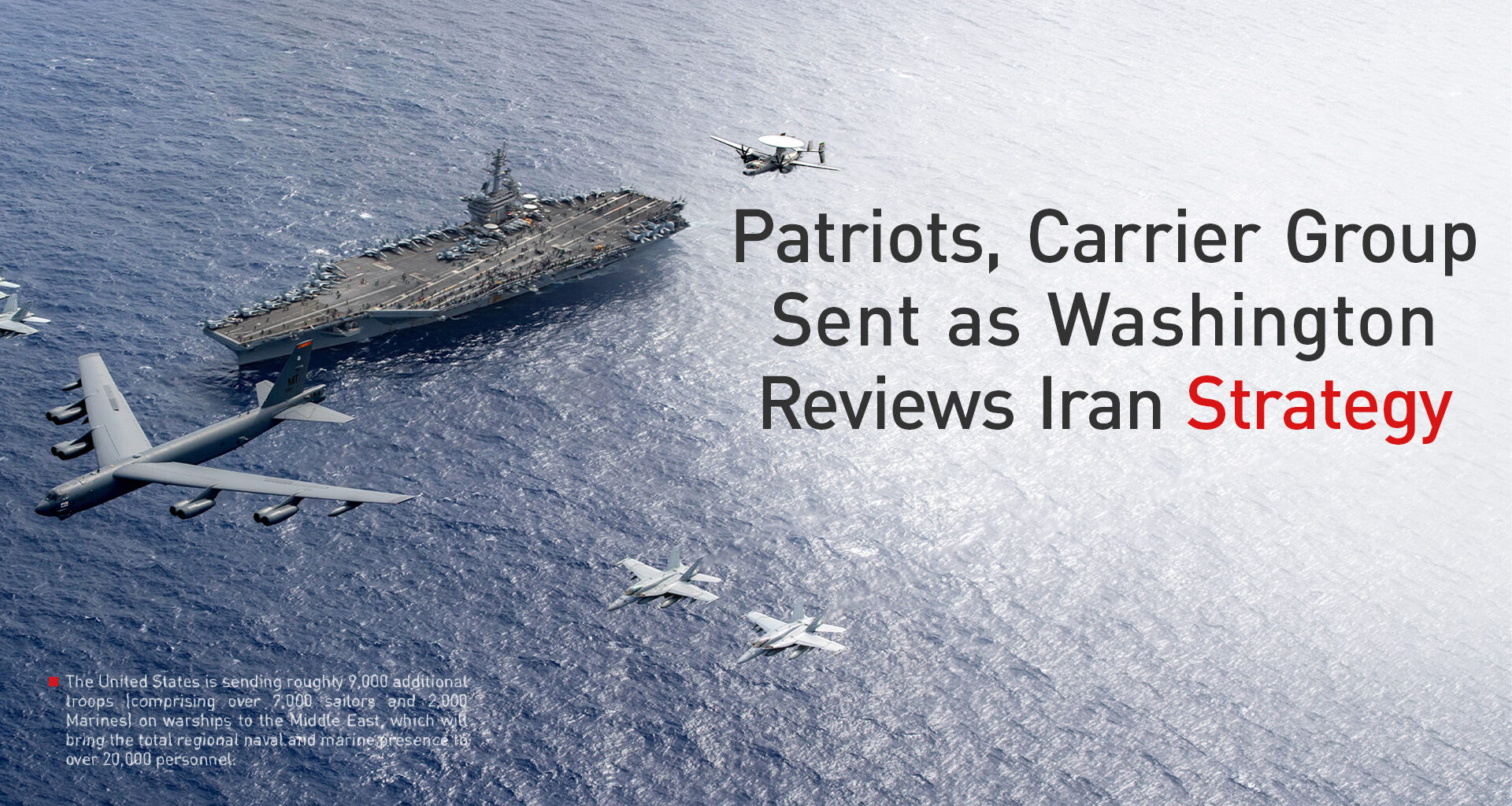
The U.S. is sending about 9,000 more personnel and Patriot batteries to the Middle East, potentially raising its regional force from 50,000 to 60,000 as Trump weighs renewed strikes on Iran after the midterms. Three carrier groups, if all present, could add nearly 20,000 troops.
ERBIL (Kurdistan24) – The United States is moving roughly 9,000 additional sailors and Marines toward the Middle East and has deployed two more Patriot missile batteries to protect energy facilities in Saudi Arabia and Qatar, as President Donald Trump weighs whether to renew major strikes against Iran after the November midterm elections.
The naval deployment includes the USS Theodore Roosevelt aircraft carrier strike group and the Makin Island Amphibious Ready Group, potentially bringing three American aircraft carriers into the region in the coming weeks.
Separately, Washington recently positioned one additional Patriot battery in Saudi Arabia to protect a key oil facility and another in Qatar to defend a natural gas installation, according to Axios reporting by Barak Ravid.
The deployments are intended to give Washington greater military flexibility while also reassuring Gulf partners concerned about possible Iranian retaliation if large-scale U.S. strikes resume.
The Washington Post’s Dan Lamothe reported, citing U.S. officials, that Pentagon planning could put the USS Theodore Roosevelt alongside the USS George Washington and USS George H.W. Bush in the Middle East.
Combined, three carrier strike groups could bring nearly 20,000 personnel, as many as 150 fighter aircraft and several destroyers capable of both launching missiles and defending against incoming attacks.
U.S. officials have said about 50,000 American troops are already deployed across the wider Middle East.
Theodore Roosevelt left San Diego in recent days and must cross the Pacific before reaching the region. The George Washington was in the Arabian Sea on Thursday, while the George H.W. Bush was operating in the Indian Ocean.
The Associated Press, in reporting by Konstantin Toropin, Michelle L. Price and Aamer Madhani, said the Roosevelt group and the Makin Island amphibious force together carry more than 7,000 sailors and about 2,000 Marines.
That movement could raise the U.S. naval presence in the region to more than 20,000 sailors and Marines, along with hundreds of aircraft.
The Wall Street Journal’s Lara Seligman and Shelby Holliday reported that the overall reinforcement could add between 9,000 and 10,000 personnel by the end of November.
The buildup does not necessarily mean Trump has decided to expand the war.
U.S. officials cited by the Washington Post said the preparations are designed to provide the president and military commanders with options. If Washington decides against a new round of major attacks, some incoming ships could instead replace vessels that have been operating at sea for months.
The USS George H.W. Bush deployed from Virginia in March, while the George Washington left its Japanese home port in May and reached the Middle East in August.
The Makin Island group could likewise eventually replace the Boxer Amphibious Ready Group, which has been in the region for months, although the two formations may overlap temporarily.
Still, the movements come as Trump publicly considers another escalation against Iran.
In an interview with TIME published Thursday, Trump said it was “possible” that he would intensify bombing after the Nov. 3 U.S. midterm elections. He declined to discuss possible targets or operational details.
Trump also said he had rejected Iran’s latest proposal for easing the conflict, including an offer concerning the Strait of Hormuz, because he considered the overall package insufficient.
The conflict began on Feb. 28 with U.S. and Israeli strikes on Iran. Fighting paused during the summer while Washington and Tehran pursued negotiations, but those efforts failed to produce a lasting settlement and intermittent attacks continued.
The Pentagon’s preparations therefore come amid uncertainty over whether the coming weeks will bring renewed diplomacy, another period of limited exchanges or a return to heavier military operations.
The additional Patriot deployments point to one of Washington’s principal concerns if the conflict escalates: protecting Gulf energy infrastructure from retaliation.
Axios reported that Saudi and Qatari leaders had previously expressed concern that strikes on Iranian energy targets could prompt Tehran to retaliate against oil and gas facilities in their countries.
The United States subsequently moved an additional Patriot battery to each country.
Patriot systems and their interceptor missiles have been heavily used since the Iran war began, and moving more of them to the Middle East has also raised questions inside the U.S. military about readiness in other regions, according to the supplied reporting.
The Pentagon buildup comes after months of demanding operations for American forces.
The Washington Post reported that the war has cost tens of billions of dollars, damaged or destroyed U.S. facilities and aircraft across the region, wounded more than 800 American troops and killed at least 19.
Long deployments have also created maintenance and morale problems.
The USS Abraham Lincoln is now returning toward San Diego after an extended Middle East deployment, while other ships and units have remained at sea for months.
Recent security incidents have added another layer of uncertainty.
Trump said Thursday that preliminary information suggested Iran could be linked to the attack involving a flydubai copilot who allegedly stabbed the captain of an Israel-bound flight, although investigators have not publicly established Iranian responsibility.
He warned that Iran would face a severe U.S. response if such a connection were proven.
British authorities have also investigated a security incident near RAF Fairford, a U.S.-used military base in England, and arrested a dual British-Iranian national on suspicion of involvement in a terrorism plot.
Those developments come as Washington seeks to increase pressure on Tehran while protecting forces, allies and strategic infrastructure from possible retaliation.
For now, the additional carriers, Marines and Patriot batteries give the United States considerably more defensive and offensive capacity in the region.
Whether that capacity is used for another major round of strikes, maintained primarily as deterrence, or partly becomes a rotation of forces already deployed will depend on decisions still under consideration in Washington.