
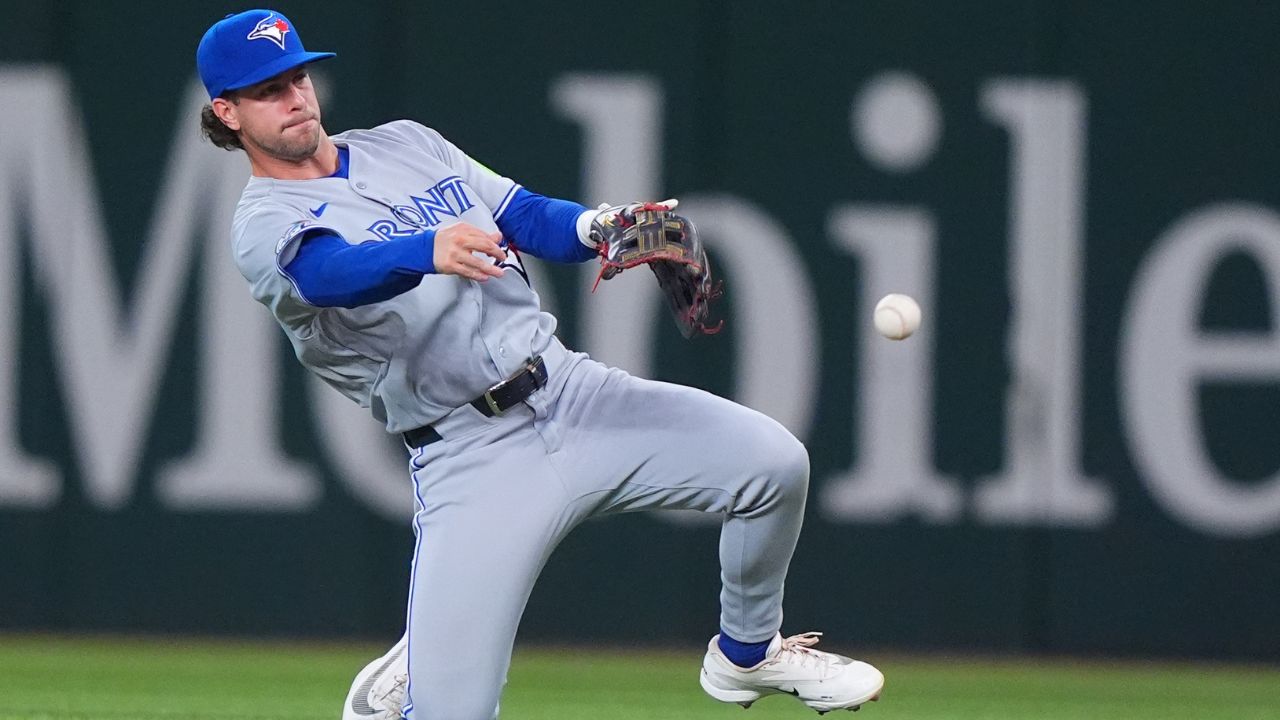
When Ross Atkins met the media following the conclusion of the Toronto Blue Jays’ season, few of his comments made waves, but what he said about Ernie Clement was noteworthy.
A lack of commitment to starting Clement at second in 2027 shouldn’t necessarily be surprising given his production this season, but the infielder appeared in the All-Star Game after a strong start to 2026, was a Gold Glove finalist in both 2024 and 2025 and set the MLB post-season record for hits last year. He’s an accomplished player to potentially demote from an everyday role.
There are several reasons why it makes sense for the Blue Jays to consider the fan favourite’s role tenuous heading into the offseason, though, ranging from his difficult 2026 to the potential alternatives in the market.
There’s no denying that Clement was an effective everyday player for the Blue Jays in 2024 and 2025. He compensated for a lack of patience and raw power by making contact with virtually everything and provided elite defensive contributions — primarily at third base.
Clement wasn’t nearly as effective in 2026. His low-walk, low-strikeout profile persisted, but his contact, which was never thunderous, got softer than it’d been in 2025, leading to plenty of harmless outs in play. Only five qualified hitters had a lower exit velocity than Clement’s 84.4 mph, and just three had a lower hard-hit rate. His xwOBA of .258 was the second-worst among qualified hitters. He didn’t excel by these metrics before, but they were more palatable, allowing him to post a near-average 96 wRC+ between 2024 and 2025. In 2026, that number dropped to 80, narrowly worse than glove-first shortstop Andrés Giménez (81).
On defence, Clement’s work (primarily at second base) earned a minus-5 OAA score from Statcast, putting him in the 12th percentile league-wide. That number likely undersells Clement’s skill set, and he made some stellar plays over the course of the year that suggest his athleticism hasn’t abandoned him.
• He’s about to enter his age-31 season
• His offence has never been league-average over the course of a full MLB campaign
• His production at the plate is tied up in a singular skill (contact) and has nothing to fall back on if that slips
• His defensive excellence is far more proven at 3B than 2B
• His defensive versatility is suited to a super-utility role
• The Blue Jays have a 1B, 3B, SS, and C all signed through at least 2029
If Toronto hopes to significantly improve its position-player core, the outfield could use a revamp, but the second-base position is also a logical spot to explore upgrades.
Internal options for 2B at-bats
Josh Smith: After playing at second base sparingly early in his career, Smith logged more games at the keystone (45) than any other position in 2026. The utility man is coming off a rough season, but his numbers from 2024-25 aren’t dissimilar from Clement’s production during those years.
Smith is a slightly better bet than Clement to produce offensively next year, but he’s likely to offer less in the field. If the team doesn’t look externally for second-base help, the two players could be mixed and matched at the position, but Smith is unlikely to surge to the top of the depth chart unless he gets hot over an extended period of time. Smith has been productive with starter-like workloads in the past, but he’s best utilized as a roving utility player.
Charles McAdoo: McAdoo has started just 33 games at second base as a pro, and he hasn’t proven himself as a major-league hitter. His combination of bat speed, raw power and sprint speed is a compelling combination, but he won’t be handed anything entering 2027.
If the 24-year-old ends up taking at-bats away from Clement or others next season, it will be because he forced the team’s hand with strong production — either off the bench or at triple-A.
Possible free-agent targets
Jazz Chisholm Jr.: Chisholm’s stock isn’t at an all-time high following a season where his offence was narrowly below league-average (98 wRC+); he earned criticism for sucking lollipops on the field, and he got benched for Game 1 of the wild-card series.
The athletic 28-year-old is no stranger to a baffling blunder, but he’s also extremely talented and younger than most free agents. He’s produced between 3.5 and 4.3 fWAR in each of the last three seasons with a 30 home-run campaign and two 40-steal efforts. Chisholm’s combination of power and speed could bring dynamism to a Blue Jays offence that often worked station-to-station in 2026, relying on strings of singles and making very little happen on the base paths.
Brandon Lowe: Lowe may be 32, but he just posted a career-high 4.9 fWAR, and he’s hit 30-plus home runs in consecutive seasons. The former Tampa Bay Rays mainstay is a reliable source of left-handed pop, who’s made a career of mashing right-handed pitching (135 wRC+ vs. RHP).
After a season when the Blue Jays were so bereft of power, he will be an appealing option, but he’s struggled with injuries at times, and his defensive numbers have fluctuated wildly in recent seasons. Lowe is a safe bet to help the middle of a lineup in 2027, but his longevity as an all-around contributor could be questioned.
Luis Arraez: Considering the only part of Toronto’s offence that worked last season was its contact hitting, it seems unlikely the team will add MLB’s most extreme contact hitter to the mix.
At the same time, a second baseman who hasn’t turned 30 yet, coming off a 4.1 fWAR season, is worthy of consideration. Arraez improved defensively in 2026 to round out his overall value; he’s played at least 144 games in five consecutive seasons, and he’s been an above-average hitter by wRC+ in every year of his career. There’s a lot to like with the eight-year veteran, but his stylistic fit may give the Blue Jays pause.
Pursuing Marte would be complicated and risky. The only reason it’s worth any consideration is that he’s a remarkable all-around contributor. Despite his relative down year in 2026, he still ranks 18th among position players in fWAR over the last four seasons (18.9). His 111 home runs during that time are the 14th-highest total league-wide. A Marte trade doesn’t seem likely, but he has the best MLB track record of any second baseman who could be available.
Zach Neto: Neto has been a shortstop for the duration of his MLB career, but he’s never graded out well defensively, and may look better at second. The 25-year-old has three more seasons of team control and has been one of the more consistent position players in the majors recently.
From 2024 to 2026, Neto has hit between 23 and 27 home runs, stolen between 24 and 30 bases, and produced between 3.3 and 4.0 fWAR each season. His wRC+ has been either 116 or 117 in each of those years. It would take a significant package to pry Neto from the Los Angeles Angels, but the club is not close to competing and has to consider moving off players with limited term remaining — as it did with the José Soriano deal.
C.J. Abrams: Abrams is another long-time shortstop, but unlike Neto, his transition to second base is already underway. He’s under control for two more seasons, and the Washington Nationals may conclude they aren’t close enough to contention to keep him.
While Neto’s appeal is in the consistency of his production, Abrams broke out offensively last season, hitting a career-high 33 home runs as his wRC+ reached 124. Whether he’d be able to keep up that level of production is up for debate. His wRC+ never exceeded 105 before 2026, and his new level of power wasn’t driven by a significant jump in bat speed or exit velocity. Part of his appeal is that he brings left-handed power that Toronto lacks, and he’s an even bigger base-stealing threat than Neto. Since he broke through as a full-time starter in 2023, he’s stolen at least 30 bases each season, and his total of 143 swipes ranks fifth in the majors.