
A terrifying CCTV video from Kyiv on Thursday captured the moment a Russian drone slammed into a school where more than 100 children had begun their day – another chilling reminder of how Russia’s expanding aerial war is reaching into the places Ukrainian children are supposed to be safest.
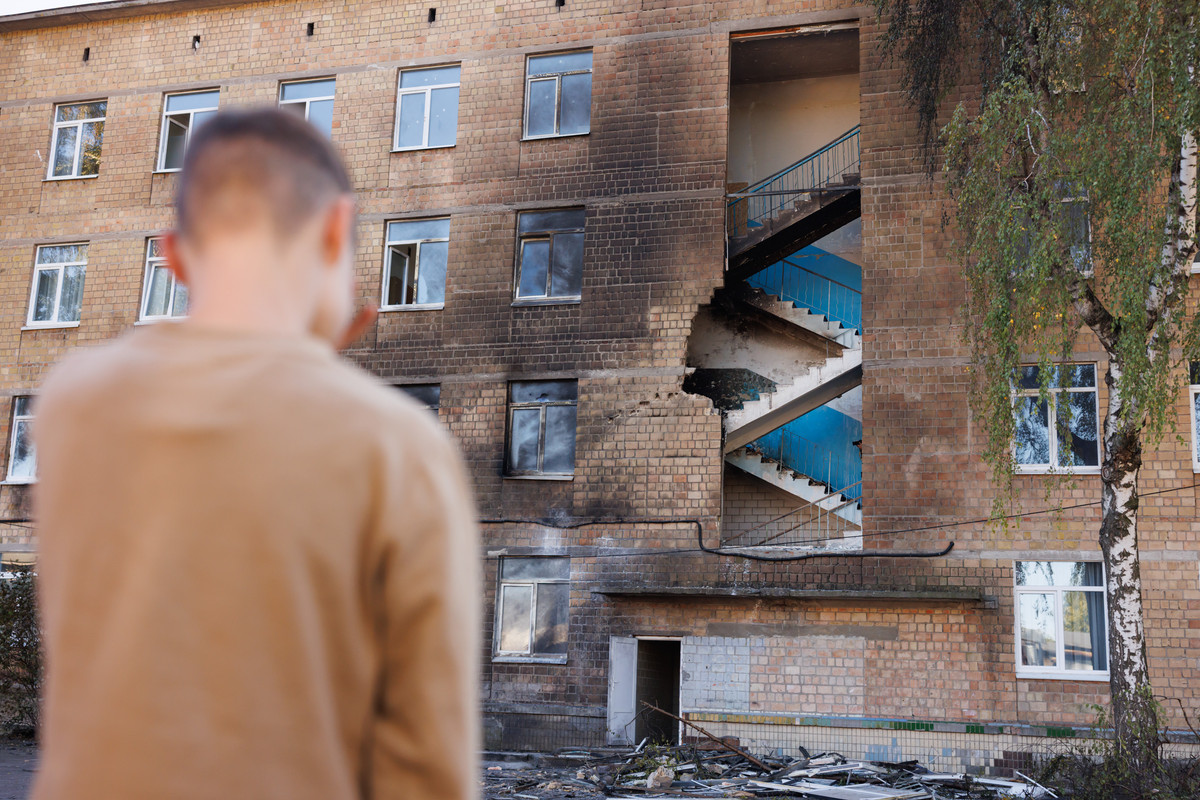
At around 9 a.m., a Russian drone struck School No. 12 in Kyiv’s Solomianskyi district, smashing through the building, shattering windows and partially destroying a wall and staircase.
JOIN US ON TELEGRAM
Follow our coverage of the war on the @Kyivpost_official.
Inside were 104 children and 60 members of staff.
They survived because classes had already moved into the school’s underground shelter after an air raid alert sounded.
But there was another extraordinary stroke of fortune: the Russian drone’s warhead failed to detonate.
The explosive payload was found inside the damaged school after the strike. Had it functioned as designed, the consequences inside a building holding 164 children and staff could have been dramatically more devastating.
Two things stood between the children and a potential catastrophe: Ukraine’s decision to send them underground and the failure of the weapon that struck their school to explode.
No children or teachers were injured.
The 21-second CCTV recording captures the sudden violence of the impact, followed by debris and smoke engulfing part of the school.
“They spare no one,” headteacher Valentyna Chorna said as she surveyed the damage.
Other Topics of Interest
Russia Turns Its Drone War on Kyiv’s Dnipro Bridges – Why Now?
Repeated strikes on Kyiv’s Southern Bridge signal a new phase in Russia’s drone campaign – one aimed at disrupting the capital’s daily movement.
“Children are our future, the future of our nation. In order to destroy a nation, of course, they need to destroy children.”
A Relentless Pattern
Thursday’s near-disaster comes amid an intensifying wave of Russian drone and missile attacks on Kyiv and other Ukrainian cities, with schools, homes and other civilian facilities repeatedly caught in the strikes.
The danger is growing as Russia increasingly deploys faster jet-powered attack drones that are more difficult for Ukrainian air defenses to intercept.
That makes the strike on School No. 12 particularly chilling.
This was not simply debris falling from an interception high above the capital. A Russian attack drone crashed directly into the building carrying an explosive warhead.
The weapon failed to complete the destruction it was capable of causing.
The strike came amid a broader pattern of attacks affecting Ukrainian children and educational facilities.
Human Rights Watch reported in September that 314 educational facilities in Kyiv alone had been damaged since Russia launched its full-scale invasion in February 2022, including at least 107 during 2026.
Across Ukraine, the scale is far greater. UNICEF told the UN Security Council earlier this year that more than 1,780 educational facilities had been verified as damaged or destroyed since 2022, disrupting education for children already entering another year of wartime schooling.
Recent Russian attacks have repeatedly reached places where children live, study and shelter.
On Sept. 29, Russian forces struck Sumy with four glide bombs, hitting a school while pupils were sheltering inside. Children were among those injured, while civilians were killed elsewhere in the city.
A day earlier in Kharkiv, a Russian glide bomb struck a residential area, injuring dozens of people, including children.
For Ukrainian families, everyday routines – walking to school, sitting in class or sleeping at home – continue to unfold under the threat of another missile or drone alert.
Schools under the laws of war
Under international humanitarian law, schools are civilian objects unless and for such time as they are being used for military purposes.
Parties to a conflict are required to distinguish between civilian objects and military objectives and to take feasible precautions to avoid harm to civilians.
Intentionally directing an attack against a school that remains a civilian object can constitute a war crime.
But the repeated destruction and damage inflicted on educational facilities across Ukraine has left children learning under conditions that would have been unimaginable before Russia’s full-scale invasion.
Ukraine has responded by expanding underground classrooms, school shelters and remote education.
At School No. 12 on Thursday, those precautions proved decisive.
More than 100 children were underground when the Russian drone tore into the floors above them.
Had they still been sitting in ordinary classrooms – or had the drone’s warhead detonated as designed — the outcome could have been catastrophic.
Zelensky visits Kyiv school after Russian Shahed strike
President Volodymyr Zelensky visited the school, where he met with the principal and teachers following the morning Russian Shahed strike.
“Most importantly, everyone is alive,” he wrote on X, thanking the school staff for their “clear and coordinated actions,” which he said saved lives.
“Striking schools and kindergartens is a deliberate Russian tactic aimed at making ordinary life a target,” Zelensky wrote.
“And we are working nonstop to strengthen our air defense and increase the production of Ukrainian interceptors against jet-powered Shaheds – in order to protect our cities and communities from such strikes.”