
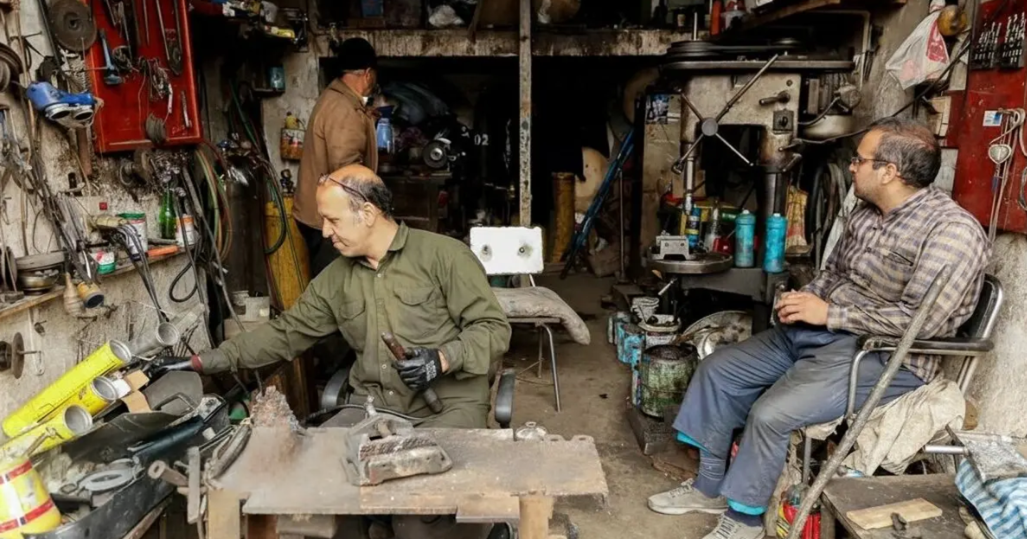
The Amir Kabir industrial area in Isfahan is home to mechanics, machinists, body shops, battery specialists and parts dealers serving trucks, construction equipment and mining machinery. Labor news agency ILNA said activity across the district had fallen sharply as transport demand weakened and the cost of keeping vehicles on the road climbed.
“When freight activity slows and less cargo is being moved, drivers face serious problems,” a person working in the district told ILNA. “Most drivers bought their vehicles on installment, so besides making loan payments, they also have to cover the high cost of supporting their families.”
Inflation eats into household budgets
The slowdown comes as Iranian households face some of the steepest price increases in years. Official data for September showed consumer prices were 89.8% higher than a year earlier, while average inflation over the preceding 12 months reached 73.6%. Food and drink prices had already risen 127.5% year on year in August.
Reuters reported in September that food prices had more than doubled while the wider economy was being squeezed by sanctions, restrictions on oil exports and the costs of the seven-month conflict with the United States.
Iran’s currency has added another layer of pressure. The rial fell beyond 2.5 million to the US dollar on the free market earlier this week, a record low, compared with roughly 1.1 million a year earlier.
For businesses dependent on imported equipment, that fall feeds quickly into prices.
“Parts dealers buy according to the day’s dollar rate,” an Amir Kabir business operator said, adding that prices often fail to come back down even when the rial temporarily strengthens.
“The consumer and the worker end up carrying the greatest burden,” he said.
Fewer loads hit an entire chain of jobs
The industrial district illustrates how weakness in one part of Iran’s economy spreads quickly into others.
A single truck can generate work for engine mechanics, gearbox specialists, machinists, painters, welders, upholsterers and parts sellers before it gets back on the road. When freight volumes fall, drivers delay repairs and workshops lose business.
“There’s a deep slowdown across the industrial area,” the tradesperson said. “It’s not that the vehicles don’t need work. Purchasing power and liquidity have fallen sharply.”
Some vehicles are repaired but then sit idle because there is no cargo to move, he said. Even when transport work is available, delayed payments from cargo owners leave drivers and workshops short of cash.
That weakness is also reflected in accounts shared with Iran International, with Iranians describing cuts to spending on food, housing and medicine as savings run down and private-sector job losses spread.
Cheap parts bring expensive problems
Workshop owners are also grappling with replacement parts that they say are either prohibitively expensive or of poorer quality.
A local tradesperson told ILNA that original components for older European and American heavy vehicles had become difficult to obtain, leaving operators increasingly dependent on Chinese-made replacements.
“In the past, if you rebuilt a Volvo or Mack with original parts, it could run for years without another major repair,” he said. “Now poor-quality parts mean repeated breakdowns.”
Original parts can still sometimes be found, he added, but at prices that often make them uneconomical for truck owners already dealing with loans, insurance and weaker freight income.
The result is a cycle in which operators choose cheaper parts, suffer more frequent failures and return to workshops while having less money available to pay for the repairs.
Skilled jobs come under pressure
The downturn is beginning to affect hiring and job security.
A machining workshop may employ 10 to 12 people repairing engine blocks, crankshafts and other heavy components. With business down and insurance, municipal charges and other expenses still rising, workshop owners may stop taking on workers or begin cutting staff, according to ILNA.
“A workshop with 10 or 12 workers may no longer want to expand its workforce and may even reduce the number of employees because its income cannot cover its costs,” a local business owner said.
The impact could outlast the immediate downturn. Training an experienced technician can take about a decade, he said, but workshops have less incentive to bring in apprentices when they are unsure whether they can retain existing staff.
Pressure reaches beyond Isfahan
The problems in Amir Kabir mirror a broader contraction in everyday economic activity as the government struggles with reduced oil revenues, sanctions and restrictions on trade.
US pressure has sharply reduced Iran’s access to foreign currency from oil exports, while sanctions evasion has become more costly. That has made imported equipment and raw materials harder to finance just as the rial’s fall raises their local-currency price.
For the workers and drivers in Isfahan, however, the crisis comes down to a simpler calculation: there is less work, while virtually everything needed to do that work costs more.
“If prices are going to remain high, then at the very least the volume of work has to increase,” a local tradesperson told ILNA. “Businesses need enough cash flow to keep operating.”