
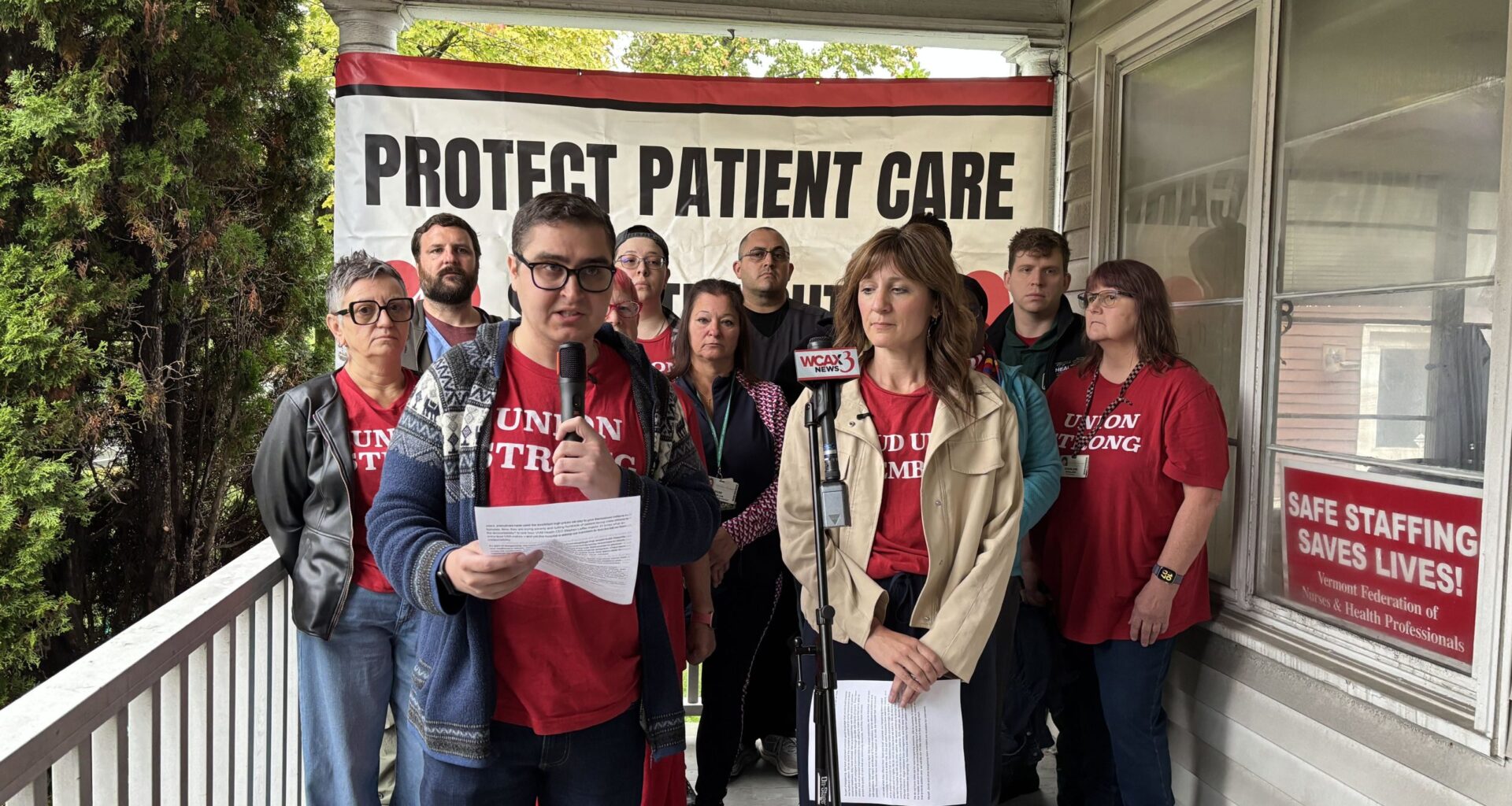
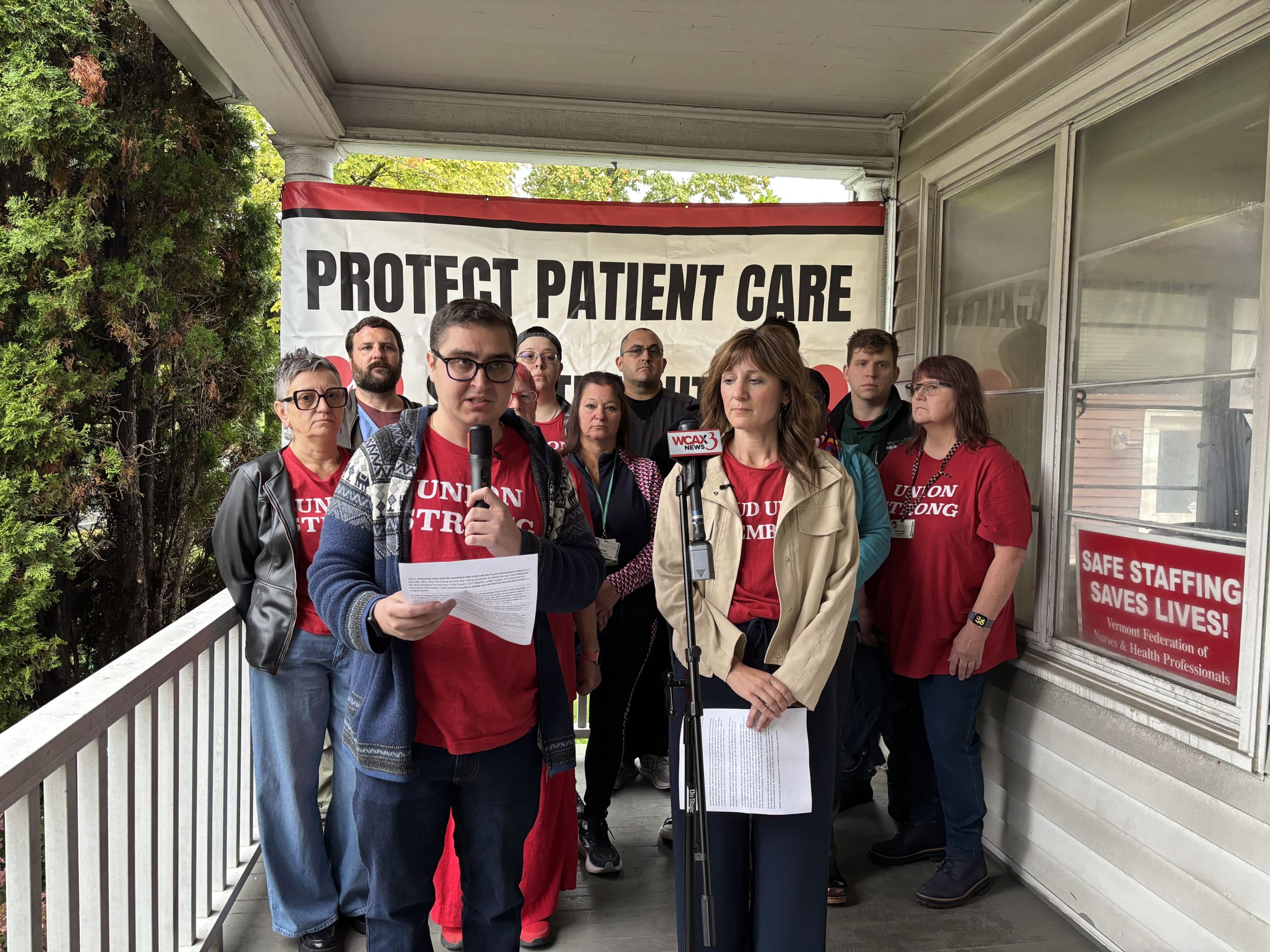
 Vermont Federation of Nurses and Health Professionals President Nicole DiVita, right, and Jacob Berkowitz, president of UVMMC Support Staff United, pictured on Oct. 2. Photo by Olivia Gieger/VTDigger
Updated at 4:24 p.m.
BURLINGTON — Two UVM Medical Center unions said Friday they have voted to authorize a strike.
The vote gives the union leadership the authority to call for a strike and begin the legal notification process before staff officially take to the picket line. Union representatives said 82% of voting members cast ballots in favor of authorizing a strike.
The support staff and technical staff unions represent 3,300 members and have been jointly bargaining over their two separate contracts. They are asking the medical center for more say over staffing levels, as the hospital network undergoes layoffs and restructuring to meet tight financial pressures.
The unions must file a 10-day notice with the Vermont Labor Relations Board before any strike begins, which the bargaining teams have not yet done.
The support staff union includes workers such as licensed nursing assistants and schedulers, while the technical professionals’ union includes roles such as lab and sterilization technicians. They share a union with UVM Medical Center’s nurses, but the nurses’ contract remains in place for another year.
Last week, the hospital’s bargaining team gave the unions its “last, best and final” offer for support and technical staff, which in turn initiated the weeklong vote surrounding strike approval. The two sides have been in negotiations since April.
The authorization is likely to kick off a series of heightened negotiations in the hopes of averting a strike, said Jacob Berkowitz, the president of the hospital’s support staff union.
“We are not going to give a strike notice until every option has been exhausted, but the window is closing,” he said. “I think we can avoid it. I have faith that now that management knows that we have not been kidding, that we can come to a reasonable agreement. But they have to come to the table.”
The hospital also signaled a willingness to negotiate and avert a strike.
“We appreciate that, while the union has secured the votes necessary to strike, they have yet to issue formal notice, which gives us the opportunity to continue productive discussions,” Phil Rau, a spokesperson for the UVM Health network, wrote in a statement. “It is our genuine belief that we can work together to avoid a strike and finalize a strong contract.”
There is no next bargaining session scheduled, both the unions and the hospital confirmed.
If the staff were to strike, the hospital would need to recruit, house and pay premium strike rates to temporary replacement staff. It could cost the health network millions of dollars when it is already projecting $150 million in losses through the 2026 and 2027 fiscal years.
Berkowitz said he thinks if staff strike, it would be the largest strike in Vermont’s healthcare industry history.
Staffing levels and job security have become sticking points in the negotiations, as UVM Health rolls out layoffs across its network of hospitals and healthcare facilities to address its losses.
The current contract for technical staff gives employees the ability to weigh in on staffing shortages and needs. Technical staff are asking for improvements on that agreement, and hospital management is asking for full say over staffing levels, according to the union.
The support staff union has no such agreement in their existing contract and have proposed creating one. In its responses, hospital management has maintained final say on staffing levels, union representatives told VTDigger.
Similarly, both unions are asking hospital management to pay a premium rate to staff working on a floor that’s deemed short-staffed.
“Our proposals maintain patient safety standards, and we have asked the unions to partner with us to develop staffing plans in a more flexible way that is in the best interests of our patients, staff and the hospital’s future,” Rau said in his statement.
Union members worry about the effects that reduced staffing levels could have on daily patient care.
“When we’re short on LNAs, it’s horrific,” Berkowitz said. “That’s where the patient falls happen. That’s where folks don’t get bathed properly. That’s where wound care gets done.”
Brett Rhodes, a licensed nursing assistant and member of the union bargaining team, told VTDigger his top priority is coming to an agreement that allows for staff to have some clarity and say over staffing levels in each department. He worries about the squeeze that short staffing has on patient care in both major and minor ways, such as meals delivered late and cold by nutrition staff spread too thin.
“The echoes of short staffing can be felt in every square inch of that building,” he said.
The unions and the hospital have also reached an impasse over wage increases. The hospital has proposed a 10% increase for the support staff and technical professionals’ unions over the next three years, which includes annual cost-of-living increases. The union is proposing similar increases in a shorter timeframe.
To Berkowitz, the fact that more than 80% of voting members authorized a strike makes it clear that staff are feeling the pressure from the hospital.
“What it says is that people are at their breaking point,” he said.