
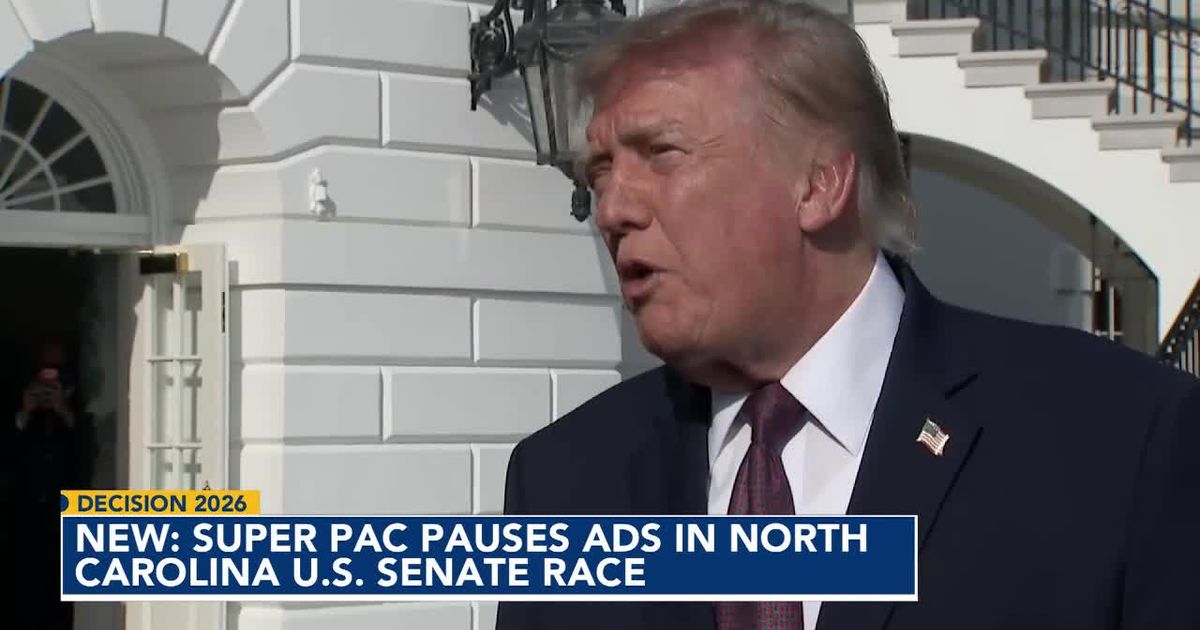
A major Republican political action committee plans to pause spending on U.S. Senate campaign advertising in North Carolina, where polls have consistently shown GOP nominee Michael Whatley trailing Democrat Roy Cooper.
The Senate Leadership Fund in April had pledged to spend $71 million to help Whatley win the North Carolina seat being vacated by Republican U.S. Sen. Thom Tillis. The group now plans to stop its spending on Senate ads in the state and redirect millions of dollars to more competitive races, a person directly familiar with the SLF’s strategy told WRAL on Friday. The group had spent at least at least $30 million in advertising to help Whatley and had reserved at least $15 million more, according to data from AdImpact.
The Senate Leadership Fund’s retreat comes less than two weeks after a separate GOP group, Old North Action, canceled $6.5 million in ad reservations in North Carolina, according to AdImpact, which tracks advertising across the nation. AdImpact data shows Old North still had at least $14.5 million in ad space reserved in North Carolina as of Oct. 2.
Asked about SLF’s decision, President Donald Trump expressed concern for Whatley’s campaign.
“I am worried about him,” Trump told reporters at the White House. Trump endorsed Whatley, a former Republican National Committee chairman: “I hope he wins,” Trump added. “He’s a great man. He was a great leader for the whole Republican Party when I won. And he’d be a great senator.”
Doug Heye, a Republican strategist and former Republican National Committee communications director, called SLF’s move “a blow to the [Whatley] campaign and a tangible recognition that we haven’t seen any real tightening in the polls.”
Every major poll conducted since the beginning of August has shown Cooper with a lead of at least 3 percentage points, according to Real Clear Polling, a group that tracks political surveys across the nation. Polls tracked by the group show Cooper with an average lead of 8 percentage points. Several polls in recent months have shown Cooper with a double-digit lead over Whatley. Green Party candidate Michael Dublin and Libertarian Shannon Bray are also vying for the seat.
Whatley previously downplayed reports that GOP groups were considering diverting money away from North Carolina.
“We are going to continue to get support,” Whatley said at a Sept. 25 event in Pittsboro. “We just had the president down last week. We had Vice President [J.D.] Vance in-state earlier this week. We will get the support we need to win this race.”
Whatley’s campaign echoed that sentiment Friday.
“Roy Cooper recently said about federal elections in North Carolina, ‘Democrats are often ahead until they are not,’” Whatley spokesman DJ Griffin said in a statement, adding: “Undecided voters who break late decide the election in North Carolina and the majority of those late-breakers typically go Republican. We feel confident we have the resources to highlight career politician Roy Cooper’s 40 Years of failures and win in November.”
Jeff Allen, Cooper’s campaign manager, said the race is far from over.
“A Democrat has not won statewide federal office here in nearly two decades, and North Carolina is a 50-50 state,” Allen said in a statement to WRAL. “We’re building a campaign to earn every vote and make sure North Carolinians know that Roy Cooper will fight for them, while Michael Whatley will continue to enrich himself at their expense.”
Spokespeople for SLF and Old North didn’t immediately respond to requests for comment on Friday.
The shifting of funds was not entirely unexpected. North Carolina’s race has been less competitive than initially projected while other U.S. Senate races have become more competitive than expected — and Republicans can maintain control of the chamber even if they lose North Carolina.
At the beginning of the year, North Carolina’s U.S. Senate race was considered one of only four toss-ups by political analysts such as Cook Political Report, a Virginia-based nonpartisan group that studies the competitiveness of elections. But since then, inflation has continued to climb and President Donald Trump began bombing Iran — not only breaking his 2024 pledge that he wouldn’t start a war but also sending gas prices skyrocketing while also leading to hundreds of U.S. casualties so far. That has put some pressure on Republican candidates, particularly those who have strong ties to the president.
Trump’s approval rating has fallen to 43% among likely voters in North Carolina, according to a poll released late last month by High Point University. And about 71% of voters who approve of Trump support Republican Whatley, according to a Catawba College-YouGov survey released this week.
Cook Political Report now says Cooper is favored to win the race, and U.S. Senate races in seven other states are considered more competitive.
Republicans hold 53 seats in the U.S. Senate and can maintain control of the chamber even if they lose three seats because the Republican vice president casts tie-breaking votes. That means the GOP can lose the North Carolina seat and still enjoy a majority in the U.S. Senate, provided they win seats elsewhere.
Cook believes Republican-held seats in Alaska, Iowa, Maine, Ohio and Texas will now be easier for the GOP to defend than North Carolina. Meanwhile, Republicans see opportunities to flip Democrat-held seats in Michigan and New Hampshire.
Republican strategists are closely monitoring polls to see where their investments would make the biggest difference, said Jessica Taylor, a Cook analyst.
“This is the time of triage almost, where you have to sort of monitor it like these were critically ill patients,” Taylor told WRAL. “If they determine in North Carolina that it would take too much money to bring Michael Whatley back into this contest — and that it may not even work — then it’s because they have more critical patients in a place like Iowa or Texas.”
A longtime GOP priority
Keeping North Carolina’s U.S. Senate seats in Republican hands has been a top GOP priority for years, and they’ve had success: No Democrat has won a U.S. Senate election in North Carolina since the late Kay Hagan did so 18 years ago. President Donald Trump carried the state three times.
While some GOP groups have reduced funding levels in the race, political analysts told WRAL they’d be shocked if the GOP were to cede a seat to Democrats without a fight.
Until now, North Carolina has been a prime target for both parties, data from the Federal Election Commission indicates. In the week between Sept. 21 and 28, outside political groups had reported spending more than $192 million on political races nationwide. That includes U.S. Senate and House races.
Ohio was the main target in those seven days, drawing $44 million in outside spending. Texas, Michigan and Iowa came next, followed by North Carolina in fifth place. Various outside groups during that week spent a combined $12.9 million on the Cooper-Whatley race as well as two competitive U.S. House races in the far western and eastern parts of the state.
FEC data shows that from Sept. 21 to Sept. 28 in North Carolina, spending by Republican groups has outpaced spending by Democratic groups by about a 3:1 margin. However, Cooper is less reliant on outside help than Whatley is, since Cooper is also a more proficient fundraiser on a head-to-head level.
The data shows SLF last dropped money on the Cooper-Whatley race on Sept. 22, with a $350,000 buy of more of its anti-Cooper ads. The data also reveals the emergence of a new GOP group jumping into the Cooper-Whatley race, even as SLF bows out. No Going Back PAC Inc. began spending in North Carolina in early September and ramped up toward the end of the month, including more than $3 million on anti-Cooper TV ads and print mailers in the week ending Sept. 28, and $140,000 more on pro-Whatley mailers.
In total, from all groups involved in North Carolina’s U.S. Senate race during that one week in late September, there was $5.8 million spent by Republican groups and $2 million spent by Democratic groups. The candidates themselves have also been spending, but that money is harder to track. Their latest FEC reports are from June, lagging months behind.
‘Protecting the majority’
Senate Majority Leader John Thune, R-SD, last month told Semafor, a Washington D.C.-based online news outlet, that Republicans hadn’t given up on North Carolina but that they would soon reevaluate spending plans.
“We’ll have to obviously make decisions when it comes to resources about where we’re going to invest the most,” Thune told Semafor. “… It’s all about keeping the majority and protecting the majority. So you know there are certain firewall states we just have to win. North Carolina, Georgia are margin-of-error races. It’s challenging in both cases.”
CNN host Jake Tapper on Sunday asked Tillis, North Carolina’s outgoing senator, if Republicans would be better off supporting GOP candidates in more competitive races than the one in North Carolina. Tillis responded: “If you’ve got an aggregate of polls that have you in the high single digits or double digits, it’s approaching a point where it’s going to be difficult to make it up, absent a mistake by the candidates.”
In 2020, Tillis’s contest against Democrat Cal Cunningham was the most expensive U.S. Senate race in history at the time. Tillis surged in the polls only after news emerged in the weeks before the election that Cunningham had cheated on his wife. Tillis didn’t respond to WRAL’s request for an interview, but he noted in his CNN interview that there’s still time for Whatley to catch up to Cooper.
“Members of the other party making a mistake could actually help Whatley maybe get some steam here in the final days of the election,” Tillis said.
Tighter than polls show?
Historically, North Carolina’s U.S. Senate contests tend to end up closer than polls indicate.
In 2022, Republican Ted Budd defeated Democrat Cheri Beasley by 3 percentage points after polls showed Budd leading by an average of 6 percentage points. In 2020, Tillis beat Cunningham by 1.75 percentage points after polls showed Cunningham leading by an average of 2.6 percentage points. In 2016, Republican incumbent U.S.Sen. Richard Burr defeated Democrat Deborah Ross by 5.69 percentage points after polls showed Burr leading by an average of 2 percentage points.
Heye, the former RNC spokesman, worked for Richard Burr’s U.S. Senate campaign in 2004 when the Republican defeated Democrat Erskine Bowles. Burr won by 4 percentage points despite Bowles’s perceived strength. “We never led in a single poll,” Heye recalled.
Heye said North Carolina voters might not notice the pullback in ads. Right now, if you turn on a TV show or online video, you’re likely to see a political ad about Whatley or Cooper. He believes voters will still see ads during popular television programs, such as college football games, albeit at a lower rate. “You just see it once a quarter, not three times a quarter.”
Recent polls have shown Cooper leading by only 5 percentage points, including an Aug. 21 High Point University poll, a Sept. 18 InsiderAdvantage poll, and a Sept. 23 Quantus Insights poll. Polls tend to underestimate Republican support, the Whatley campaign has said.
Cooper has said on multiple occasions that he expects the race to be decided by 1 to 3 percentage points. In an interview with MS NOW earlier this month, Cooper said deceptive attack ads against him helped Whatley narrow the polling gap and that he expects Republican super PACs to continue relying on that strategy through Election Day.
“We know a lot of undecided voters in North Carolina lean Republican,” Cooper told the network, formerly MSNBC. “That’s what’s happened so many times before. We’re not going to let it happen this time, but we need people’s help to make sure that we get across the finish line because we can’t flip the Senate without North Carolina.”
WRAL state government reporter Will Doran contributed