
The Institute for the Study of War (ISW) and The Critical Threats Project (CTP) at the American Enterprise Institute are publishing updates Monday through Friday to provide analysis on the war with Iran and the broader Middle East. Weekday updates cover events from the past 24-hour period, whereas weekend updates are abbreviated and cover the Houthi-Saudi conflict and major breaking developments related to the war with Iran.
Key Takeaways
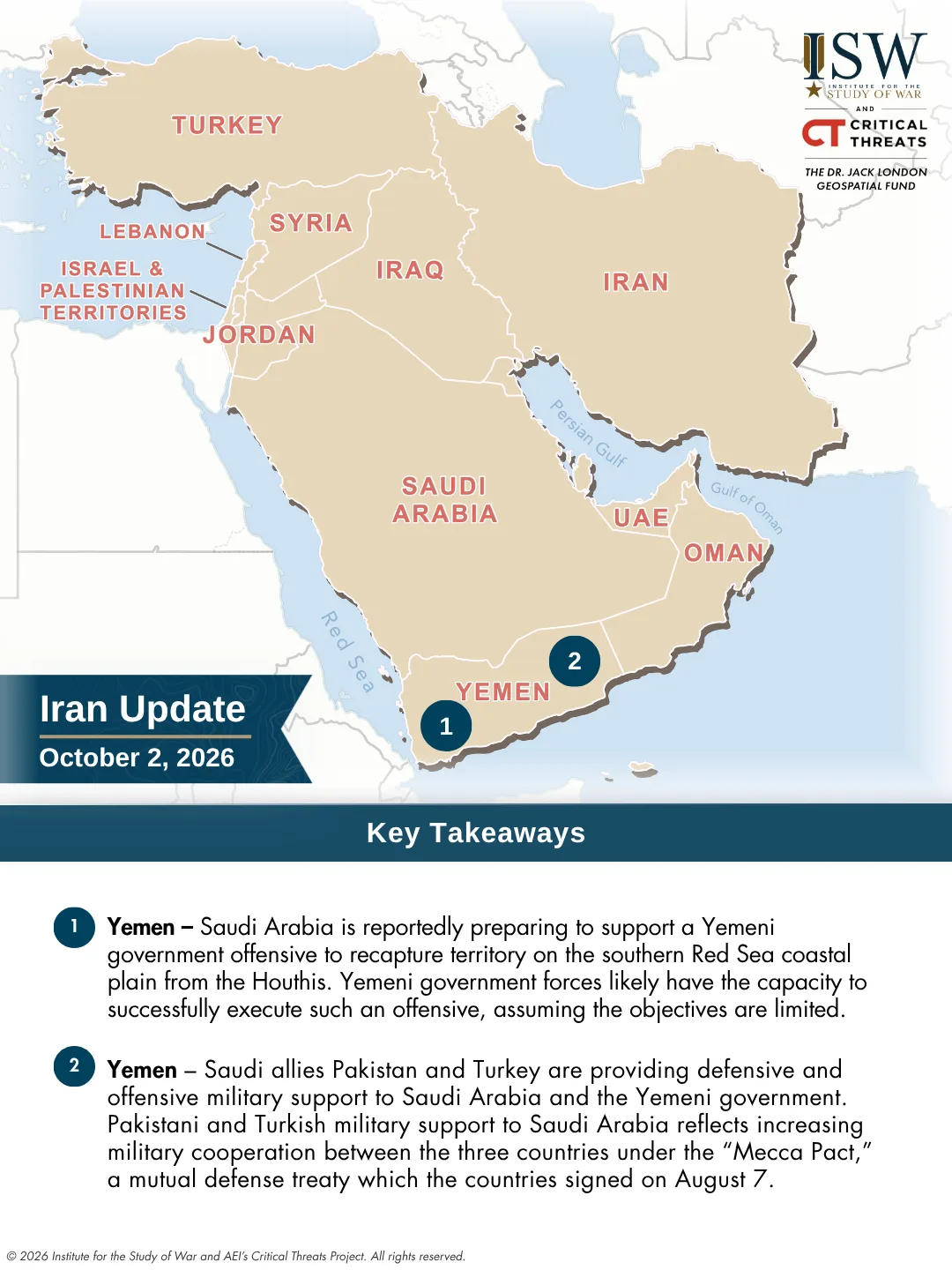
Saudi Arabia is reportedly preparing to support a Yemeni government offensive to recapture territory on the southern Red Sea coastal plain from the Houthis. Yemeni government forces likely have the capacity to successfully execute such an offensive, assuming the objectives are limited.
Saudi allies Pakistan and Turkey are providing defensive and offensive military support to Saudi Arabia and the Yemeni government. Pakistani and Turkish military support to Saudi Arabia reflects increasing military cooperation between the three countries under the “Mecca Pact,” a mutual defense treaty which the countries signed on August 7.
Saudi and Yemeni government-aligned forces are attempting to disrupt Houthi advances in southwestern Yemen by conducting airstrikes targeting Houthi front-line positions, reinforcements, supply centers, and command and control (C2).
Iranian-backed Iraqi militias Kataib Sayyid al Shuhada and Harakat Ansar Allah al Awfiya announced their commitment to an unspecified Shia Coordination Framework disarmament agreement on October 1. The agreement will likely enable the militias to retain access to their weapons, which would not meet US demands regarding militia disarmament.
Toplines
Saudi Arabia is reportedly preparing to support a Yemeni government offensive to recapture territory on the southern Red Sea coastal plain from the Houthis. Yemeni government forces likely have the capacity to successfully execute such an offensive, assuming the objectives are limited. Western and regional officials told Reuters on October 2 that Saudi Arabia plans to coordinate ground operations and provide air support to Yemeni government-aligned forces in an offensive to recapture territory and ports on the Red Sea coast that the Houthis captured between September 9 and 11.[1] This is a relatively limited objective that requires a roughly 50-mile advance in an open coastal plain where the Houthis are at a considerable disadvantage given Saudi airpower. The sources claimed that Saudi leaders are unwilling to enter any truce negotiations with the Houthis as long as the group controls territory along the Bab al Mandeb Strait, which implies some requirement for military operations in order to reverse the present situation.[2] The Houthis view themselves as holding the upper hand in the conflict at present and therefore will not accept a ceasefire unless the Saudis accept their demands.
The offensive could take the form of either one push along the southwestern coast or several simultaneous attacks across the Yemeni frontlines designed to stretch Houthi bandwidth.[3] Multiple offensives would force the Houthis to devote forces to various frontlines. The operational movement required to shift these forces would probably present targets for Saudi interdiction as well.
The Houthis have constructed a variety of defenses along the coast, but these defenses are likely designed to stop ground assaults, not protect defenders against airpower. The Houthis have also constructed and expanded earthwork defenses, such as berms, across the coastal plain’s southeastern edge to defend positions against direct fire and enemy advances, although these defenses are rudimentary.[4] These defenses can be suppressed or destroyed by Saudi airpower, however. The Houthis would require more time to build up sufficient passive defenses to survive effective air strikes against these positions.[5] Some “sufficient” passive defenses could include subterranean complexes, for example. The Houthis will almost certainly build such defenses if given time and space to do so.
Yemeni government forces likely have the capacity to conduct an offensive along the lines described by Reuters, and similarly limited offensives have been successful in the past. The Yemeni government and the factions aligned with it currently face an existential threat from the Houthis that is particularly salient given recent Houthi military victories.[6] These forces, though fractious, have come together in the past to unite and achieve operational success against the Houthis. The United Arab Emirates (UAE) and Saudi Arabia orchestrated a political agreement between competing UAE-backed and Saudi-backed factions in 2021, for example, that enabled an offensive against the Houthis to relieve the pressure on Marib City.[7] This offensive involved the Giants Brigades — presently on the frontline in southwestern Yemen —advancing against the Houthis with Saudi air support.[8] Houthi forces historically have had substantial issues operating in open terrain like the terrain they currently occupy along the southwestern coast. Saudi airpower has frequently conducted effective attacks against the Houthis in similarly open areas. Yemeni government-aligned forces have also previously conducted successful offensives against the Houthis in far less permissive terrain, such as in Aden in 2015.[9]
Yemeni government-aligned forces face challenges that may complicate their efforts to mount a successful offensive against the Houthis, however, and could cause it to fail. Yemeni government-aligned forces are a loose coalition of regional militias and military units that have previously failed to coordinate attacks against the Houthis, and in some cases have engaged one another in combat.[10] Western, regional, and Yemeni officials told Reuters on September 16 that Yemeni government-aligned forces’ internal divisions and weak command-and-control (C2) structure hindered defensive efforts during the Houthis’ coastal plain offensive.[11] This friction is not insurmountable, and the Saudis have over a decade of experience in managing these challenges — particularly ahead of military offensives.
Saudi allies Pakistan and Turkey are providing defensive and offensive military support to Saudi Arabia and the Yemeni government. Pakistani and regional officials told Reuters on October 2 that Pakistan and Turkey have supplied military aid to Saudi Arabia to combat the Houthis in Yemen.[12] A Pakistani official said that Pakistan dispatched four cargo aircraft carrying military equipment to Yemeni government-aligned forces in Aden, the government’s provisional capital, in September.[13] The equipment, including light artillery and drones, could support a Yemeni government offensive against the Houthis on the coastal plain.[14] Pakistan has also recently deployed between 30,000 and 40,000 military personnel, including soldiers and military advisers, to Saudi Arabia, according to a second Pakistani official.[15] The official claimed that the Pakistani military personnel would provide air defense support to Saudi Arabia and help protect Saudi Arabia’s borders.[16] The Houthis are likely to consider a sizeable international force presence on the Saudi Arabia-Yemen border to constitute a significant threat, as the group already engages Yemeni government-aligned forces in combat in areas along the Saudi Arabia-Yemen border and has conducted attacks on Saudi bases near the border.[17] Pakistani and Turkish military support to Saudi Arabia reflects increasing military cooperation between the three countries under the “Mecca Pact,” a mutual defense treaty which the countries signed on August 7.[18]
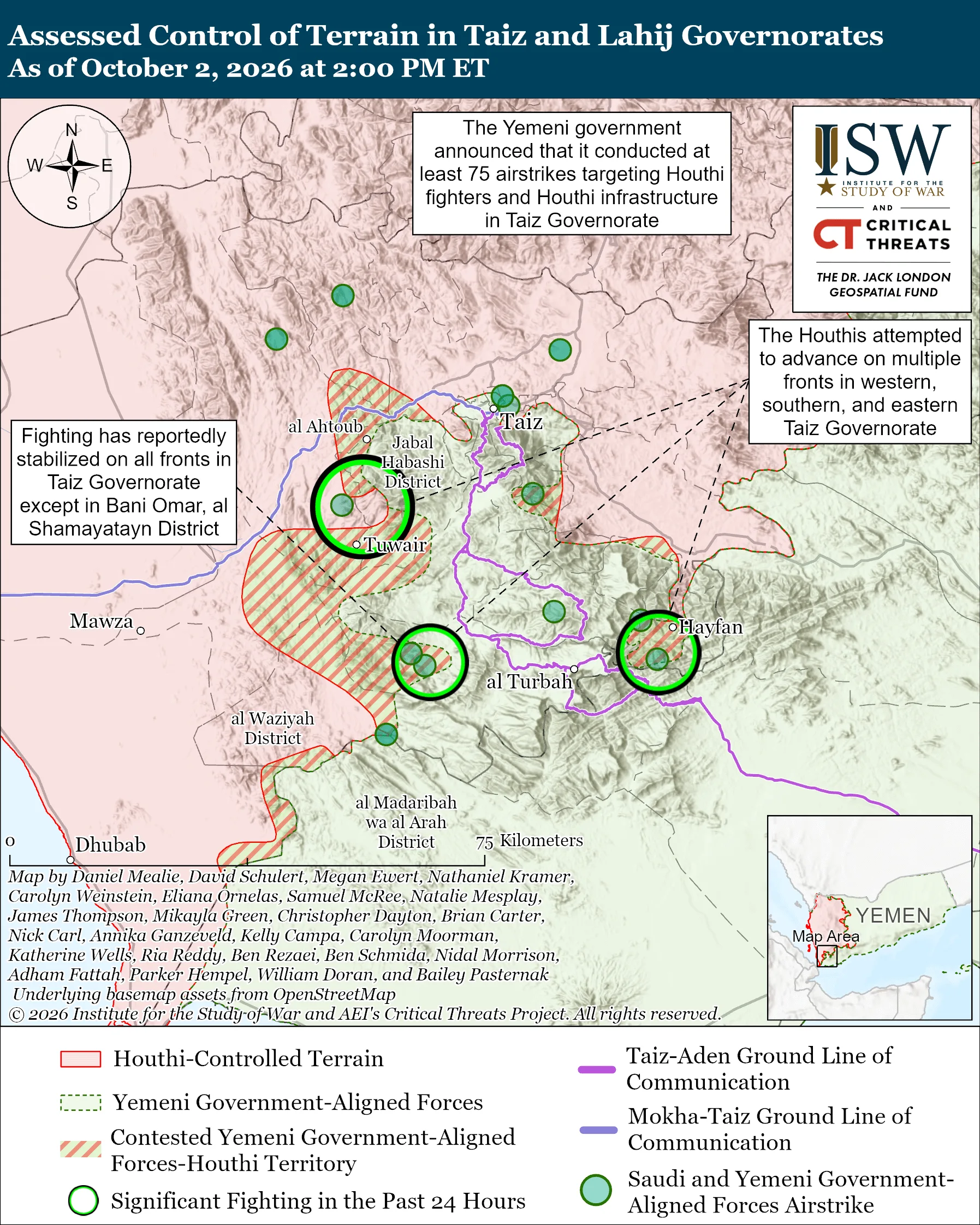
Saudi and Yemeni government-aligned forces are attempting to disrupt Houthi advances in southwestern Yemen by conducting airstrikes targeting Houthi front-line positions, reinforcements, supply centers, and C2. Houthi fighters engaged Yemeni government-aligned forces and attempted to advance on several fronts in western, southern, and eastern Taiz Governorate, which a Marib-based journalist characterized as the Houthis’ “largest coordinated assault” across Taiz, on October 1 and 2.[19] The Houthis likely attempted to sever the Yemeni government’s last ground line of communication (GLOC) between Taiz City and Aden, encircle Taiz City, and seize favorable terrain overlooking the coastal plain.[20] A US-based Yemen analyst reported that most front lines in Taiz Governorate, except for the Bani Omar front in southwestern Taiz Governorate, had “stabilized” by October 2.[21] Yemeni government-aligned forces conducted at least 75 airstrikes targeting Houthi fighters, reinforcements, weapons depots, and sustainment centers throughout Taiz Governorate since ISW-CTP’s last data cutoff on October 1.[22] These strikes targeted both front-line Houthi forces and military resources that are necessary to sustain Houthi advances across Taiz Governorate. The Yemeni government also announced that it struck “high-value targets” in Sanaa City, the Houthi-controlled Yemeni capital.[23] Saudi and Yemeni government airstrikes provide close air support to government-aligned forces, disrupt Houthi sustainment and logistics efforts, and target Houthi leadership and military capabilities central to the group’s offensive campaigns.[24] These strikes advance various objectives in the Saudi-Yemeni government air campaign, which intends to degrade the Houthis’ combat effectiveness.
Iranian-backed Iraqi militias Kataib Sayyid al Shuhada and Harakat Ansar Allah al Awfiya announced their commitment to an unspecified Shia Coordination Framework disarmament agreement on October 1. The agreement will likely enable the militias to retain access to their weapons, which would not meet US demands regarding militia disarmament.[25] The announcements came shortly after Iraqi Prime Minister Ali al Zaydi stated on October 1 that all militias must disarm by June 2027.[26] The text of the framework disarmament agreement that both militias agreed to is not public, but UK-based, Qatari-owned media reported on September 22 that the framework recently approved some details of an Iraqi government plan to disarm Iranian-backed Iraqi militias by June 2027.[27] The plan reportedly calls for the creation of a new directorate within the Popular Mobilization Forces (PMF) to receive militia weapons and determine storage and usage protocols for them under Iraqi federal government supervision.[28] The plan’s inclusion of this stipulation suggests that the plan also requires the militias to surrender their weapons to the PMF. Iranian-backed Iraqi militias’ infiltration of the PMF suggests that the militias would very likely retain access to their weapons under this disarmament plan, however.[29] Kataib Sayyid al Shuhada has also repeatedly refused to disarm for ideological reasons.[30] Kataib Sayyid al Shuhada’s support for this agreement, therefore, further suggests that the group calculates that the agreement will fail to disarm Iranian-backed Iraqi militias.
US and Partner Military Operations
The United States deployed the USS Theodore Roosevelt carrier strike group (CSG) to the Middle East on September 27 to replace the USS George Washington CSG.[31] The United States also deployed an amphibious ready group (ARG) that will replace the ARG presently in the region.
Iranian Strike Campaign
Assessed Iranian War Aims:
Secure international recognition of Iranian control over the Strait of Hormuz
Degrade the US ability and willingness to continue the war
Restore deterrence vis-à -vis the United States and its regional partners
Divide the United States and Israel from the Arab states
Nothing significant to report.
US-Iran Negotiations
Nothing significant to report.
Iranian Domestic Affairs
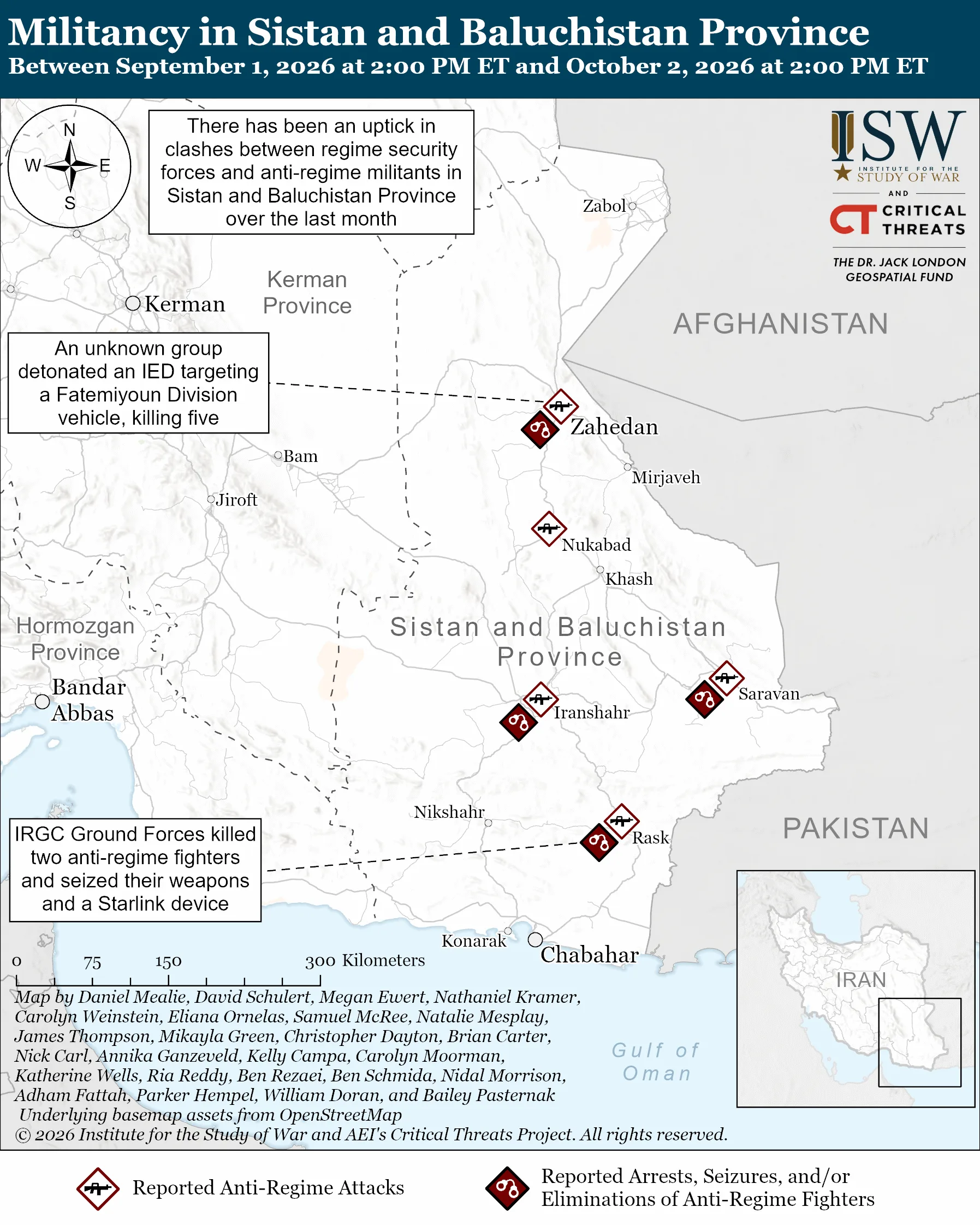
The recent uptick in clashes between Iranian regime security forces and anti-regime fighters in southeastern Iran highlights the threat that anti-regime groups pose to the regime. Islamic Revolutionary Guards Corps- (IRGC) affiliated media reported on October 2 that the IRGC Ground Forces killed two unspecified fighters west of Rask, Sistan and Baluchistan Province, and seized weapons and a Starlink device.[32] The engagement comes after unknown gunmen killed a Law Enforcement Command (LEC) officer at a police checkpoint in Rask on September 30.[33] The BBC, citing local media groups, reported on October 2 that an unknown group separately detonated an IED targeting a Fatemiyoun Division vehicle, killing five.[34] The Fatemiyoun Division is an IRGC Quds Force-controlled Afghan Shia Militia that conducts internal security operations in Sistan and Baluchistan Province.[35] The IED attack comes after the IRGC Ground Forces killed six Mobarizoun Popular Front fighters and seized several explosive devices during a large security operation in the Manzil-e Ab area in Zahedan on October 1.[36] An anti-regime group previously detonated an IED targeting regime security forces on the Zahedan-Khash Road in Sistan and Baluchistan Province on July 26.[37] The IED attacks suggest that at least some of the anti-regime fighters in southeastern Iran have the ability to conduct sophisticated attacks. ISW-CTP noted on September 21 a slight uptick in regime security operations in Sistan and Baluchistan.[38]
The United States is targeting Iran’s remaining channels for trade as the US naval blockade and recent US sanctions on Iranian airlines severely restrict Iran’s ability to trade. The US Treasury Department sanctioned three Iranian railway companies on October 1 to constrain Iran’s ability to trade through alternative routes amid the US naval blockade.[39] The US blockade on Iranian ports has forced Iran to rely more heavily on alternative transport routes, including by rail transport and air. Bloomberg reported in May 2026 that cargo trains from Xi’an, People’s Republic of China, to Tehran increased from roughly one per week before the war to roughly twice a week after the blockade began, for example.[40] The United States also recently imposed secondary sanctions on countries that support Iran’s aviation sector in August and warned foreign firms in September against providing aircraft transfers, cargo services, sales support, or other assistance to sanctioned Iranian carriers.[41] Several countries, including the United Arab Emirates, Georgia, Oman, Azerbaijan, and Iraq, have complied with the US sanctions and restricted or suspended Iranian airline operations in recent days, which will restrict Iran’s international air access and further deepen the regime’s economic isolation.[42]
The US Treasury also sanctioned Iran’s automotive sector on October 1.[43] Iran’s automotive sector is one of Iran’s largest economic sectors outside the oil and gas industries and generates revenue for the Islamic Revolutionary Guards Corps.
Lebanon
Nothing significant to report.
Iraq
See topline section.
Arabian Peninsula
The United States delivered a Patriot missile battery to Saudi Arabia in September to help protect Saudi oil infrastructure, according to two US officials speaking to Axios on October 2.[44] The sources added that the United States also recently delivered one Patriot battery to Qatar in order to help protect Qatari energy infrastructure from possible Iranian attacks.[45] Saudi and allied air defenders, including Greek forces, have been defending Saudi infrastructure.[46] Saudi air defenses intercepted one ballistic missile over Jizan and four ballistic missiles and four drones over Khamis Mushait since ISW-CTP’s last data cutoff.[47] The Houthis likely targeted Saudi energy infrastructure in Jizan. The Houthis have attacked Saudi oil infrastructure since July 2026 to maximize the political and economic costs of the Saudi campaign to compel Saudi Arabia to surrender to Houthi demands.[48]

Endnotes
[1] https://www.reuters.com/world/asia-pacific/saudis-plan-assault-houthis-break-red-sea-chokehold-2026-10-02/ ; https://understandingwar.org/research/middle-east/iran-update-september-10-2026/ ; https://understandingwar.org/research/middle-east/iran-update-september-11-2026/
[2] https://www.reuters.com/world/asia-pacific/saudis-plan-assault-houthis-break-red-sea-chokehold-2026-10-02/
[3] https://www.reuters.com/world/asia-pacific/saudis-plan-assault-houthis-break-red-sea-chokehold-2026-10-02/
[4] https://understandingwar.org/research/middle-east/iran-update-september-17-2026/ ; https://x.com/Osint613/status/2100596574543917534 ; https://x.com/BashaReport/status/2100600411602206777 ; https://x.com/war_cube/status/2106024434788192532
[5] https://understandingwar.org/research/middle-east/iran-update-september-17-2026/
[6] https://understandingwar.org/research/middle-east/iran-update-september-11-2026/ ; https://understandingwar.org/research/middle-east/iran-update-september-24-2026/ ; https://www.aljazeera dot com/news/2026/9/14/why-the-houthi-advance-towards-yemens-marib-taiz-matters ; https://understandingwar.org/research/middle-east/iran-update-september-18-2026/
[7] https://sanaacenter dot org/publications/the-yemen-review/16768 ; https://www.bbc.com/news/world-middle-east-59459750
[8] https://sanaacenter dot org/the-yemen-review/jan-feb-2022/17005 ; https://x.com/alamalikah/status/2105754957848666595
[9] https://www.nytimes.com/2015/07/18/world/middleeast/yemen-aden-houthis-saudi-arabia.html ; https://www.washingtoninstitute.org/policy-analysis/saudi-uae-war-effort-yemen-part-1-operation-golden-arrow-aden
[10] https://x.com/BashaReport/status/1939650450061431076?s=46&t=nQTab-m77zhUUBSh8E68DQ ; https://www.criticalthreats.org/analysis/salafi-jihadi-movement-weekly-update-february-8-2023
[11] https://www.reuters.com/world/middle-east/houthi-blitz-leaves-saudi-arabia-exposed-iran-emboldened-2026-09-16/
[12] https://www.reuters.com/world/asia-pacific/saudis-plan-assault-houthis-break-red-sea-chokehold-2026-10-02/
[13] https://www.reuters.com/world/asia-pacific/saudis-plan-assault-houthis-break-red-sea-chokehold-2026-10-02/
[14] https://www.reuters.com/world/asia-pacific/saudis-plan-assault-houthis-break-red-sea-chokehold-2026-10-02/
[15] https://www.reuters.com/world/asia-pacific/saudis-plan-assault-houthis-break-red-sea-chokehold-2026-10-02/
[16] https://www.reuters.com/world/asia-pacific/saudis-plan-assault-houthis-break-red-sea-chokehold-2026-10-02/
[17] https://x.com/MMY1444/status/2105723059089080685?s=20 ; https://t.me/army21ye/3761 ; https://x.com/TvAlmasirah/status/2102869738162647446
[18] https://www.reuters.com/world/asia-pacific/saudi-arabia-turkey-pakistan-sign-joint-defence-deal-amid-regional-turmoil-2026-08-07/
[19] https://x.com/Alsakaniali/status/2105740933572731079 ; https://x.com/war_cube/status/2105778172868387115 ; https://x.com/Alsakaniali/status/2105763917431529786 ; https://x.com/Alsakaniali/status/2105840294813913382 ; https://x.com/BashaReport/status/2105946384654578106
[20] https://understandingwar.org/research/middle-east/iran-update-september-30-2026/ ; https://understandingwar.org/research/middle-east/iran-update-september-28-2026/
[21] https://x.com/BashaReport/status/2105946384654578106
[22] https://x.com/Yem_army_media/status/2105888684675309807?s=20; ; https://x.com/Yem_army_media/status/2105813467127222433?s=20 ; https://x.com/Yem_army_media/status/2105771225918169502?s=20 ; https://x.com/Yem_army_media/status/2105729871313768951?s=20 ; https://x.com/TvAlmasirah/status/2105943956974604359?s=20 ; https://x.com/TvAlmasirah/status/2105942359657845029?s=20 ; https://x.com/TvAlmasirah/status/2105744839019229600?s=20
[23] https://x.com/Yem_army_media/status/2105776343296385408?s=20
[24] https://understandingwar.org/research/middle-east/iran-update-september-30-2026/
[25] https://t.me/Smedia1/2081 ; https://x.com/Haider_Gharawi/status/2105683769999200294
[26] https://ina dot iq/ar/political/275018-1-2026.html
[27] https://www.alaraby dot co.uk/politics/خاص-تفاصيل-مهلة-30-يونيو-لحصر-سلاح-الفصائل-العراقية
[28] https://www.alaraby dot co.uk/politics/خاص-تفاصيل-مهلة-30-يونيو-لحصر-سلاح-الفصائل-العراقية ; ] https://english.aawsat dot com/arab-world/5318393-arsenal-iraqi-armed-factions-‘remaining-until-2028’ ; https://alhurra dot com/en/35620
[29] https://understandingwar.org/research/middle-east/the-leadership-and-purpose-of-iraqs-popular-mobilization-forces/
[30] https://x.com/alssaanetwork/status/2077015639940649051 ; https://shafaq dot com/ar/سیاسة/كتا-ب-سيد-الشهدا-ندعم-حكومة-الزيدي-لكننا-لن-نسل-م-السلاح
[31] https://thehill.com/policy/defense/6115812-uss-theodore-roosevelt-middle-east-bound-iran-war/ ; https://www.armyrecognition.com/news/navy-news/2026/u-s-aircraft-carrier-uss-theodore-roosevelt-heads-to-middle-east-as-navy-sustains-iran-operations
[32] https://t.me/farsna/465867
[33] https://t.me/mehrnews/418230
[34] https://x.com/bbcpersian/status/2106012124145213865
[35] https://understandingwar.org/research/middle-east/iran-crisis-update-february-3-2023/ ; https://farsi.alarabiya dot net/amp/iran/2026/10/01/%D8%A7%D8%B3%D8%AA%D9%82%D8%B1%D8%A7%D8%B1-%D9%81%D8%A7%D8%B7%D9%85%DB%8C%D9%88%D9%86-%D8%AF%D8%B1-%D8%A8%D9%84%D9%88%DA%86%D8%B3%D8%AA%D8%A7%D9%86-%DA%AF%D8%B4%D8%AA-%D9%87%D8%A7%DB%8C-%D9%85%D8%B3%D9%84%D8%AD%D8%A7%D9%86%D9%87-%D8%AF%D8%B1-%D8%B3%D8%B1%D8%A7%D9%88%D8%A7%D9%86-%D9%88-%D8%B2%D8%A7%D9%87%D8%AF%D8%A7%D9%86-
[36] https://www.tasnimnews dot ir/fa/news/1405/07/09/3710939/; https://t.me/mehrnews/418259 ; https://t.me/jmmfront/183
[37] https://x.com/IranIntl/status/2081445339039752488?s=20
[38] https://understandingwar.org/research/middle-east/iran-update-september-21-2026/
[39] https://home.treasury.gov/news/press-releases/sb0643
[40] https://www.bloomberg.com/news/articles/2026-05-08/iran-turns-to-china-rail-link-to-try-to-bypass-us-blockade
[41] https://home.treasury.gov/news/press-releases/sb0623; https://home.treasury.gov/news/press-releases/sb0614/
[42] https://www.criticalthreats.org/analysis/iran-update-september-25-2026 ; https://t.me/MyAsriran/796492 ; https://www.reuters.com/world/middle-east/three-iraqi-airports-suspend-iranian-flights-starting-friday-sources-state-media-2026-09-25/
[43] https://home.treasury.gov/news/press-releases/sb0643
[44] https://www.axios.com/2026/10/02/patriot-missiles-iran-war-saudi-arabia-qatar
[45] https://www.axios.com/2026/10/02/patriot-missiles-iran-war-saudi-arabia-qatar
[46] https://www.reuters.com/business/aerospace-defense/greek-operated-air-defence-system-shoots-down-ballistic-missile-drone-over-saudi-2026-09-24/ ; https://www.reuters.com/business/aerospace-defense/greek-operated-air-defence-system-shoots-down-drones-over-saudi-2026-08-27/
[47] https://x.com/CJFCSpox/status/2105735066290950540 ; https://x.com/CJFCSpox/status/2105816524858777731 ; https://x.com/CJFCSpox/status/2105734910782624247 ;
https://x.com/CJFCSpox/status/2106078293158142234
[48] https://understandingwar.org/research/middle-east/iran-update-september-16-2026/