
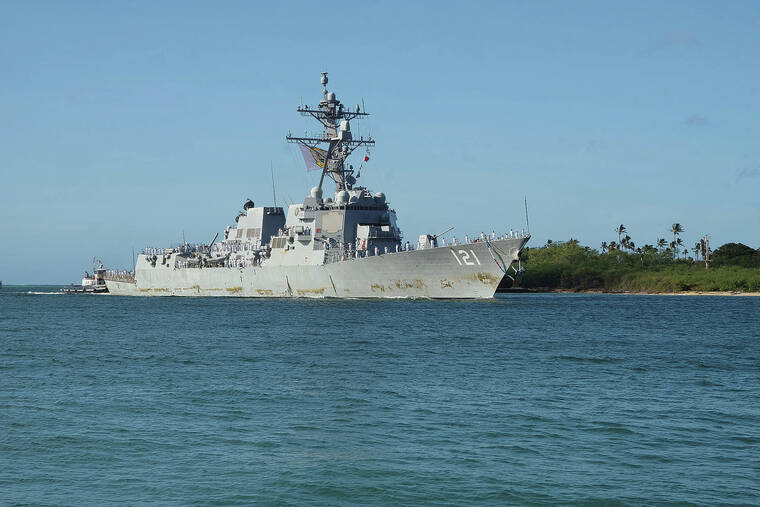
After a grueling 10-month deployment, the USS Frank E. Petersen Jr. returned to Pearl Harbor on Monday.
The destroyer and its crew of 330 sailors had been participating in the U.S. and Israeli war against Iran, coordinating missile defense for the USS Abraham Lincoln Carrier Strike Group as they repelled Iranian drones and missiles.
As the ship — known as “FPJ” to its crew — sailed into port, the rust on its sides offered a visible reminder of the long deployment. As it entered Pearl Harbor, friends and family of the crew cheered and brandished signs welcoming them home.
For Petty Officer 1st Class Ryhean Tucker it was his fourth and longest deployment of his career. As he stood with his wife and two children after reuniting with them, he explained that his previous deployments were closer to 3 months compared to the 10 month he just completed.
He said that “it was challenging, but when we out there, all we can do is try to go day by day.”
“They showed resilience, they showed professionalism, they showed adaptability, and it really goes to show that the U.S. Navy’s greatest advantage is that he’s a U.S. Navy sailor,” said Capt. Casey Mahon, the ship’s commanding officer. “The strike group as a whole, learned a lot of lessons of how to stay at sea for a long period of time.”
The FPJ set sail in December for what was at first slated to be a Pacific-centered deployment. But as the carrier group transited the Pacific, it received orders to sail to the Indian Ocean off the coast of Iran and when the war began on Feb. 28 the destroyer was among those that launched missiles at targets across Iran.
After U.S. and Israeli forces began bombing Iran, Iranian forces and Tehran-backed militant groups in the across the Middle East retaliated with drone and missile strikes, sparking off a regional conflict that has effectively closed off the Strait of Hormuz, a crucial choke point for global oil supplies, throwing energy markets and international shipping into turmoil.
President Donald Trump and senior members of his administration assured Americans the war would be swift and easy to win, but the war has dragged on and oil prices have continued to rise worldwide.
The number of people killed in the conflict is difficult to verify, but strikes have killed more than 3,000 people and at least 19 American Service members have died during operations in support of the war. Some reports suggest as many as 800 American service members may have been wounded in Iranian drone and missile attacks.
The FPJ and its crew were in charge of air and missile defense for the carrier group, making them responsible for coordinating efforts to fend off attacks from Iranian drones and missiles targeting ships. Mahon said the crew “defended dozens of warships against a number of different types of missiles and drones.”
Iran’s use of low-cost, mass produced drones and munitions has vexed American commanders and done damage to American forces and facilities. But Mahon said his crew focused on “the fundamentals.”
“Air defense hasn’t really changed in a lot of ways since since World War II,” he said. “You have a radar, you find the thing, you got to track it. But how these things fly, how they do their missions were very different, and so the crew showed a lot of adaptability to that.”
Mahon said “we learned a lot of lessons on how to deal with that, and we pass those lessons on to the ships that are out there right now.”
The ongoing war has put major strains on U.S. military logistics as Iranian attacks have severely damaged bases in the Middle East. American forces have rapidly burned through munitions in strikes against Iran as well as its interceptors shooting down Iranian missiles and drones, and has had to pull resources from the Pacific and elsewhere.
Over the course of the deployment, reports emerged of food shortages and other challenges among the carrier group as it dragged on longer and longer.
Last week Acting Navy Secretary Hung Cao acknowledged that eight sailors assigned to the carrier group attempted suicide during the deployment in a letter to U.S. Sen. Kirsten Gillibrand. Some jumped overboard and had to be pulled from the ocean.
Mahon said that none of them were members of his crew, but acknowledged that mental health and morale were challenges during the deployment, saying “I think you can’t do a 10-month deployment like that without really having to really dive deep into the resiliency factor.”
He said that “one of the things we did is really making sure people had a chance to express themselves.”
Among the outlets they offered was an idea from the ship’s top enlisted man to put a “meme wall” on the ship where sailors could “put up memes to talk about how their feelings were.” Mahon said “some of them, they’re edgy. They’re edgy memes.”
“Some other things we did, we had kind of group therapy sessions, for lack of a better word, where people would get together in groups to just talk about how they felt,” said Mahon. “No rank, no none of that. Again, when you have those outlets, that’s how we help get through it.”
Among those welcoming their loved ones was Alysha Nishikawa, who was waiting for her husband Max. The two both grew up on Maui. She stood with their son Ace, 10 and daughter Mia, 8 as they waved up to him on the upper decks of the ship.
“It’s been a long time coming but we’ve been generally okay, we’ve got a lot of help from friends and family on Maui,” she said. “I know that when we talk to him, he says he’s okay, and I just let him know we’re okay, so he doesn’t have to worry about us.”
She said that the first things on the list when her husband gets off the ship were to take him out to get fresh sushi, and that their children hoped to take him to Kids City.