
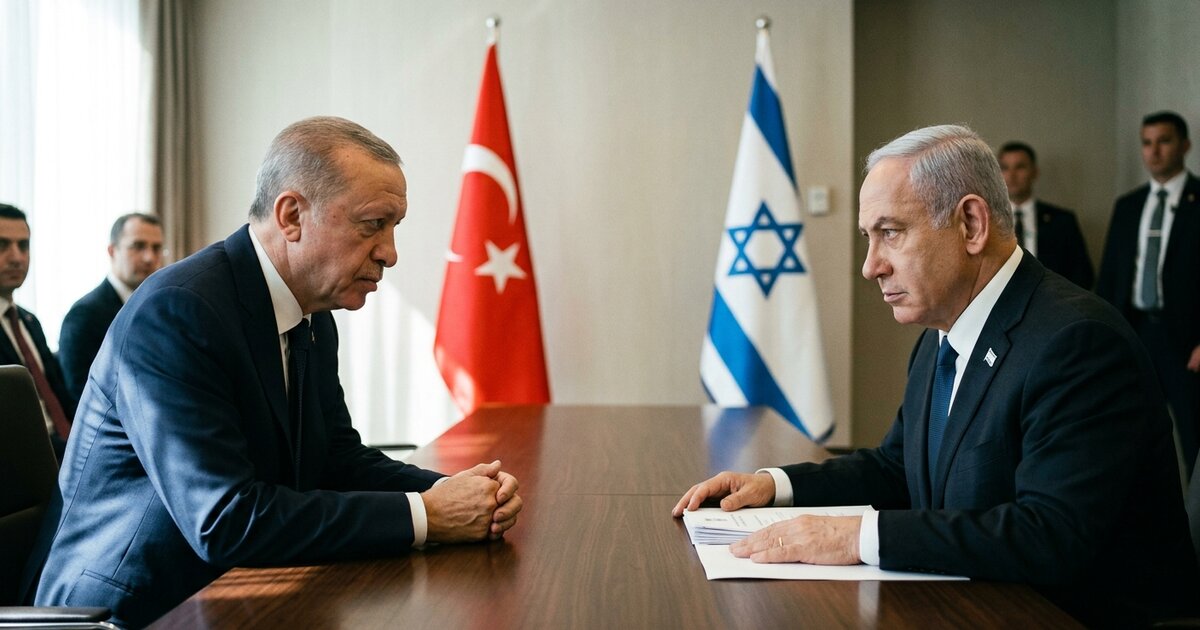
The tension between Israel and Turkey has ebbed somewhat in recent weeks, but it has certainly not gone away.
Erdogan leads global criticism
In his recent speech to the UN General Assembly, Turkish President Recep Tayyip Erdogan spoke with his usual bravado. He made claims about genocide in Gaza and criticized what he considers Israel’s hostile expansionism in the region.
Many heads of state did the same, and Jordan’s King Abdullah II was perhaps the most eloquent among them.
Israeli Prime Minister Benjamin Netanyahu, by contrast, arrived in New York for his address with few friends.
Even U.S. President Donald Trump had no plans to meet him, and Netanyahu will have remembered that, a year ago, most delegations walked out of the giant auditorium as he took the stage.
Trump’s affinities
Erdogan’s New York visit seems to have been successful, and he continues to enjoy praise from Trump. “Sometimes you get along with the toughest people, like him,” Trump said, gesturing at Erdogan, during the Ankara NATO summit in July.
However, Trump’s affinity for Erdogan does not necessarily portend good news for Israel–Turkey relations. It might escalate the hostility between them by making Netanyahu and his far-right Cabinet more frustrated.
Third-party geopolitics
Syria sits at the core of current Israel-Turkey tensions. The two sides are contesting what kind of state will emerge from the December 2024 collapse of the Assad regime. In my view, everything else follows from that contest.
After Bashar al Assad fell, Turkey made itself the principal external patron of the al-Sharaa government. The sides signed a defense and training agreement in August 2025.
Turkey began training Syrian personnel that October. Its military keeps bases in Syria’s north, and in August, Ankara was reported to be preparing a deployment to a Syrian airbase.
August air strikes
That annoyed Israel. Jerusalem wants Syria to remain too weak and decentralized to threaten Israel, with no powerful military on its northern border. That is why Israel has continued to strike Syrian military assets and has held on to the buffer zone it seized inside Syria after Assad fell.
The sharpest recent expression of this regional dispute occurred in mid-August, when Israel carried out strikes on Idlib Province’s Abu al-Duhur airbase.
According to Syrian state television, there were eight total strikes, which Israel justified as preempting a Turkish deployment. Turkish sources denied any such intent.
Washington’s ambassador to Turkey, Tom Barrack, publicly called the strikes an unnecessary escalation and added that the United States had reviewed Israel’s intelligence, and Washington was told no Turkish deployment was happening.
Disputed regional order
Fundamentally, the current tensions stem from the wholly divergent views Turkey and Israel hold of the regional order. Turkey favors an integrated, stable region led by strong central states. Israel’s current leaders prefer fragmented neighbors that are unable to threaten it.
There is huge distrust between the two sides, and extremely dangerous rhetoric, in that context, can bring unintended consequences.
Each holds an unspoken conviction that the other is not merely a regional actor, but an aspiring hegemon seeking to reshape the Middle East in its own image.
Who is the aspiring hegemon?
Turkey sees that Israel wants a chaotic neighborhood to ensure its own security, and that it views any Turkish attempt to stabilize or centralize regional states as a direct threat to Israeli freedom of action.
Conversely, Israel assumes Erdogan’s “status quo” regionalism is a thin veil for neo-Ottoman expansionism. It believes Turkey intends to tether Syria and other neighbors under a yoke of subservience. Eventually, this would constrain Israel’s strategic depth and its ability to counter Iranian influence.
Both sides operate on the silent premise that the other’s regional vision is incompatible with their own survival — it is a zero-sum game.
Electoral implications
How will Israel’s Oct. 27 elections affect the relationship with Turkey?
It may be that the current Netanyahu government has been pulled to the far right and holds a deeply pessimistic and cautious worldview, viewing regional threats through a lens of existential vulnerability in part because of the trauma of October 7.
But . . . Israel’s military and strategic decisions are often driven by institutional security assessments rather than direct political calculation. Yes, the hawkish environment could abate if Netanyahu leaves office. But seeing Turkey as a threat, I’m afraid, will continue.
Dangers of miscalculation
Could the push and pull between the two sides turn into a more direct confrontation? I am not as optimistic as some experts that it will not.
The history of wars and conflicts is full of contingent moments that change everything. When tensions are this high, there are many things that could go wrong and lead to a head-to-head clash, especially in Syria.
My main hope is that Turkey believes it is winning in Syria without having to fight for it. Why open a front with Israel? A direct clash with Israel would put at risk the al-Sharaa government the Turkish government has spent nearly two years building up, would hand Netanyahu the confrontation that suits his reelection campaign, and would strain the relationship with the United States at exactly the moment Trump is dangling the sale of the F-35 fifth-generation fighter aircraft Turkey has wanted for years.
Sitting still costs the Turkish government little, and escalating with Israel would cost it a great deal. I believe the Erdogan regime thinks time is on its side — it is behaving much like a power that thinks that. But . . . and it is a big BUT . . . there is surely a limit to Turkey’s restraint.