
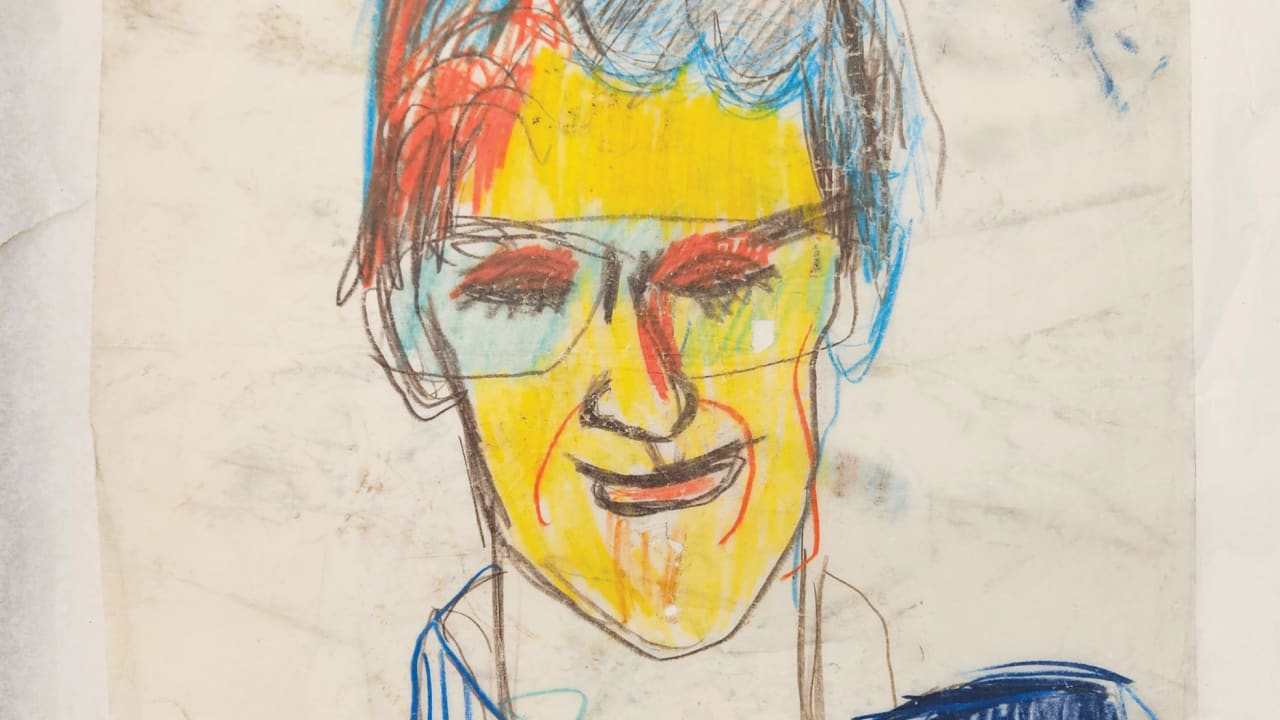
Three pairs of artists stand at the center of Something to Hold On To, which opened recently at the Genia Schreiber University Art Gallery at Tel Aviv University.
They are Hedwig Grossman and Rudi Lehmann, who came from Germany in 1933; Siona Shimshi and Jachin Hirsch, born in Tel Aviv in the 1930s; and Menashe Kadishman and Igael Tumarkin, who studied with Lehmann in the 1950s and wrote to him for decades.
What hangs on the walls is what they kept about one another – letters, diaries, sketchbooks, and photographs from the Ziffer House Archive: Documentation and Research Center of Israeli Visual Arts, now on public view for the first time.
The exhibition title, Something to Hold On To, came out of a conversation between the two curators during the Israel-Hamas War. Hila Cooper, who curated the show with Roni Kochavi, noted that when they began working on the exhibition, there were still hostages being held in Gaza.
New exhibition shows never-before-seen private work from six Israeli artists
“We tried to talk about what we were feeling at that time and what had become important to us in such a turbulent and difficult period.” For Cooper, it was the closeness of relationships, the support that family or friends gave each other.
 TAU RANKED seventh among the world’s top 100 universities in the number of alumni entrepreneurs who have founded venture capital-backed companies. (credit: TAU)
“I was also swept into the ‘baby boom’ of the war, and there was my third child, the little one who is now in kindergarten. He was with me right from the moment we started working on the exhibition, and he was really my something to hold on to.”
‘Thanks to those who chose not to throw them’
The title has a second meaning. “We work with archival materials,” Cooper said. “These collections exist today because somebody held on to these materials. The photographs, letters, sketches, work processes, correspondence between artists, drawings that artists gave one another. It survived and reached us, and today it is an important document, thanks to those who chose not to throw them.”
Grossman and Lehmann are the pair of artists to whom Cooper feels personally connected. “Hedwig Grossman is considered the mother of the artistic ceramics field in Israel, and Rudi Lehmann was a sculptor. She was Jewish, but he was not. They were born in Germany, and they came in the aliyah before the war. He was swept into the Zionist story following Hedwig, who was part of the Zionist movement in Germany. Here they really built an artistic hub over the years.”
“She was known as a rigid woman, very pedantic,” Cooper said. But what the drawers held was different. “When we dived into the materials, we felt we were really discovering a woman,” she noted. “Suddenly, when you see the materials in the archive, you meet a much softer and more romantic side of her. It is the personal materials that allow you to understand the professional practice in a different context.”
Shimshi and Hirsch, a generation later, left a different kind of record. Hirsch was a photographer and a documentarian, and his camera was trained on his partner. “She was his constant subject and muse,” Cooper said. There is plenty of evidence in the exhibition: photographs of her in New York in the early 1960s, at the Williams House in Eilat in 1965, in Paris, and asleep, taken over the years – even when she was older.
Kadishman and Tumarkin came into the show through the back door, out of other people’s archives. “We found that both of them had a central presence in the collections, both in Hedwig and Rudi’s and in Siona and Jachin’s, because Rudi was Kadishman and Tumarkin’s teacher,” Cooper said. “We saw how they stayed in touch with him for years, for decades, how they exchanged letters, and how they valued him. It is not something to be taken for granted, to stay in touch with your teacher from the very beginning of the road and to keep it up for decades.”
The exhibition feels like a ‘rabbit hole’
Kadishman also put it into pictures. In the letters he sent to Lehmann and Grossman, he drew himself as a figure smaller than the great Lehmann, holding a little flower, a motif Lehmann had used in his early portraits. It was Kadishman’s homage to his teacher.
Tumarkin and Lehmann also shared a language. “Both of them came from Germany, and there was the matter of the language,” Cooper said. “I say this carefully, but Tumarkin saw in Rudi some kind of father figure. He sent him letters later on, and you see that he wanted Rudi to appreciate him.”
Editing all of this into a single exhibition was the hard part; the collections run to tens of thousands of items. It is work she calls Sisyphean and loves. “You can go in there and never come out, like a rabbit hole,” she said.
Something to Hold On To, Genia Schreiber University Art Gallery, 64 Haim Levanon St., TAU, next to Gate 7. Curators: Roni Kochavi and Hila Cooper. Runs through the end of January 2027. Free entry. Tue. and Fri., 10 a.m.-2 p.m.; Wed., 10 a.m.-4 p.m.; Thurs., 10 a.m.-7 p.m.