
US Secretary of Defense Pete Hegseth warned Iran that US President Donald Trump remains determined to prevent it from acquiring nuclear weapons, cautioning that Tehran must choose between relinquishing its nuclear ambitions and facing further American action.
Speaking to reporters on Saturday, Hegseth also declined to confirm whether the United States intends to deploy a third aircraft carrier to the region, saying his responsibility is to ensure that Trump retains the widest possible range of military options.
Asked directly whether three aircraft carriers would be deployed, Hegseth replied: “It’s a fair question, but I will never answer it.”
“I’d say maximizing the decision space for the commander in chief at any point is my job, while also recognizing the way we balance global demands as a force with global responsibilities,” he explained.
“So the president’s going to have options. Let’s put it that way, and I’ll leave it there.”
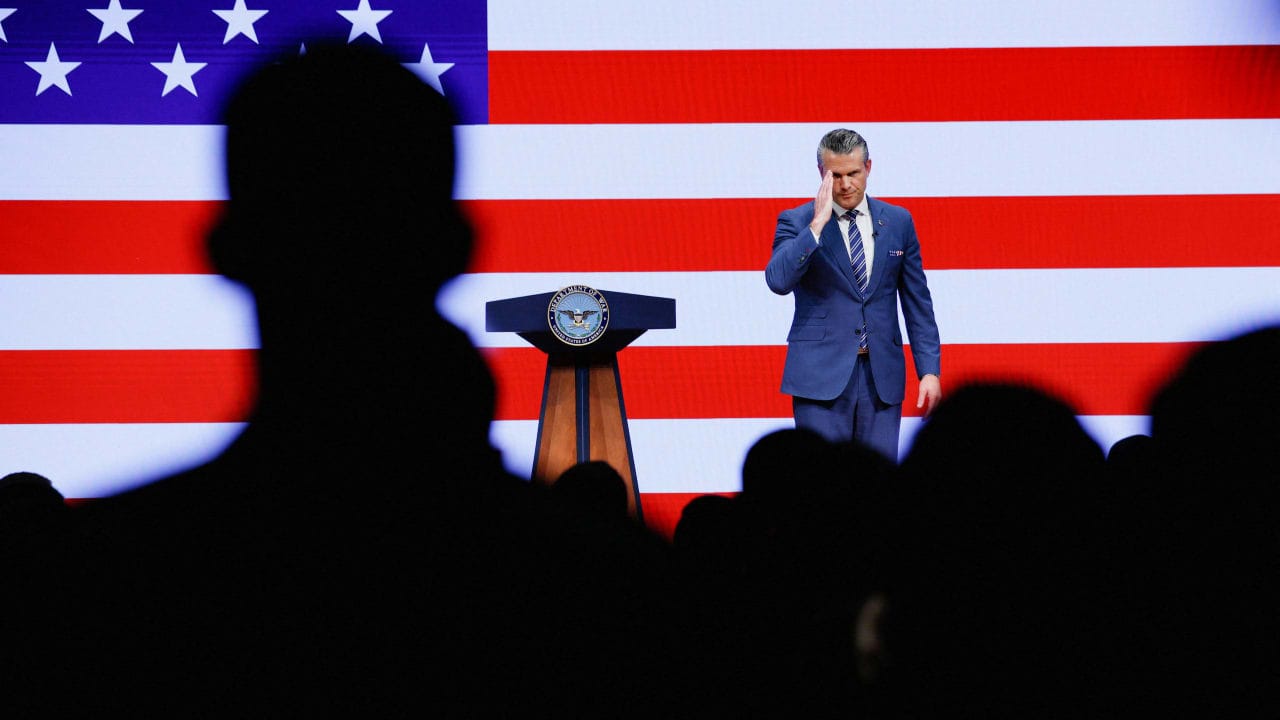
 US Defense Secretary Pete Hegseth delivers his 2026 ”State of the Force” address to US junior officers and enlisted leaders at Marine Corps Base Quantico in Quantico, Virginia, US, September 30, 2026. (credit: REUTERS/Evan Vucci)‘Iran will never, ever, ever have a nuclear weapon’
Hegseth delivered his strongest warning when asked to clarify the administration’s message to Tehran.
“Well, the message is very simple: Iran will never, ever, ever have a nuclear weapon,” he said.
“President Trump is hell-bent and determined to ensure that they do not. They will not. If they want to blink and think that he doesn’t mean it, it would be to their detriment.”
He added that Iran had reached a decision point.
“So now’s a moment where they can decide to give it up the way that they should, without any leverage that they have, or it may have to happen the hard way.”
Earlier in the exchange, Hegseth was asked whether he expected military operations to conclude before the end of the year. He declined to commit to a timetable, deferring the decision to Trump.
He nevertheless contrasted the administration’s approach with previous American military campaigns that, he said, had continued for years or decades without clearly defined objectives or an identifiable end state.
“As we’ve stated from the beginning, Iran will never have a nuclear bomb. Full stop. That is a vital national interest of the United States of America,” Hegseth said, citing Operation Midnight Hammer and Operation Epic Fury.
He stressed that Trump would not allow operations to continue unnecessarily, arguing that the administration understands its mission and has the capabilities required to accomplish it.
Hegseth acknowledges Iranian efforts to rebuild missile capabilities
Asked whether Washington had evidence that Iran was attempting to reconstitute its missile capabilities and launchers, Hegseth said the United States was monitoring developments in real time.
He acknowledged that Tehran would attempt to rebuild its military infrastructure but maintained that the damage inflicted during Operation Epic Fury had severely complicated those efforts.
“Think of it this way, their Raytheons, their Boeings, their Lockheeds, their Northrop Grummans are what was destroyed in Epic Fury,” he said, referring to the Iranian equivalents of major American defense manufacturers.
“So they’re going to attempt to reconstitute, and they’re a terror state. So they’re going to always attempt to reconstitute, but when you’ve been so destroyed and degraded the way that they have, it’s a very slow process, a very frustrating process, and we see that, and we understand that.”
Hegseth argued that the extent of the damage to Iran’s defense industrial base, economy, and ability to rebuild would continue to constrain Tehran’s military options.
‘They don’t control the Strait of Hormuz, we do’
The defense secretary also emphasized American control over the Strait of Hormuz, describing the US blockade as a central component of Washington’s pressure campaign against Iran.
“Iran wants to play games with things like the Strait of Hormuz. They don’t control it. We do,” Hegseth said.
“Our blockade has been ironclad, and we’re running almost at pre-war levels every single night through that,” he added, referring to maritime throughput.
Hegseth asserted that Iran’s naval and air capabilities had been so extensively degraded that it could no longer effectively challenge American dominance over the strategic waterway.
“It’s pretty tough for them to control the Strait of Hormuz when they don’t have a navy. They don’t have fast boats, and they’ve got no air force,” he said.
“And then we’ve done such incredible damage to their ability to see and sense the Strait of Hormuz. We control it. We dominate it in both an asymmetric and a conventional sense.”
He added that Washington was capable of maintaining the blockade for as long as necessary and adapting its implementation according to operational requirements.
“The longer we hold the blockade, and we can hold it as long as we need to. Trust me, we can adapt that as necessary,” he said, arguing that the pressure would further restrict Tehran’s remaining options.
Asked whether the conflict could ultimately have a military solution, Hegseth said it could be resolved in multiple ways and maintained that Trump had repeatedly offered Iran an opportunity to reach an agreement through negotiations.
“The president has given Iran every opportunity to do it at the table,” he said.
However, he reiterated that the combination of American military strikes and the continuing blockade had left Washington in a strong position.
“Iran ought to make the right choice. If they don’t, the president’s going to have all the options he needs on the table,” Hegseth concluded.