
JUANA SUMMERS, HOST:
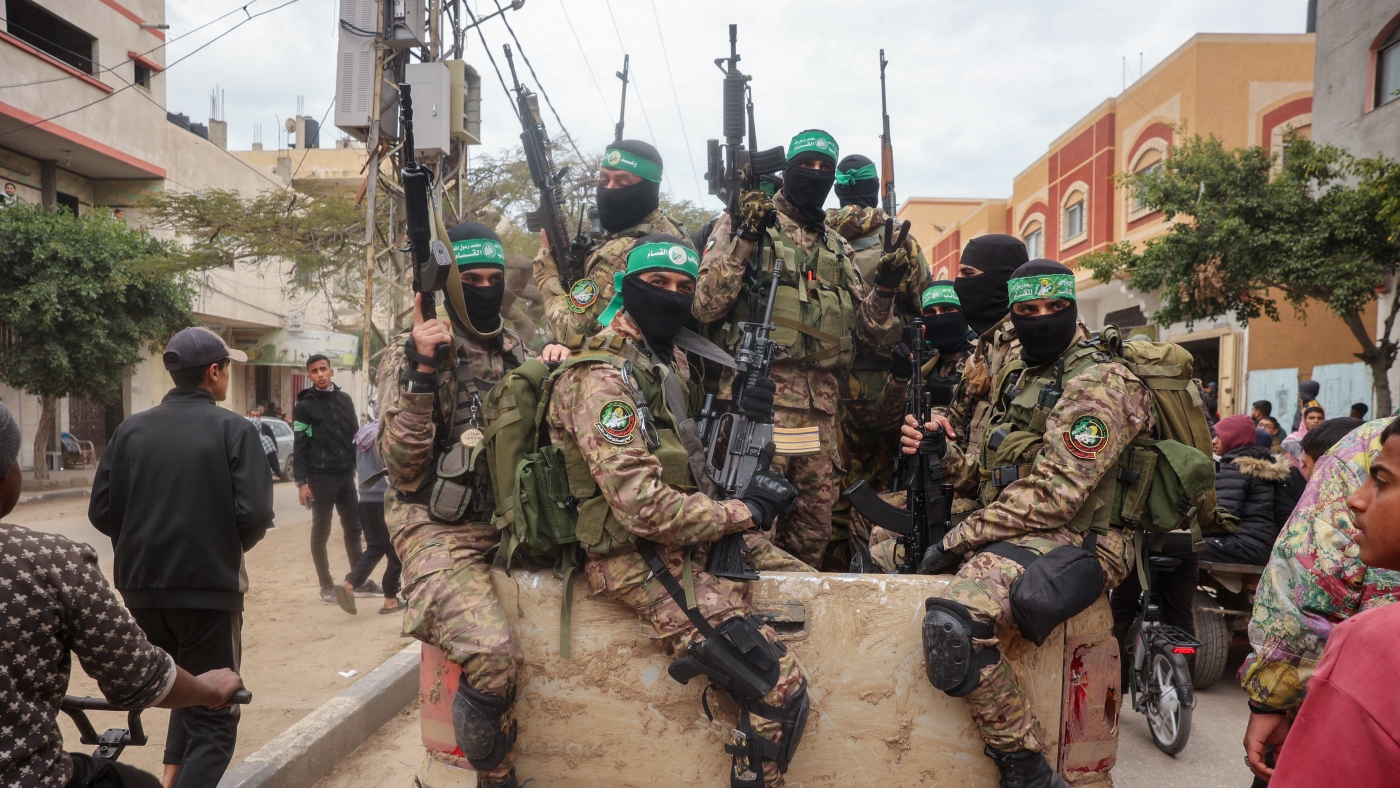
This week, Hamas accepted a proposal from Egypt and Qatar for a ceasefire in Gaza. Now Israel is considering its response. What motivated Hamas to make that decision now, and what is its strategy for the future? NPR’s Daniel Estrin reports.
DANIEL ESTRIN, BYLINE: Nearly two years after it launched the surprise attack that sparked the war with Israel, Hamas is facing its worst crisis yet, says Palestinian political analyst and former militant Esmat Mansour. He’s in touch with figures close to Hamas.
ESMAT MANSOUR: (Speaking Arabic).
ESTRIN: “Hamas faces pressures from all directions,” he says. “From Israel, from the street, from the West and from Arab countries.”
Last month, for the first time, the 22 countries of the Arab League called in a statement for Hamas to give up control of Gaza and hand over its weapons.
MANSOUR: (Speaking Arabic).
ESTRIN: “Hamas’ main goal is to exist and only to exist,” Mansour says.
Israel is trying to end Hamas’ existence as a military and governing force in Gaza. Hamas knows militarily Israel is stronger. Mansour says one thing that plays to Hamas’ advantage is Israelis’ impatience as the war drags on.
MANSOUR: (Speaking Arabic).
ESTRIN: He says, “Israeli soldiers will get tired. Israelis will increasingly protest to end the war. International pressure will increase on Israel. And all Hamas must do is preserve its one bargaining chip – the hostages.”
Ibrahim al-Madhoun, a Palestinian analyst in Turkey who’s close to Hamas, says Hamas is trying to improve its relations with Arab governments.
IBRAHIM AL-MADHOUN: (Speaking Arabic).
ESTRIN: He says the main disagreement between Hamas and the Arab countries is using weapons against Israel, but he says their governments realize the Palestinian cause is important to their people, and Hamas is the primary player.
Samir Ghattas is an Egyptian security analyst who studies Hamas and Gaza. He says Hamas is wrong – Arabs support Gazans, not Hamas.
SAMIR GHATTAS: (Speaking Arabic).
ESTRIN: “Hamas has no real military capabilities left,” he says, “just localized guerrilla warfare.” But Hamas also refuses to give up its weapons and join the internationally recognized Palestinian leadership committed to diplomacy, so Hamas is stepping up its fighting.
On Wednesday, a group of Hamas militants stormed an Israeli military position in southern Gaza, leading to close-range fighting. Most of the Hamas militants were killed, according to the Israeli military. Israel thinks Hamas may have tried to abduct a soldier. The ambush demonstrates how Hamas is still willing to fight at all costs.
In Gaza, 35-year-old Mohammed Ahmad tells NPR producer Anas Baba that Hamas cannot afford to give up its weapons now.
MOHAMMED AHMAD: (Speaking Arabic).
ESTRIN: “No one will accept during a battle and a continuous fight with the occupation to surrender their weapons,” he says. “The Israelis will not leave Gaza if Hamas surrenders its weapons.”
Twenty-two-year-old Amjad Saleh says civilians, not Hamas, are paying the price of the war.
AMJAD SALEH: (Non-English language spoken).
ESTRIN: “Hamas is not here at all. Their leaders are either abroad or in the tunnels underground in Gaza. They conduct their operations, and we get punished for it,” he says. “The plan for displacement is coming.”
That displacement is Palestinians’ biggest concern now. Israel’s military is calling up tens of thousands more soldiers and vowing in the coming weeks to take control of Gaza City and drive out hundreds of thousands of Palestinians to southern Gaza, near the Egyptian border. Israel eventually seeks to send as many Palestinians as possible to other countries. That could be one major driving factor for Egypt to help propose a new ceasefire and for Hamas to support it, to hold off the bigger concern of a mass displacement of Palestinians from Gaza into Egypt or beyond.
Daniel Estrin, NPR News.
(SOUNDBITE OF MUSIC)
Copyright © 2025 NPR. All rights reserved. Visit our website terms of use and permissions pages at www.npr.org for further information.
Accuracy and availability of NPR transcripts may vary. Transcript text may be revised to correct errors or match updates to audio. Audio on npr.org may be edited after its original broadcast or publication. The authoritative record of NPR’s programming is the audio record.