
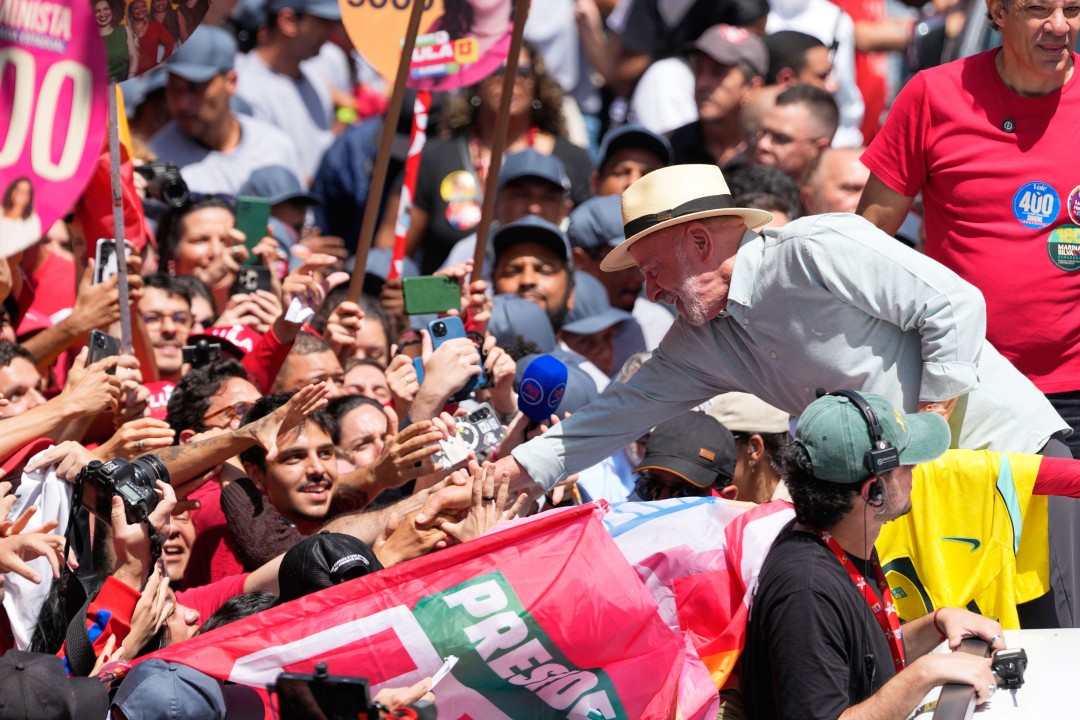
Brazil’s presidential election on Sunday isn’t just about who runs the government—it’s a test of President Trump’s sway in Latin America and the future of the Amazon, Axios reports. President Luiz Inacio Lula da Silva faces Sen. Flavio Bolsonaro, heir to the movement built by his father, Jair Bolsonaro, who is serving a 27-year sentence over a coup plot and is barred from office. Trump, who slapped new tariffs on Brazilian goods this summer and briefly sanctioned a Brazilian Supreme Court justice involved in Jair Bolsonaro’s prosecution, said he’s watching the contest “very closely” but hasn’t backed a candidate. Polls show Lula and the younger Bolsonaro essentially tied and probably headed to a runoff.
The differences: The stakes extend far beyond domestic politics. Brazil controls most of the Amazon, where deforestation has dropped sharply under Lula even as he pushes new offshore oil. Flávio Bolsonaro questions climate science and wants looser environmental rules, tougher crime policies, tax cuts, and deeper alignment with Trump’s “Shield of the Americas” initiative. Lula, seeking a fourth nonconsecutive term, is running on left-wing economic policies and social spending. If no one tops 50% of valid votes, the race heads to an Oct. 25 runoff.
The voting: Almost 160 million eligible voters will use electronic voting machines to punch in digits corresponding to their candidates, preparing number-heavy lists, per the AP. Electronic voting machines were adopted in the 1990s to combat fraud. In earlier local elections, ballot boxes were stuffed or stolen, and paper ballots were routinely falsified, according to Brazil’s electoral authority. The country held no direct presidential elections between 1960 and 1989, a period that included military rule from 1964 to 1985. Now, results are reported mere hours after polls close. In the lead-up to the 2022 vote, Jair Bolsonaro repeatedly cast unfounded doubts on Brazil’s electronic voting system. No significant fraud has ever been detected.