
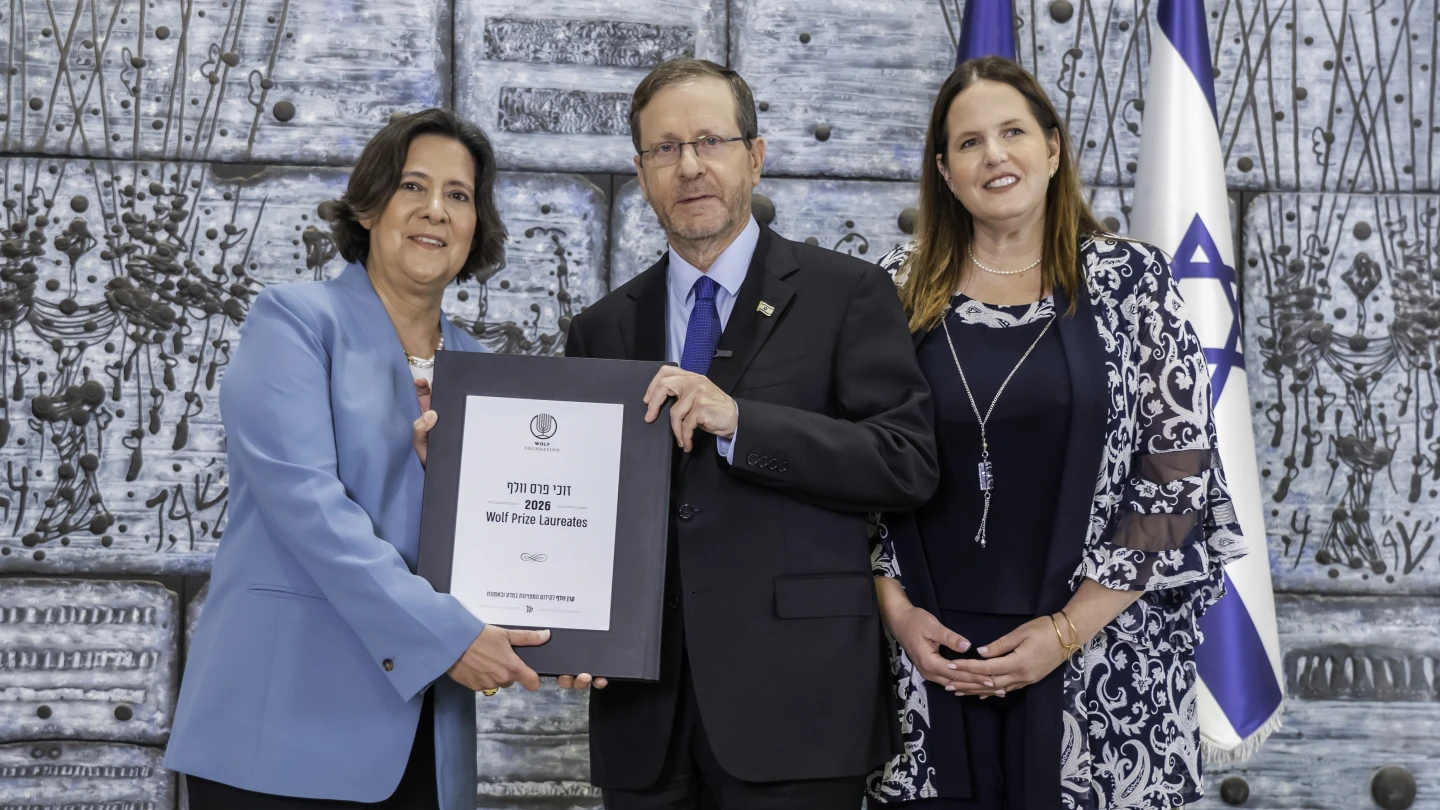
(Oct. 4, 2026 / Wolf Foundation)
The Wolf Prize is presented annually by the president of the State of Israel on behalf of the Israeli Wolf Foundation. It honors scientists and artists from around the world for significant contributions to humanity, irrespective of religion, race or gender.
The 2026 Wolf Prize laureates were announced at the President’s Residence in Jerusalem, in the presence of President of the State of Israel Isaac Herzog and Osnat Luxenburg, acting chair of the Wolf Foundation Council.
This year, prizes were awarded in medicine, physics, chemistry and mathematics to eight laureates from around the world. The laureates will receive their awards at the Wolf Prize Ceremony at the Knesset in Jerusalem in June 2027.
The 2026 Wolf Prize laureates
Wolf Prize in Medicine
The 2026 Wolf Prize in Medicine is awarded to Chilean-born Charles S. Zuker (Columbia University, United States):
“For revolutionizing our understanding of taste, the last of our senses to be elucidated.”
Zuker revolutionized our understanding of the sense of taste. His research uncovered the cells and receptors that allow us to detect the five basic taste qualities—sweet, bitter, salty, sour and umami—and revealed how this information is transmitted to and represented in the brain.
Through experiments, he demonstrated that taste perception is determined not only by the receptor that detects a particular substance, but critically by the neural pathway to which the sensory cell is connected. His work transformed taste from one of the least understood sensory systems into one whose molecular and neural mechanisms are understood in greater detail.
Wolf Prize in Physics
The 2026 Wolf Prize in Physics is awarded jointly to German physicist Immanuel Bloch (Max Planck Institute of Quantum Optics and LMU Munich, Germany) and Chinese-born physicist Jun Ye (National Institute of Standards and Technology, United States):
“For transformative, widely applicable advances in the control of ultracold atomic systems.”
Bloch and Ye have achieved advances in our ability to control atoms and explore the quantum world with high precision.
Bloch transformed ultracold atoms into a platform for simulating and investigating complex quantum systems, helping to establish quantum simulation as a field of modern physics. Ye has led the development of highly accurate and stable optical atomic clocks, enabling measurements of time and frequency at high levels of precision and opening new possibilities for testing fundamental physics.
Together, their achievements reflect a transition in modern physics from observing the quantum world to controlling, measuring and harnessing it for scientific discovery and emerging technologies.
Wolf Prize in Chemistry
The 2026 Wolf Prize in Chemistry is awarded jointly to Indian-born Shankar Balasubramanian and British David Klenerman (both of the University of Cambridge, United Kingdom), together with French Pascal Mayer:
“For developing impactful, low-cost, large-scale DNA sequencing methods for genomic medicine.”
Balasubramanian, Klenerman and Mayer contributed to the development of technology that changed the way DNA is read. Their work helped lay the foundations for next-generation sequencing (NGS), enabling millions of DNA fragments to be sequenced in parallel, increasing speed while reducing costs.
This technology transformed genome sequencing from an expensive and time-consuming research process into a more accessible tool, helping advance genomics research from the study of disease and cancer to genetic diagnosis and the development of precision medicine.
Wolf Prize in Mathematics
The 2026 Wolf Prize in Mathematics is awarded jointly to Israeli mathematicians David Kazhdan (Hebrew University of Jerusalem, Israel) and Joseph Bernstein (Tel Aviv University, Israel):
“For foundational work on representation theory, automorphic forms and algebraic geometry and their role in creating geometric representation theory.”
Kazhdan and Bernstein changed the way mathematicians understand the connections between different areas of mathematics. Their ideas created new bridges between algebra, geometry and analysis and helped lay the foundations of a field in modern mathematics—geometric representation theory.
The concepts and tools they developed have become widely used in mathematical research and continue to play a central role in addressing problems across many areas, from group theory to the Langlands program.