
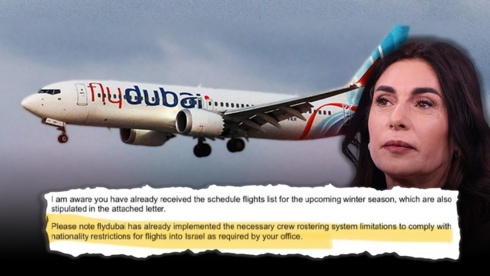
There is no shortage of parties to blame for the flydubai flight security failure, for which, as of Sunday, no Israeli agency is prepared to take responsibility or guarantee that such an incident will not happen again. But the scale of the failure becomes even clearer when examining the rigorous checks conducted by the Transportation Ministry’s Aviation Security Operations Center. The problem is that those checks apply only to private aircraft. When it comes to commercial flights, oversight is far more lax.
In 2018, the Transportation Ministry’s security division warned of a problem involving pilots from Egypt and Jordan, saying there was insufficient certainty regarding their identities. It requested additional positions to conduct checks, but the request was rejected by the National Security Council. A State Comptroller report two years ago also identified shortcomings in the handling of the issue, but as far as is known, nothing has been done since.
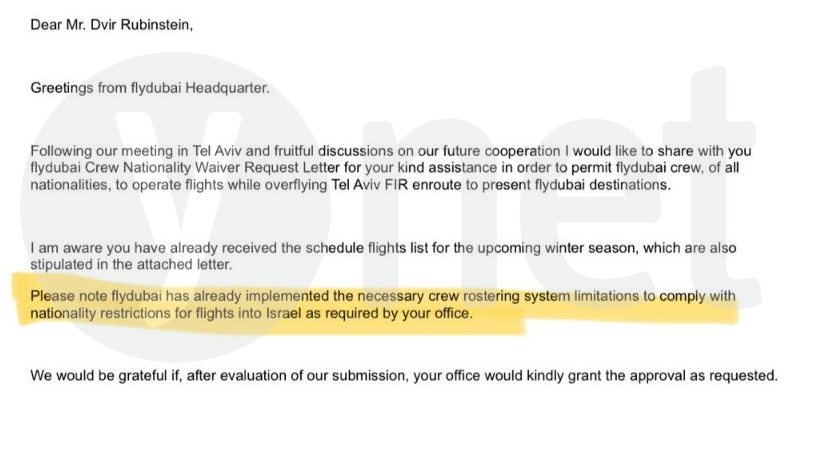
The email sent by flydubai: ‘We comply with the restrictions you requested’
The Transportation Ministry’s Aviation Security Operations Center, meanwhile, applies extremely stringent checks to private flights. Private companies are required to submit pilots’ employment histories, passports and full details three days in advance. Those details are scrutinized so closely that a Jewish billionaire businessman who once sought to fly to Israel for a bar mitzvah was denied permission simply because he had never previously visited the country. He was required to arrive on a commercial flight instead. An American pilot was previously barred from arriving aboard a private aircraft solely because he had been in Iraq.
But with commercial flights, everything changes. Although the potential damage from a commercial aircraft is far greater — with much more fuel and 100 to 200 times as many passengers — authorities do not examine commercial flights at anything approaching the same level of detail as private ones. The security division instead conducts a general assessment of the airline and the security procedures in its home country, then grants seasonal approval.
The rationale is that the agency lacks the intelligence capabilities needed to vet lists of 200 to 300 people and conduct background checks on every crew member, flight attendant and passenger. If something suspicious is identified, it can issue an alert. In practice, however, no one checks exactly who is arriving in Israel.
Transportation Ministry officials said Saturday night that flydubai apparently violated its commitments. A document obtained by ynet shows the written commitment the airline provided to the Aviation Security Operations Center in 2020.
“flydubai has already implemented the required crew scheduling system restrictions to comply with the nationality restrictions for flights to Israel, as required by your ministry,” the airline wrote.
The background of pilot Hamam al-Hammami
(Credit: CNN)


In practice, without oversight, an airline that employs pilots from countries around the world — including states considered hostile to Israel — can send such pilots to Israel while claiming ignorance, with Israeli authorities failing to verify the matter.
It is important to note that flydubai is not alone. Other airlines, including carriers from Uzbekistan and Azerbaijan, may employ pilots or crew members from hostile countries. Lufthansa, for example, could employ a pilot who also holds Iranian citizenship, with no Israeli authority enforcing restrictions against it.
First and foremost, there needs to be a clear division of responsibility and dedicated personnel assigned to conduct background checks on air crews. That is complicated and requires cyber capabilities and international intelligence capabilities, including cooperation with intelligence agencies. But currently, no one is even checking social media histories.
The Transportation Ministry’s attempts to evade responsibility are untenable. If the ministry believed it was incapable of handling the issue, it should have said so. Instead, it presented itself as the responsible authority.
“The body responsible for centralizing the information is the Tax Authority, under a government decision made several years ago, and indeed, that list was in its possession. The list was not transferred to us because the bodies responsible for verifying the identities of the crew are the intelligence agencies.
“Aviation security is a very complex issue. The intelligence responsibilities are divided between the Mossad and Shin Bet. The Shin Bet is responsible for Israeli flights and charter flights, while the Mossad is responsible for foreign flights. flydubai is a foreign airline. It has nothing to do with the Shin Bet. It falls under the Mossad. No security agency has said Israelis cannot fly with foreign airlines to Dubai. The security agencies are the ones responsible for determining the level of threat and whether it is possible to fly to a particular destination.”
At a briefing for reporters held several hours after Regev’s comments, Transportation Ministry officials said the names had not been provided to them in advance, adding that they “rely on a declaration from the foreign airline regarding security checks conducted on crew members aboard the flight.”
According to the ministry’s security division, “We are not an intelligence agency that conducts intelligence background checks on foreign nationals. We do not have personnel abroad. We do not have a team that checks every individual there.”
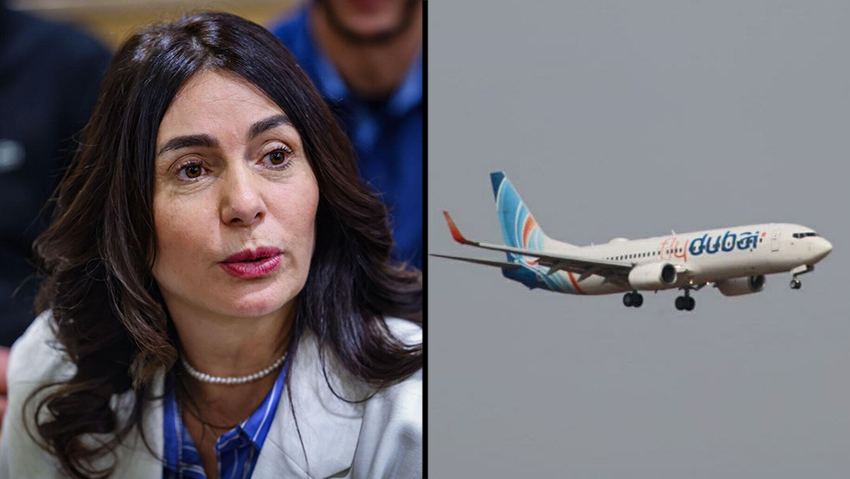
Transportation Minister Miri Regev; flydubai airliner
(Photo: Itay Blumental, Chaim Goldberg/Flash90)
Asked how many pilots from hostile countries may already have landed in Israel and how passengers can be certain of their safety when boarding a foreign airline, Civil Aviation Authority officials had no answer.
“We estimate there have not been any. But we cannot be certain. There is no such thing as 100% security. Only if we stop aviation altogether will everything be completely secure. We rely on local security,” said Tamir Uri, deputy director of the security division.
Shmuel Zakai, director general of the Civil Aviation Authority, stressed that “if there was a violation here, it will be investigated.”
Officials later acknowledged that there is no way to know with certainty who has landed in Israel in recent years or whether hostile individuals were among them.
Regarding a 2023 law requiring the transfer of passenger data, Transportation Ministry officials said: “This is a center for collecting passenger data. It is an agency that is not yet operational. The information is transferred to the Tax Authority, which is then supposed to distribute it to the relevant parties — the police, Mossad and Shin Bet.”
There was, however, no response to claims that the ministry’s security division had failed to proactively obtain the data.
Joseph Fischer, an aviation and tourism expert, told the ynet studio that “it is the job of the Emirati airlines to check this, and it is the job of Israel’s security agencies to verify the identities of the air crews aboard the aircraft.”
“In this case, there was no red flag, no notification from the Omanis about any concerns,” he said. “In my opinion, the Emiratis simply did not know. They missed it in their checks.”
Fischer added: “The Transportation Ministry is accustomed to shirking responsibility. This flight is just the tip of the iceberg. There is something called a flyover, in which Arab airlines fly over Israel. That means there are aircraft over our heads all the time, flying west from Jordan and crossing Israeli airspace — and we do not know who is aboard those planes. We have no oversight whatsoever.
“A pilot could snap and simply take his aircraft and crash it into the Tel Aviv metropolitan area.”