
 Play Brightcove video
The UAE has described what unfolded as a terrorist attack, as Sam Holder reports
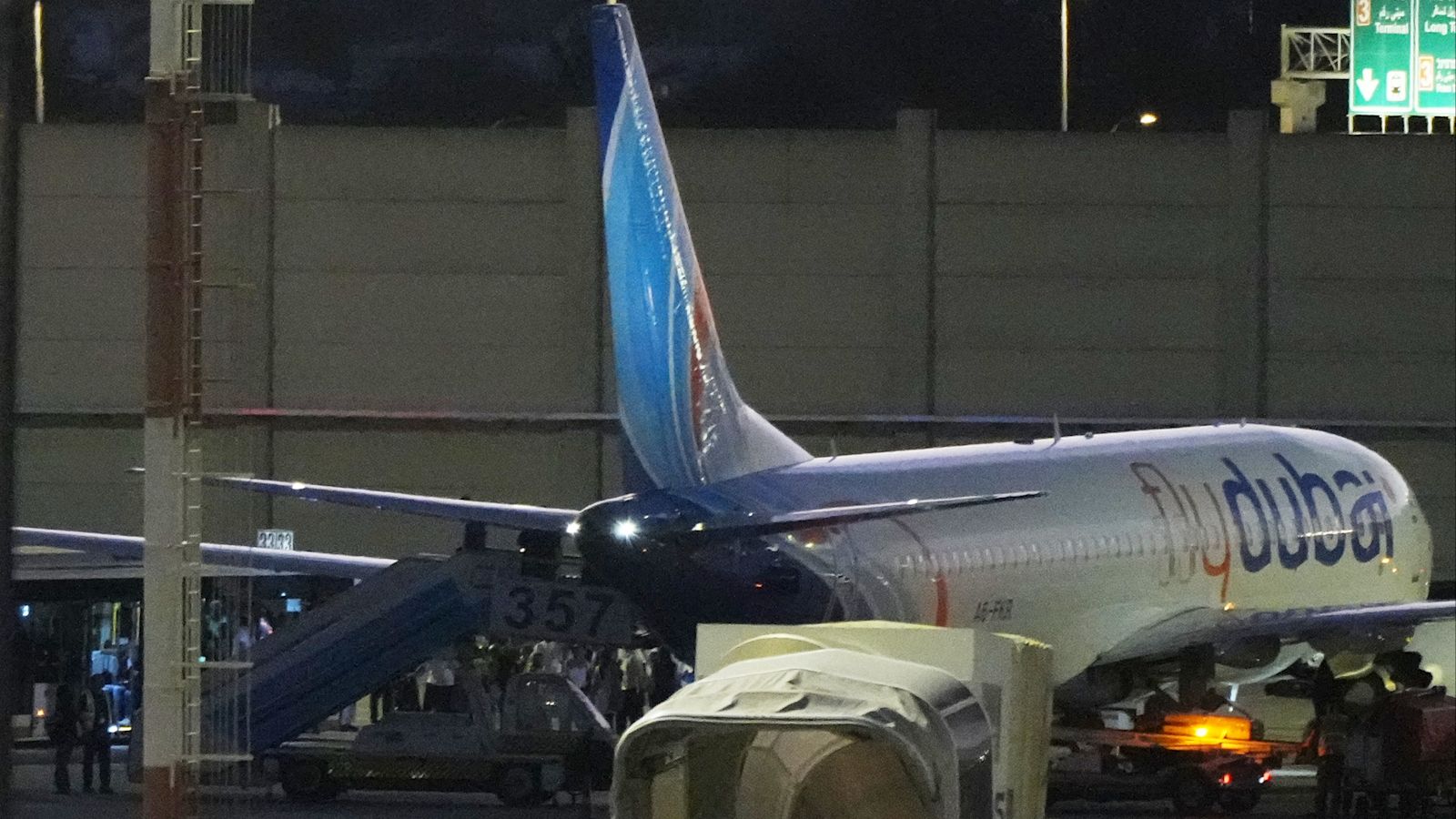
The co-pilot of a FlyDubai plane, who attacked the captain with an axe, had been barred from flying on his country’s airline because of concerns about extremist views, officials said.
Omani national Hamam al-Hammami was named by three separate sources, according to the Associated Press.
UAE authorities described what unfolded on the plane as a “terrorist attack”. The co-pilot was arrested after the plane made an emergency landing in Saudi Arabia.
It has also emerged that Al Hammami completed a distance-learning course in aviation management at Buckinghamshire New University.
In a statement, a spokesman for the university said: “Our thoughts are with the injured pilot, crew and passengers involved in this incident.
“Hamam al Hammami previously completed a distance-learning course in aviation management. He did not undertake any pilot training at the University.”
Passengers and crew managed to intervene and stabilise the plane during the Israel-bound flight on Wednesday, which was diverted to an airport in Saudi Arabia.
The attack involved a crash axe, a tool kept in the cockpit to help pilots break through the plane’s fuselage in emergencies.
Separately, a regional official and a person familiar with the matter said the co-pilot had been barred from flying by Oman over concerns that he had adopted extremist views. The official said he was moved to an administrative job at Oman Air. Both spoke on condition of anonymity to discuss the ongoing investigation. They gave no details about the alleged extremist views.
The co-pilot was later hired by UAE-based airline FlyDubai, the person said.
The new details raised questions about how thoroughly FlyDubai vets potential employees, and how the co-pilot’s presence on a flight filled with Israeli passengers got past Israel’s strict security protocols.
Israel has said it has agreements with foreign carriers to keep pilots of nations without diplomatic ties from flying there. Israel and Oman don’t have formal diplomatic relations. The UAE government has earned a reputation for effective measures against extremist activities but has bristled in the past over criticism of security lapses.
The Gulf diplomat said he had undergone standard security checks before being hired, but it appears that the checks focused on whether he had been convicted of criminal charges and didn’t go deeper into examining his background for potential signs of radicalization.
Little else was immediately known about the co-pilot’s background. His Instagram account was active until the day of the flight and then deleted.
The regional official also said security agencies from four regional countries were working to establish the co-pilot’s motives, aided by the United States and other Western governments. The Gulf diplomat said the investigation, which hasn’t concluded, hasn’t found any connections with militant groups, suggesting that the co-pilot acted on his own.
The regional official said the co-pilot was born in the UAE and his mother is Syrian. He obtained Omani nationality from his father, also an Omani national. The regional official also said the co-pilot had traveled to Syria, with no details.
The chaos unfolded about two-and-a-half hours after flight FZ 1073 left Dubai on Wednesday morning as a fight broke out in the cockpit, causing the plane to plummet from 33,000 to 17,000 feet in about a minute.
Passengers described how the bloodied Indian captain managed to open the cockpit door to let them in before they grappled with the copilot and stabilised a descent so sharp that the plane’s rudder was torn away.
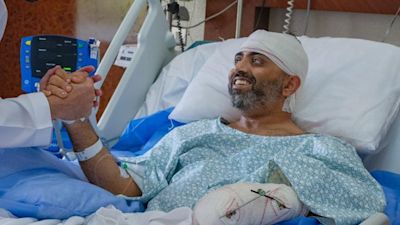
Captain Smit Machchhar spoke to Indian Prime Minister Narendra Modi from hospital. Credit: AP
Asaf Rajuan, one of the four Israeli nationals who helped stop the hijacking, said: “We felt helpless, suspended in midair, and I didn’t know who to turn to. But it was all instinct to survive.”
Captain Smit Machchhar, praised as one of the heroes of the flight, was reportedly in stable condition, the Indian Embassy in Saudi Arabia said.
Speaking from a hospital in Abu Dhabi during a video call with Indian prime minister Narendra Modi on Friday, the pilot said: “I had so many wounds. I had fallen down… I was thinking what if I don’t get up?
“I was fighting for my life. At one point, I realised that if I didn’t get up… then passengers would lose their lives.”
Among those to rush towards the cockpit was plumber Yaniv Hayoun, who was embraced by Israeli PM Benjamin Netanyahu after passengers were returned to Tel Aviv late on Wednesday.
He recounted to Modi how he put the alleged attacker in a chokehold and dragged him out of the cockpit with other passengers.
In a second video, Capt Machchhar spoke more about his experiences during a phone call with Netanyahu.
Recalling the moments leading up to the alleged attack, he said: “It was a normal flight and the co-pilot wanted to pray, which a lot of locals do pray, which is not out of the ordinary.
“While he was praying, out of respect, I was looking at the front and not at the back and suddenly, after about four-five minutes, there was a big blow to the back of my head.
“My first thought was that there was catastrophic damage to the aircraft, that something is not right but after that the blows kept coming, one after the other and that’s when I realised that it’s not the aircraft.”
Want a quick and expert briefing on the biggest news stories? Listen to our latest podcasts to find out What You Need To Know…