
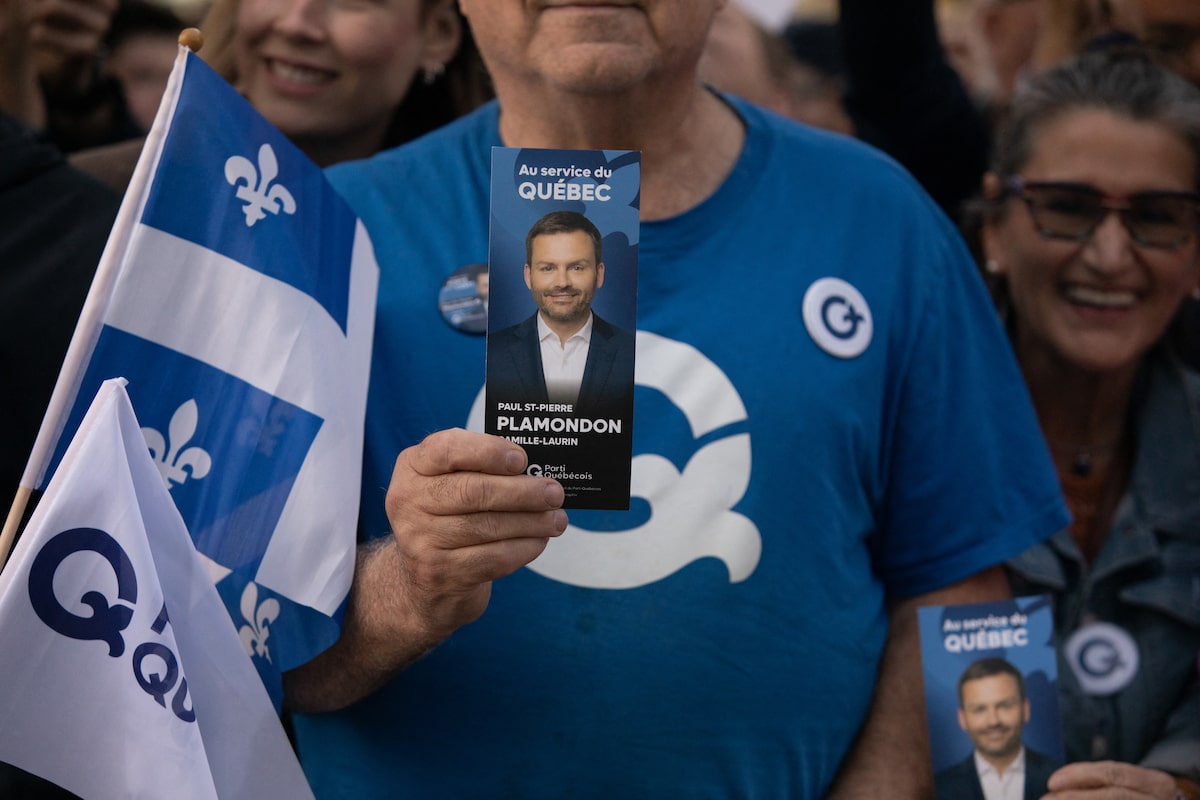
A supporter holds a flyer featuring the Leader of the Parti Québécois (PQ) Paul St-Pierre Plamondon outside the Maison de Radio-Canada in Montreal, Sept. 23.ALEXIS AUBIN/AFP/Getty Images
Quebec appears poised to elect a separatist government for the first time in more than a decade, even though most of the province has little interest in a promised vote on independence.
The Parti Québécois, polls show, will likely take the reins of power from the governing Coalition Avenir Québec on Monday after a lacklustre campaign in which voters expressed a desire for change but little enthusiasm for any of their options.
A victory for the PQ would give new life to a decades-old debate over sovereignty that took a back seat during the CAQ’s eight years in power. Leader Paul St-Pierre Plamondon has promised to hold a referendum on independence within a first mandate, though not before U.S. President Donald Trump leaves the White House in 2029.
The separatist party could claim a majority of the 127 seats in the province’s National Assembly despite the fact that support for the PQ – and for sovereignty – has not climbed above 30 per cent during the campaign. The CAQ, meanwhile, is lagging in polling, with forecasters suggesting the party could find itself with few, if any seats.
After a six-week campaign in which none of the five viable parties managed to capture the imagination of voters, the Parti Québécois stands to win because the alternatives appeared to be even less inspiring.
PQ leader’s vow to break with monarchy raises prospect of constitutional showdown
Mr. St-Pierre Plamondon’s pitch – three years of good government followed by a referendum once Mr. Trump leaves office – has not rallied any new support.
The Coalition Avenir Québec, under new Leader Christine Fréchette, briefly benefited from a Trump bump when Canada-U.S. trade talks broke down and Prime Minister Mark Carney – enduringly popular in the province – unveiled a series of funding announcements alongside the Premier. She tried to make the campaign about the trade war and called the U.S. President her main adversary.
But Quebeckers quickly turned the page, seemingly persuaded by rival parties who argued that Ms. Fréchette was not at the table in tariff negotiations and could not influence their outcome. The perception that she was not consulted on Mr. Carney’s countertariffs, some of which hurt Quebec businesses, further undermined her standing on the issue.
An attempt in the late stages of the campaign to warn of the potential for U.S. interference in the election, based on a blog post from a right-wing think tank proposing American funding for sovereigntists in Canada, backfired.
The most full-throated federalist party, the Quebec Liberals, struggled to find their voice under new leader Charles Milliard until late in the campaign, when the CAQ’s collapse positioned them as the most plausible alternative to the separatist PQ. They will likely remain the Official Opposition, a role they have occupied since 2018.
Explainer: What to know about the Quebec election, the major parties and how to vote
The election revealed a province preoccupied by the cost of living, homelessness, crumbling infrastructure, immigration and emergency-room waiting times, but unsure of how to fix any of it. The existential questions of Mr. Trump’s aggression and independence from Canada largely failed to become defining issues.
The big questions of the future received little attention. The dangers and possibilities of artificial intelligence were barely discussed until Friday, when it emerged that Conservative Leader Éric Duhaime had used AI to write his latest book. The other parties mocked him, while Mr. Duhaime countered that it was “a tool like any other.”
Perhaps the most ambitious policy agendas were put forward by the two parties who were never in the running to form government – the left-wing Québec solidaire (QS), which proposed publicly owned grocery stores and raising taxes on the very rich, and the Conservatives, who campaigned on sweeping tax cuts and easier access to private health care.
Despite a well-liked co-leader in Ruba Ghazal, QS has remained marginal in the campaign and is working to hold on to its handful of seats. But Mr. Duhaime’s promises to rein in government spending have struck a chord with voters who feel the CAQ government has played fast and loose with their money. For the first time, his party will likely win several seats in the National Assembly and become a real political force.
Quebec appears to have little appetite for grand projects, preferring help with making ends meet. One of the campaign’s most popular ideas – proposed by the Conservatives and péquistes alike – was to abolish the provincial sales tax on used goods.
Opinion: With a PQ majority in reach, Quebec federalists will need all the help they can get
Cuts were also prominent on the menu – both to the immigration rate and the size of the state. A majority of the five parties proposed substantial cuts to the number of newcomers coming in and the size of the public-sector work force, differing only on how many thousands.
The well-known Montreal businessman Andrew Lutfy roughly captured the state of Quebec’s self-image on Friday when he declared that the province had become “uninvestable” because of excess red tape and needed 6-per-cent annual growth to fix its hospitals, schools and roads.
But with the province legally required to balance its budget by the end of the decade, the three main parties had little room to propose big ideas, said political analyst Raphaël Melançon. “Basically, what we are selling is the status quo,” he said. “We’re just going to keep governing the province as it is.”
“It’s been a pretty boring and beige campaign.”