
The attempted attack aboard a flydubai flight to Israel was thwarted and the security incident ended without disaster, but it also exposed a system in which no single agency bears full responsibility. The state comptroller warned about the problem in 2024; recommendations to create a coordinating authority were shelved and the Transportation Ministry, Shin Bet, National Security Council and Prime Minister’s Office are now pointing fingers at one another.
Dozens of flights operated by foreign airlines land in Israel every day carrying Israeli citizens. Most passengers are unaware that security arrangements on those flights are fundamentally different from those aboard Israel’s El Al, Arkia and Israir airlines.

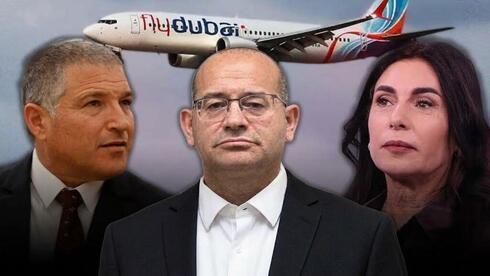
Transportation Minister Miri Regev, Shin Bet Director David Zini, Mossad chief Roman Gofman
(Photo: Itay Blumenthal, Olivier Fitoussi, IDF)
The drama aboard flydubai Flight FZ1073 raised a simple question with no simple answer: Who, exactly, checks those aircraft and their crews?
ynet examined what the state comptroller wrote, what has been done since and what two former senior officials who worked inside the system have to say: Danny Shenar, who headed the Transportation Ministry’s Security, Emergency and Cyber Division for 25 years, and Eyal Hulata, who served as national security adviser and head of the National Security Council under the government of former prime ministers Naftali Bennett and Yair Lapid.
In May 2024, State Comptroller Matanyahu Englman issued a report on security for international civil aviation to and from Israel. The report, covering 2022 and 2023, remained classified by the Knesset’s State Control Committee, but its main findings are known: There were serious gaps and failures in aviation security, including the protection of aircraft operated by foreign airlines.
Its central recommendation was clear. The National Security Council was asked to lead a review with the Transportation Ministry, Finance Ministry, Israel Airports Authority, Shin Bet domestic security agency and police and formulate a new, comprehensive aviation security policy.
“Basically, the comptroller was right about everything he wrote, from A to Z,” Shenar said.
“He says a national authority needs to be established, that everything cannot rest with MAMLAT,” Shenar said, referring to the Hebrew acronym for the Aviation Security Operations Center, an operational body under the Transportation Ministry’s security division that is responsible for issuing security clearance for foreign flights seeking to land in Israel. “He said a comprehensive review had to be conducted. And they didn’t do it.”
Hulata was equally blunt.
“Nothing has been done since the comptroller’s report in 2024,” he said. “It’s a failure that cries out to the heavens.”
On paper, the answer regarding foreign flights is straightforward: the Transportation Ministry.
Under Israeli law and government decisions, the ministry’s Security, Emergency and Cyber Division, including MAMLAT, is responsible for conducting security assessments of foreign flights to Israel and issuing security instructions to airlines. According to the ministry, it has held that responsibility since 1977.

The flydubai flight after landing safely in Saudi Arabia
In practice, Shenar said aviation security is now divided among seven different bodies, resulting in “chaos and misunderstandings.” MAMLAT, he said, handles only about 20% of the sector: foreign and private flights.
In response to the criticism, the Transportation Ministry itself stressed the limits of its authority and capabilities.
“The Transportation Ministry is not an intelligence agency and does not have the tools to conduct intelligence background checks on crew members and passengers,” the ministry said. “Its procedures rely on security in the countries of origin, written commitments from the airlines and inspections at airports abroad.”
The “chaos” described by Shenar was also reflected in a report by Haaretz concerning Avri Cohen, head of the Transportation Ministry’s security division, who according to the newspaper simultaneously holds another job.
In addition to heading the division, Cohen reportedly works as a reserve security officer responsible for security at an overseas airport on behalf of Israeli airlines. It is paid work, separate from his official government position, for which he receives additional compensation. According to Haaretz, Cohen said the Transportation Ministry’s director-general approved the arrangement in 2018. Such an arrangement is highly unusual given the heavy workload associated with the positions.
Haaretz reported that Cohen also works with Ofek, a state aviation security apparatus operating on behalf of the Shin Bet to protect passengers on Israeli airlines overseas. Ofek security officers are deployed to airports around the world, where they oversee screening procedures for Israeli carriers. The job requires them to spend several days abroad at a time.
Cohen previously served in the system, which offers former personnel opportunities to fill in when staffing shortages arise. The Transportation Ministry said simply that “the management approved it in 2018.”
In 2011, the Transportation Ministry submitted a proposal to the prime minister to establish a national aviation security authority as a ministry-affiliated government agency responsible for all aspects of aviation security in Israel and abroad.
Shenar, who led the planning effort, said he coordinated the work of the various government ministries before presenting the proposal to senior officials.
“I coordinated all the government ministries and brought it to the director-general and the minister, and they brought it to Prime Minister Benjamin Netanyahu,” he said. “There was a three-and-a-half-hour discussion, and the prime minister rejected the recommendation by Israel Katz, Dan Harel and me. There is no such body, and all the failures stem from that.”
According to the Transportation Ministry, two committees led by the National Security Council also previously recommended establishing a national authority responsible for all flights. The ministry said it supported the proposal then and continues to support it, but the recommendations were never implemented. Establishing such an authority would require a government decision.
Hulata placed responsibility on Netanyahu.
“He has an obligation to conduct a comprehensive review, identify gaps and identify who is not doing their part,” Hulata said. “The prime minister doesn’t want to touch anything.”
Very little, according to the former officials, and mostly around the edges.
The Transportation Ministry said that “after decades” it secured a dedicated budget to upgrade MAMLAT’s computer systems.
A gap involving charter flights — flights operated by Israeli airlines using foreign aircraft — was also addressed. Until 2021, all such flights were under Shin Bet security. That year, the security Cabinet decided the Shin Bet would secure only high-risk flights. The others were left without a clear security framework, a gap also identified by the state comptroller.
At the beginning of 2026, the Transportation Ministry assumed responsibility for those flights despite its reservations and subject to receiving the necessary budget and staffing.
So why are private aircraft, considered less dangerous, subjected to thorough checks?
“Because it’s easier, simpler,” Shenar said, arguing that the system had functioned better in the past.
MAMLAT was established following a 2003 government decision and began operating in 2006.
“We identified aircraft from 180 miles away, and within three or four minutes we could determine whether an aircraft was the one that had received clearance,” Shenar said.
At its peak, he said, fighter jets were scrambled about 19 times a month to intercept civilian aircraft, while officials from the United States, Britain and Canada came to study the Israeli model.
But after Shenar retired in 2017, he said, the security officer position remained vacant for a year and a half amid disputes over the appointment and petitions to the High Court of Justice.
With dozens of foreign flights arriving each day and hundreds of crew members involved, checking everyone may sound impossible for a single agency. Shenar rejects that argument.
“Technically, there’s no problem doing it,” he said. “Today, you enter a list of 5,000 pilots into a computer and get an answer within a minute.”
The legal basis already exists, he said. According to Shenar, the 1997 Aviation Law governing civil aviation security allows the transportation minister to demand the names of crew members flying aircraft to Israel and submit them to an intelligence agency for screening.
The problem is that, in practice, those lists are not being received.
In the flydubai case, according to the Transportation Ministry, the Emirati airline had committed to vetting its crews and said in writing that it had incorporated nationality restrictions into its crew scheduling system. Those restrictions were supposed to prevent pilots from countries without diplomatic relations with Israel — including Oman, Syria, Iran and Pakistan — from operating flights to the country.
The Transportation Ministry said it did not receive the crew list for Flight FZ1073 and that its security division does not have access to flight crew lists.
In other words, Israel relied on a written declaration from a foreign airline.
After the incident, the blame game began.
An internal National Security Council document concluded last year that the Transportation Ministry was failing to fulfill its role in securing foreign flights. According to the document, professional officials in the ministry’s security division opposed transferring the responsibility to them, the director-general of the Civil Aviation Authority insisted on the move and Transportation Minister Miri Regev and Netanyahu ultimately approved it.
Hulata apportioned responsibility differently.

Terrorist hijacker Hamam al-Hammami
“It’s clear to us that Dubai is the first line of defense,” he said. “They should have checked who the Omani pilot was. The first line of contact collapsed.”
Had the Transportation Ministry conducted spot checks, Hulata argued, it could have determined whether flydubai was honoring its commitments.
“I’m not absolving the Shin Bet of responsibility,” he added, though he said the Mossad foreign intelligence agency had no direct responsibility unless there were gaps in understanding the threat.
Hulata also pointed to an earlier dispute with the United Arab Emirates. Israel did not allow Israeli airlines to fly there because Emirati authorities refused to permit Israeli security screening using CT scanners. The result, he said, was that Israelis instead flew aboard Emirati airlines that did not use the same screening procedures.
“The State of Israel abandoned its citizens,” Hulata said. “Who are we protecting here, El Al’s reputation? What about the Israeli citizen? They simply abandoned them.”
For now, the Transportation Ministry says security authorities are examining the circumstances of the flydubai incident.
“If it emerges that there was a deviation from the guidelines, it will be addressed accordingly,” the ministry said.
CNN profile on the terrorist hijacker
(Video: CNN)


No agency, however, has announced any change to the underlying division of responsibilities.
Shenar pointed to what he sees as the next danger. Flights from major airports such as Athens operate with a strong security framework and advanced screening equipment, he said.
“But in most peripheral destinations and on the islands — Kos, Mykonos — the level of security is very poor,” he warned. “These are tiny airports, and aircraft fly from there to Israel without a security envelope. That’s where the danger lies.”
Shenar said the first step is to establish the facts. In the longer term, he said, Israel should create the national aviation security authority that has repeatedly been proposed.
In the meantime, he said, Israel could require the names of all foreign pilots flying into the country, submit them for intelligence screening and prevent crew members from Iran, Syria, Iraq or Turkey from operating flights to Israel.
“At least an initial screening,” he said, acknowledging: “I understand there is no agreement on these things.”
If the current situation continues, Shenar warned, Israel could face “instability in the security of incoming foreign aviation.”
The latest incident ended safely. Next time, he said, Israel cannot afford to rely on luck.