
Officials in Oman have said the flydubai co-pilot was taken off flying duties there over concerns about extremism.
The Financial Times reports that Australian intelligence kept a file on him from his student years, when he allegedly visited radical mosques and extremist websites.
Royal Air Maroc trained him for three months in 2025, then declined to hire him. They won’t say why. None of it kept him out of a cockpit. Whatever investigators eventually find about Tehran, that is the part they have to explain.
Political motive to link the attack as backed by a state
It is easy to see why some governments would rather talk about Iran. A state sponsor makes the threat bigger and the diplomacy more serious, and it puts off indefinitely any discussion of who failed to read what.
It wouldn’t come free. A proven Iranian role would force the Emiratis into a confrontation with a neighbor they have worked hard to manage, and it would put pressure on Jerusalem to respond. But it would also move the conversation away from the hiring files.
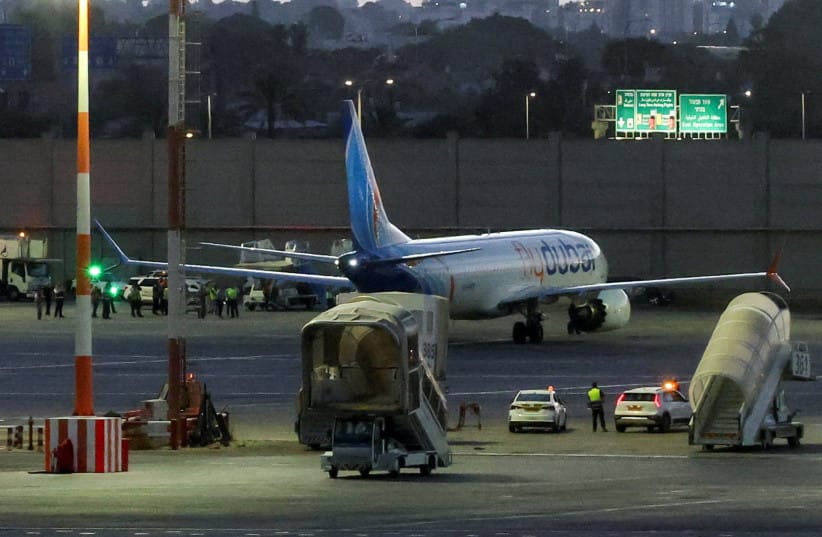 A plane, carrying passengers who were on the FlyDubai aircraft bound for Israel from the United Arab Emirates, which was diverted to Saudi Arabia following an emergency signal, on the tarmac as it arrives at the Ben Gurion International Airport, in Lod, near Tel Aviv, Israel, September 30, 2026. (credit: REUTERS/Ammar Awad TPX IMAGES OF THE DAY)
The incentive is strongest in Jerusalem. Prime Minister Benjamin Netanyahu has been warning about Tehran’s reach for most of his career, and a trail leading there would vindicate him.
He would have allies to rally and a response to discuss. Explaining which Israeli agency was supposed to have checked the crew, a question Israeli officials are now arguing about among themselves, offers none of that.
What is on the record is thin. A senior Emirati source with knowledge of the inquiry told The Jerusalem Post that a possible Iranian connection is being examined among other hypotheses.
There is no publicly established evidence tying Tehran to the attack, and Iran denies any role. US President Donald Trump has raised the possibility. Netanyahu said it is too early to say. On October 1, an Israeli official told the Post that the working assessment was still that the attacker acted on his own. Three governments, one unfinished investigation, and they don’t agree.
The suspect’s reported exposure to Al-Qaeda ideology cuts both ways. Sunni jihadists and Iran’s Shi’ite regime have been at odds for decades and have cooperated when it suited them.
The US State Department said senior Al-Qaeda figure Saif Al-Adl is based in Iran. The 9/11 Commission documented Iranian help with al-Qaeda transit, though it found no evidence that Iran or Hezbollah knew about the plot.
The oddest chapter came in August 2020, when Al-Qaeda’s deputy leader, Abu Muhammad Al-Masri, was shot dead in his car in Tehran, along with his daughter Miriam, the widow of Hamza bin Laden.
According to The New York Times, he had been living freely in an upscale part of the city for years, and Israeli operatives killed him at Washington’s request. Iranian state media first reported the dead man as a Lebanese history teacher.
Tehran called the Times story invented. So the history makes the question legitimate, and that is about all it does. Whether this pilot had anything to do with Iran depends on evidence about this pilot.
Establishing a connection is useful to politicians
Whoever eventually announces a “connection” should be made to say what they mean. Contact with somebody linked to Iran is one thing. Assistance is another, and operational direction is something else again, with very different consequences for policy. Until somebody defines the term, it is mostly useful to politicians.
Netanyahu’s statement that Israel had no specific warning may well be accurate. It also answers a question nobody was asking. Intelligence that names a plot is one kind of information. Doubts about whether a particular man should be flying passengers are a different kind, and the second is what a vetting system exists to catch.
You don’t need a date or a target to ground a pilot. What Israelis are entitled to know is whether anyone in the chain, here or abroad, knew enough about him to stop him, and what they did with it.
The chronology that is emerging suggests the information never traveled. Emirati sources said what Oman and Australia knew reached them only after the attack.
Someone in Oman wrote down the concerns about this man. Australia compiled a file. Royal Air Maroc had its reasons for turning him down sitting in a drawer somewhere. Investigators should establish what each contained, who was entitled to see it, and whether anyone ever asked.
Israel’s own warning about the system predates all of this. A 2024 State Comptroller report called for a review of aviation security responsibilities, including for incoming foreign flights, and urged the political leadership to formulate a comprehensive policy.
Netanyahu and Transportation Minister Miri Regev should be asked, specifically, what was done with that recommendation. If an Iranian handler turns up, the question only gets more pointed.
The UAE has handled this better than most of the governments now pointing fingers. Its prosecutor general called it an attempted terrorist attack in public, and Emirati authorities are running the inquiry. In this region, that is unusual. Flydubai’s own hiring checks are still under scrutiny, as they should be, alongside the complaints about what other countries allegedly held back.
Saudi Arabia took in the aircraft and looked after the passengers, and reportedly refused to let Israeli military planes come to collect them. Cooperation was negotiated one decision at a time, in public, during an emergency.
It would be worth knowing how those same channels worked in the months before, when nobody was watching, and a shared file might have changed the outcome.
If Iran was involved, the uncomfortable conclusion is that a hostile service walked through gaps several institutions had plenty of time to close. State sponsorship makes an operation more capable. It doesn’t tell you which safeguards were beaten and which were never there to begin with.
I would want an inquiry that follows the attacker’s communications and his paperwork with the same seriousness. Whatever evidence of outside direction exists belongs in the same file as the employment records, the requests for information and the replies, and the security clearances. Read together, they will show who had enough to act, even if nobody had the whole picture.
If the evidence leads to Tehran, the response should be serious. The governments whose job it was to protect those passengers will still owe them an explanation of how this became possible.
An Iranian connection would widen the investigation and the list of people who owe answers along with it.