
The ongoing global energy crunch doesn’t just cause pain at the gas pump: As winter approaches, millions of Americans are facing dramatic spikes in their home heating costs.
The price of heating oil, which some 4.8 million households, mostly in the Northeast and Alaska, use to heat their homes, is approaching all-time highs as two wars strain global supply.
Heating oil costs are expected to jump 50% this winter, according to one estimate from the National Energy Assistance Directors Association, adding nearly $900 to the average home’s heating bill. The jump is catching consumers by surprise at a time of year when many households fill their tanks for winter, and it’s stoking concern that the high prices will force low-income families to make tough choices between warming their homes and paying for necessities.
Read more: What an extended war with Iran could mean for gas prices
“There’s a lot of sticker shock,” said Chris Herb, president of the Connecticut Energy Marketers Association, a trade group for local fuel providers and other energy companies in the state.
Heating oil is nearly identical to diesel, and diesel prices have continued to rise while crude oil prices have plateaued as higher seasonal demand collides with ongoing supply shocks. The Iran War has disrupted exporters’ ability to reliably pass through the Strait of Hormuz, while escalating Ukrainian attacks on Russian oil refineries have limited another key source of supply.
Read more: How to protect your money as Mideast turmoil fuels market volatility
Record-high prices
In recent weeks, diesel prices have topped $6.50 a gallon, breaking an all-time record. And across the Northeastern states, heating oil prices have either recently broken or are just short of the highest levels on record.
“Diesel and heating oil are basically directly tied now,” said Patrick De Haan, head of petroleum analysis at GasBuddy. “Diesel setting all-time records is certainly very worrisome for home heating oil expenses this winter.”
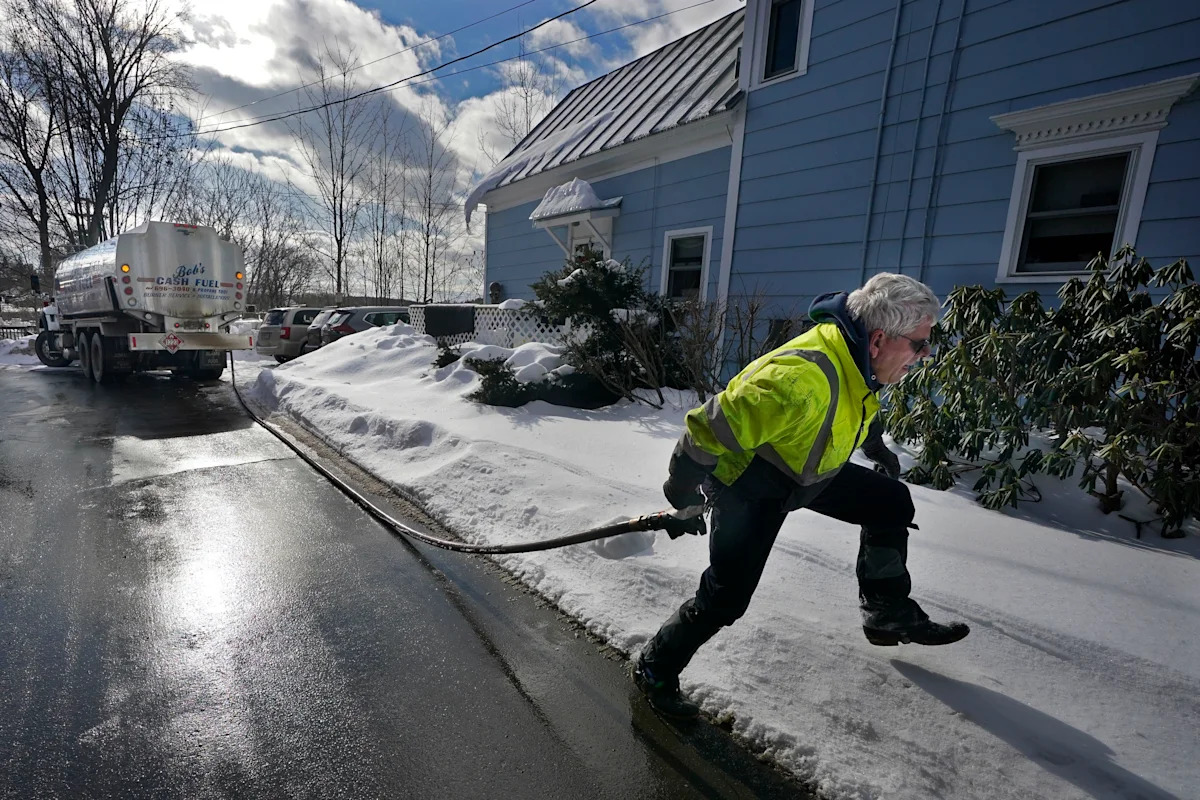
 Heating oil costs are expected to jump 50% this winter, according to one estimate from the National Energy Assistance Directors Association. (AP Photo/Robert F. Bukaty) · ASSOCIATED PRESS
A gallon of heating oil now averages around $5.96 in Maine, where more than half the state relies on oil, the highest share anywhere in the country. Prices are $5.87 in Vermont and $5.91 in Connecticut, meaning 100 gallons, a common minimum order threshold, comes out to nearly $600.
During the winter months, a typical home relying on heating oil alone can run through 100 gallons in a few weeks.
Homeowners have been making tough choices: Fill up now, or hold off in hopes that prices fall in the months ahead? Look into alternative heating sources that might be pricey up front but deliver savings in the long-term? Lower the thermostat and shiver to stretch a tank’s worth of oil longer?
Story Continues
‘Do I order? Do I hold off?’
In Connecticut, Herb said suppliers were seeing more business than is typical for September, perhaps a sign that households who had been waiting in vain for prices to go down after February’s Iran war shock didn’t want to risk another price jump later in the season.
KC, who lives near Augusta, Maine, and asked that her last name be withheld to protect her privacy, recently made a similar calculation. She was just quoted $5.99 per gallon for her 100-gallon order and could end up paying even more if prices are higher when her delivery arrives. In a typical year, she pays closer to $3 a gallon.
“I was shocked, honestly, to find out that oil was this much,” the 51-year-old said. She knew prices had been rising, but didn’t realize the extent of the jump until a month ago, when a colleague at her healthcare job mentioned paying around $5 a gallon.
“That’s when I started thinking, ‘Do I order? Do I hold off?'” she said. “I really didn’t think it would get this bad.”
Meanwhile, she’s taking several other steps to reduce her heating costs. She’ll set her thermostat to 50 — the lowest she thinks she can go without risking a pipe freeze — and rely primarily on her two pellet stoves for heat. She’s also looking into sealing her windows with plastic insulation and adding fans to help heat circulate more evenly throughout her home.
Weatherization measures and system tune-ups can shave up to 10% off a typical bill, Herb said.
“Ten percent at these levels is meaningful, meaningful money back in your pocket,” he said.
Options also exist for those who need help with rising energy bills. The federally funded Low Income Home Energy Assistance Program provides grants to qualifying households, and many states also have similar programs for low- and moderate-income families.
But with costs so high this year, politicians, industry watchers, and worried neighbors alike have all expressed concerns about how lower-income households and elderly people who rely on fixed incomes will manage, and if the existing programs are enough.
A bipartisan group of senators is pressuring the Trump administration to release this year’s assistance funds early, and several bills aimed at expanding the program have been introduced.
Meanwhile, Maine Sens. Susan Collins and Angus King have requested that President Trump tap the federal government’s 1 million-barrel emergency supply of heating oil “to protect Mainers from the very high prices that are imposing a difficult financial burden.”
Claire Boston is a Senior Reporter for Yahoo Finance covering housing, mortgages, and home insurance.
Click here for the latest economic news and indicators to help inform your investing decisions
Read the latest financial and business news from Yahoo Finance