
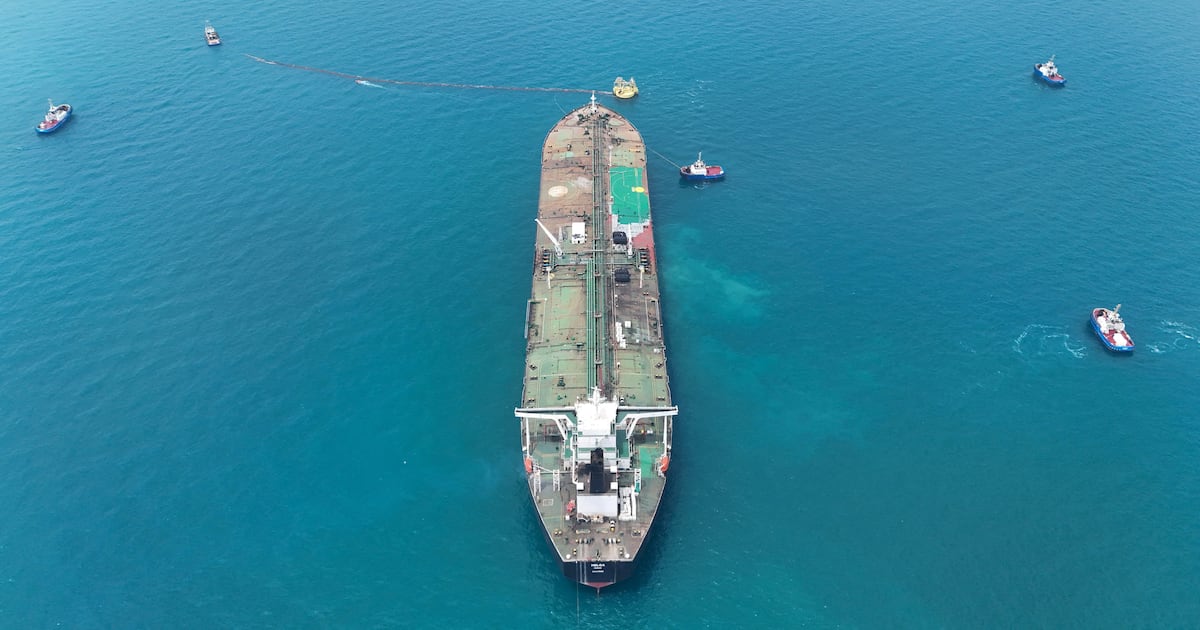
Iraq‘s state oil company has moved its own crude beyond the Strait of Hormuz for the first time in decades as the US-Iran war threatens the country’s primary export route.
The Iraqi Oil Tankers Company shipped two million barrels of crude through the waterway on a very large crude carrier, director general Ali Qais was quoted as saying by state media.
The move was aimed to shift part of Iraq’s oil exports from the existing free-on-board Basra port model to transit the strait and take advantage of better sale and pricing opportunities, he added.
The company is now in talks to buy specialised crude tankers “as soon as possible and to compete with regional peers”, Mr Qais said.
Since the Iran war broke out in February, Iraq has been facing one of its most serious economic and security situations.
Opec’s second-largest producer depends on oil for at least 90 per cent of its revenue. Most of its exports – about 3.3 million barrels a day before the war – crossed the Strait of Hormuz after leaving its southern Basra terminals.
The strait has been effectively closed by Iran since the conflict broke out, with shipping disrupted by missile and drone attacks, insurance surges and naval confrontations.
Total Hormuz flows in September stood at 6.02 million bod, less than a third of February’s 20.64 million bpd, according to Kpler, highlighting the continued disruption to the region’s main oil export artery.
Iraq has been caught in the middle of the war, with pro-Tehran armed groups having launched drones towards Gulf states from Iraqi territory, prompting countries in the region to hold Baghdad responsible.
Meanwhile, ships crossing Iraqi waters near the strait have been at increased risk, forcing Baghdad to offer discounted rates on services at Basra Port and causing buyers to demand delivery outside the waterway.
The government has been struggling to revive alternative routes – including a proposal to reopen the Iraq-Turkey pipeline through Ceyhan and another to move crude to Syria by land – but these solutions would only cover a fraction of Iraqi exports.
Iraq has been able to move three million barrels of oil a day since the beginning of September, Oil Minister Bassim Khudair said last month.
Opec’s second-largest producer is now looking to further boost its production as it expects alternative pipelines and the country’s improved export infrastructure comes on stream, he told the Iraqi News Agency.
“The government plans to increase export capacity to five million barrels a day after the completion of the strategic pipelines extending to Fishkhabour and Baniyas, in addition to the export terminals in the Strait of Hormuz,” he said.
The latest shipment indicates that Iraq has adopted the strategy of moving oil past the Strait of Hormuz to guarantee delivery and secure better prices, rather than leaving buyers to shoulder the war risk premium.
The tanker company, once a major fleet operator in the 1980s, has been trying to rebuild itself after successive wars and rounds of sanctions. Buying its own VLCCs would provide Baghdad with more control over its main source of income.