
Editor’s Note: This story has been updated with additional details.
Germany on Oct. 4 announced a new support package worth more than €1.3 billion ($1.46 billion) for Ukraine, including funding for interceptor drones and energy assistance.
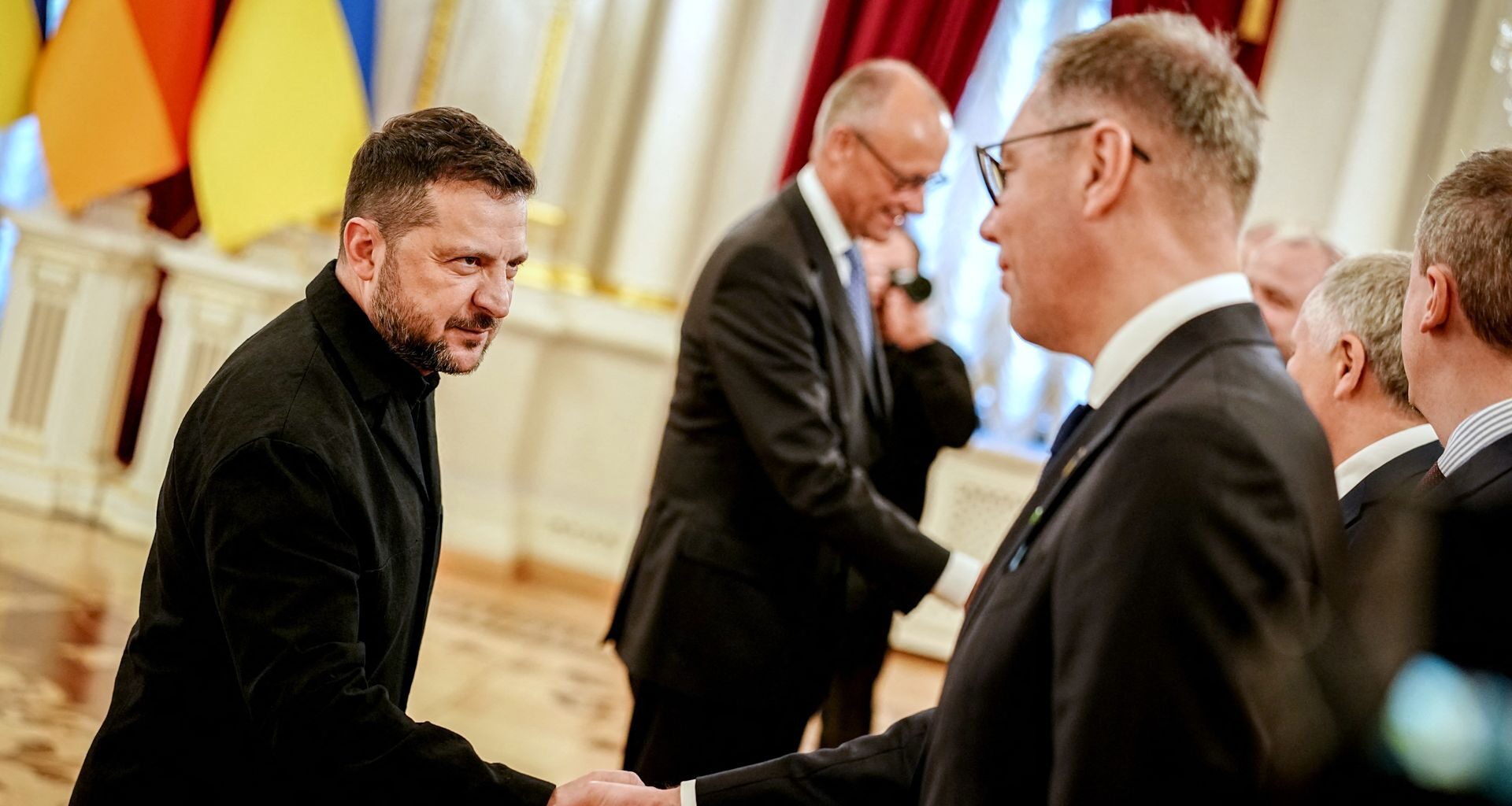
The package was announced by President Volodymyr Zelensky and German Chancellor Friedrich Merz at a joint press conference in Kyiv.
Zelensky said the broader value of agreements reached with Germany during the visit exceeded €8.5 billion ($9.57 billion), including a separate agreement aimed at expanding joint efforts to counter drones.
“The total value of today’s agreements is more than €8.5 billion ($9.57 billion),” Zelensky said. “A special agreement was signed that creates more opportunities for our joint counter-drone efforts.”
Zelensky said the package included weapons needed immediately, support for Ukraine’s energy sector, and funding to produce new interceptors specifically designed to counter Russia’s jet-powered attack drones.
“These are weapons that will help now, support for our energy sector — this is very important,” Zelensky said.
The package includes €1 billion ($1.13 billion) in military aid, including financing the production of interceptor drones capable of countering Russian jet-powered weapons, Merz said.
“This will quickly and noticeably strengthen Ukraine’s air defense, and this reinforcement is urgently needed,” Merz said.
The defense package also includes “thousands” of missiles for the German-made IRIS-T air defense systems and the delivery of additional IRIS-T fire units.
Additionally, the chancellor announced around €350 million ($394 million) in energy assistance, including support for generators and repairs to infrastructure damaged by Russian attacks.
He added that the energy package was intended to mitigate the impact of Russian attacks on Ukraine’s power infrastructure ahead of winter.
Joint weapons production
The European drone manufacturer Quantum Systems will receive financing from Germany to produce tens of thousands of interceptors in Ukraine.
“Ukraine needs interceptor drones at industrial scale,” Sven Kruck, Quantum Systems Co-CEO, said in a press release announcing the agreement. “By expanding production in Ukraine, we can respond faster to the immediate threat while building an industrial capability that will also strengthen Germany and its allies.”
The joint production program is designed to adapt to Russia’s evolving threats, including the increased use of deadly high-speed jet drones in aerial attacks.
Quantum Systems also signed a memorandum of understanding (MOU) with the Ukrainian defense company Fire Point on Oct. 4. The two companies have agreed to jointly develop new technologies for unmanned systems.
A number of other German and Ukrainian companies also signed MOUs during Merz’s visit.
Ukraine’s Culver Aerospace signed a letter of intent with the German company Helsing to cooperate on the mass production of long-range strike systems for Ukraine. The Lviv-based Roboneers also signed an MOU with Germany’s ARX Robotics on the development of ground drones.
German and Ukrainian companies also reached a framework agreement regarding 25 and 40 mm air defense systems and 155 mm artillery systems.
The announcements build on Germany and Ukraine’s expanded joint defense production. In May, Berlin and Kyiv launched “Brave Germany,” a joint initiative backed by Ukraine’s Brave1 defense-tech platform to support Ukrainian and German defense companies and accelerate development of new military technologies.
The much-needed weapons package comes as Russia continues to terrorize Ukrainian cities and civilian infrastructure with jet-powered attack drones. “Just this week, Russia has used more than 1,900 attack drones, 1,700 aerial bombs, and 25 missiles against Ukraine. More than 800 of the drones were jet-powered,” Zelensky said.
Earlier in the day, Merz visited the National Academy of Sciences building in central Kyiv, which was damaged in a Russian drone strike on Sept. 28.
“Mr. Putin, stop this senseless war,” Merz said during the visit, according to dpa. “We are ready for talks, we are ready to speak with one another about ending this war. But these barbaric attacks on the civilian population of Ukraine must stop.”
Zelensky described air defense as Ukraine’s current “number one priority,” saying he and Merz had discussed additional measures the two countries could take together.
The new package was announced during Merz’s visit to Kyiv on Oct. 4, where he arrived with German Economy Minister Katherina Reiche and executives from the country’s defense and energy sectors.