
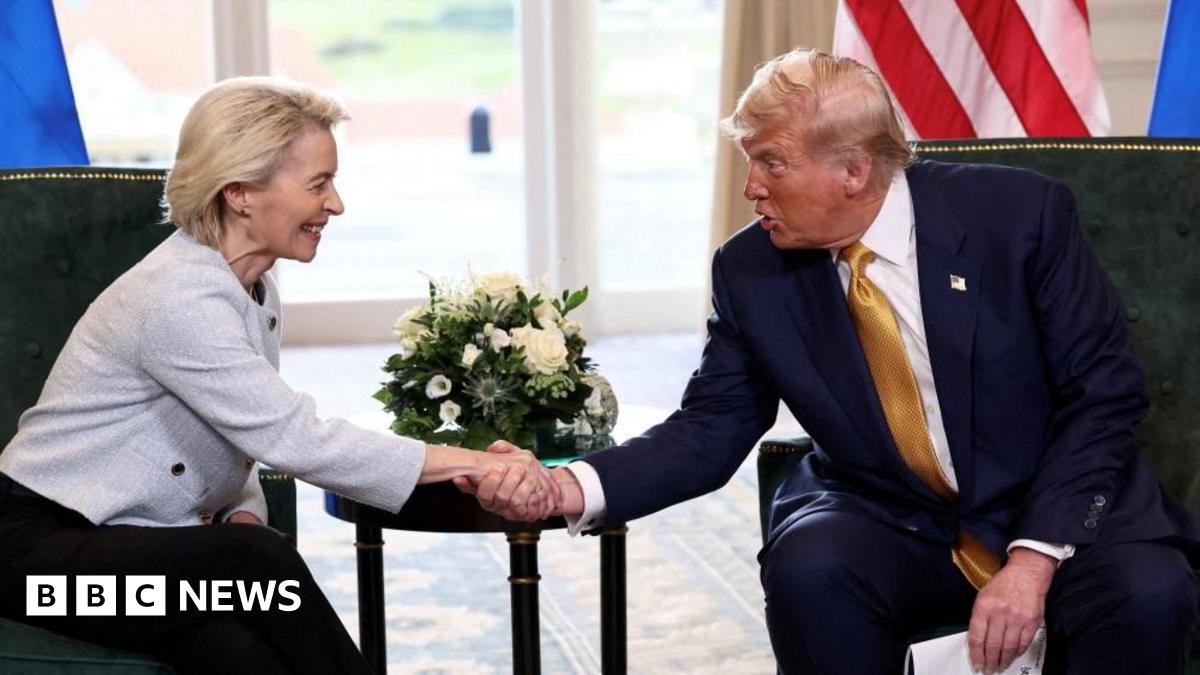
According to the joint agreement, the US will apply the new 15% tariff rate on most European goods, including European semiconductor and lumber exports, from 1 September.
In return, the EU will reduce to zero tariffs on “all US industrial goods”, including agricultural products such as fresh fruit and vegetables, pork, bison meat, and tree nuts.
It is only once Europe removes tariffs on US exports – a move that requires legislation – that the White House will reduce the 27.5% tariff on European motor vehicle exports to 15%, the agreement said.
EU Trade Commissioner Maros Sefcovic told a news conference the deal sets out that the 15% tariff on cars would be retroactively applied from the first of the month in which the legislative process begins.
Sefcovic said it was the EU’s “firm intention” to get that process started this month, and he had received reassurance from the US that the lower tariff would then apply from 1 August.
EU Commission President Ursula von der Leyen said the deal offered predictability for the bloc’s businesses and consumers, as well as “stability in the largest trading partnership in the world”.
“This EU-US trade deal delivers for our citizens & companies, and strengthens transatlantic relations,” she said on X on Thursday, external.
US Secretary of Commerce Howard Lutnick said the deal “creates historic access to the vast European markets” for American producers.
“The America First Trade Agenda has secured the most important trading partner creating a major win for American workers, US. industries, and our national security,” he wrote on X, external.
“Tariffs should be one of America’s favorite words.”
The deal comes after months of tariff threats and intense negotiations between the US and the EU, after Trump first announced in April that he would hit all European exports with a 30% tariff.
However, there was disappointment on both sides of the Atlantic that wine and spirits had not managed to be exempted from tariffs.
The French wine exporters federation, FEVS, said it would “create major difficulties for the wines and spirits sector”.
Mr Sefcovic said that with wine and spirits, “unfortunately, here we didn’t succeed”, although he added, “these doors are not closed forever.”
In the US, the Distilled Spirits Council also said it was disappointed by the agreement.
It said that without “a permanent return to zero-for-zero tariffs on spirits”, US distillers would not have the certainty to plan for future growth, while higher tariffs on EU spirits would “further compound the challenges facing restaurants and bars” in the US.