
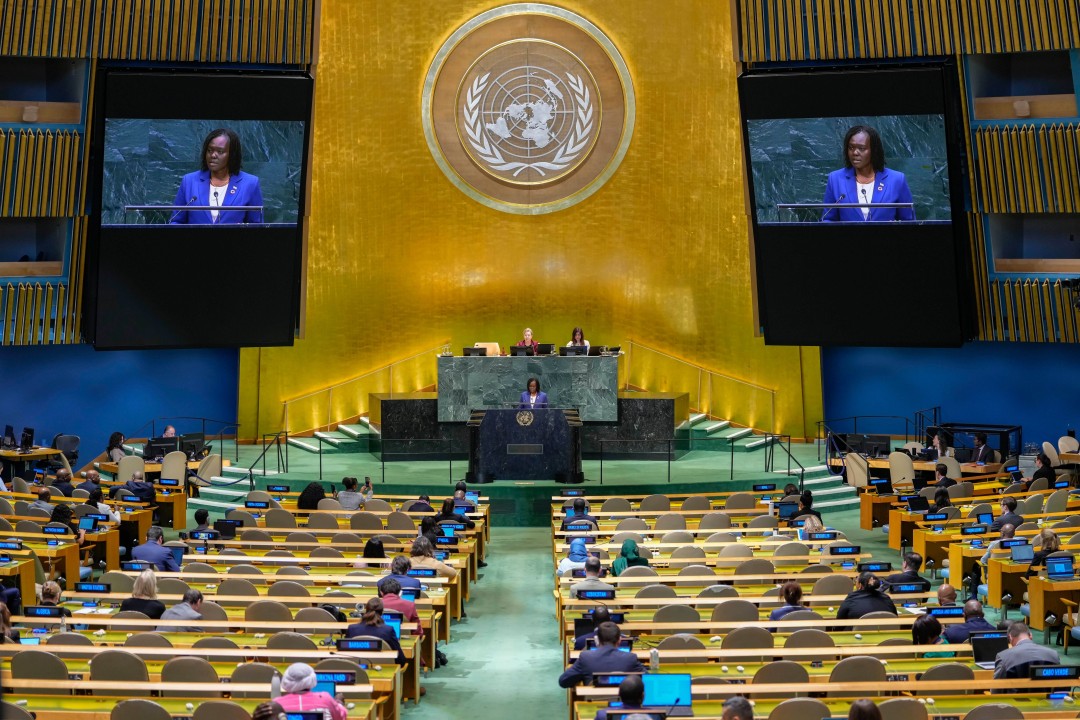
At a time when the fight for gender equality is facing a backlash, pressure is mounting for the next leader of the United Nations to be the first woman in its more than 80-year history. The contradiction isn’t lost on UN Women, the agency facing an uphill struggle pressing for the rights of women and girls—and for women to be at the top in international organizations, governments, business, technology, and the escalating debate over artificial intelligence, per the AP. According to the UN agency’s recent “gender snapshot,” at the current rate of progress it will take 171 years to achieve gender equality, a UN goal initially set for 2015 and then moved to 2030.
Other findings are also grim: Nearly 1 in 3 women globally have experienced sexual violence, and nearly 1 in 5 girls is married before age 18. And, after years of upward movement, women’s political leadership is also losing momentum, with 6 in 7 countries still led by men. Sarah Hendriks, a high-ranking official in UN Women, said the just-ended annual gathering of world leaders in the UN General Assembly hall “very much reflected a male-dominated world, both in terms of representation as well as content.”
“This is not just a question simply of symbolism,” Hendriks said. “It’s a question of whether the UN actually reflects the equality it asks the world to uphold. … We can’t ask governments to dismantle barriers to women’s leadership while accepting those barriers in its own institutions. We can’t tell companies to break glass ceilings while the UN leaves our own ceilings intact.” Among those speaking out was East Timor President Jose Ramos-Horta, co-winner of the 1996 Nobel Peace Prize. He said that after more than 80 years, “we ought to have enough wisdom and elect a woman with unquestionable integrity.”
Liberian President Joseph Boakai, meanwhile, told the gathering that “when women lead, peace agreements last longer, economies grow faster, and government becomes more accountable.” There are currently seven candidates to replace Secretary-General Antonio Guterres, whose second five-year term ends on Dec. 31. The slate consists of four women and three men. By tradition, the job of secretary-general rotates by region; this is Latin America’s turn, though there are two African contenders. While the General Assembly has the final say, decision-making rests with the five veto-wielding members on the Security Council—the US, Russia, China, Britain, and France. They’ve been mum about their choices. More here.