
Facebook
Twitter/X
LinkedIn
Pinterest
Reddit
Email
Print
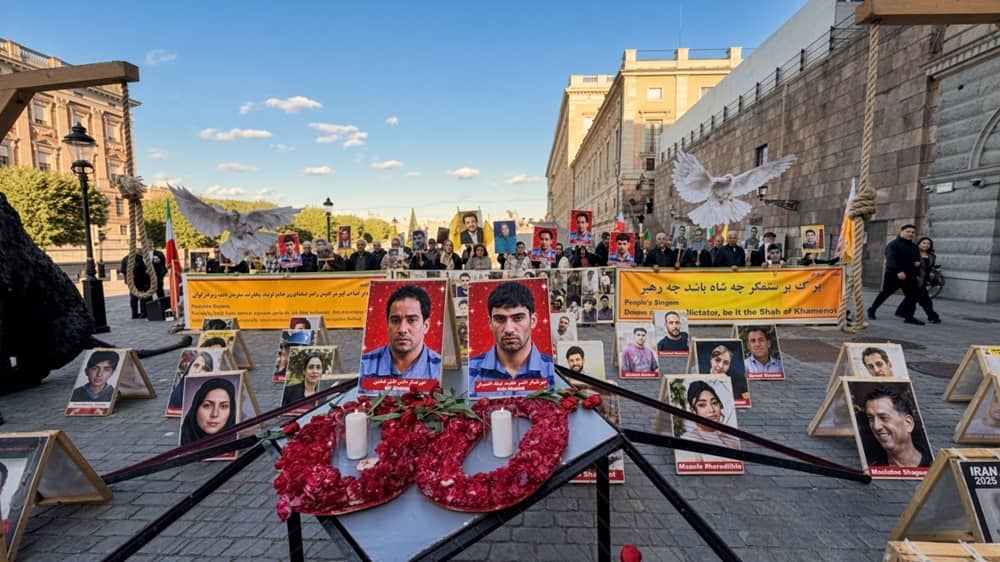 On October 3, 2026, NCRI supporters in Stockholm held a rally outside Sweden’s Parliament to condemn the Iranian regime’s execution of political prisoners and protesters
THIS PAGE WILL BE UPDATED WITH THE LATEST NEWS
UPDATE: 8:00 AM CEST
Women Teachers in Iran Struggle with Inflation and Low Wages
Every year, October 5, World Teachers’ Day, provides an opportunity to recognize millions of teachers around the world and to reaffirm the reality that quality education is impossible without supporting teachers.
According to Education at a Glance 2025, the average statutory salary for teachers with 15 years of experience in OECD countries ranges from approximately $55,725 per year at the pre-primary level to $63,925 at the upper-secondary level. In these countries, teachers’ actual earnings at the primary and secondary levels average around 83 to 91 percent of the earnings of people with university-level education.
Even in wealthy countries, teachers’ circumstances are far from ideal. In Iran, however, the issue unfolds in a different context: high inflation, declining purchasing power, housing and living costs, delays or discrepancies in the payment of certain benefits, differences among types of educational employment contracts, and the need for most teachers to take on a second job.
For a teacher, the question is how much remains from the monthly pay slip after paying rent or housing installments, food, transportation, medical expenses, children’s education, and other essential costs.
Iran’s Regime Faces Growing Economic Pressure as Inflation Nears 90 Percent
Iran’s regime is once again placing “people’s livelihoods” and “social unity” at the center of its public messaging as the country’s economic crisis reaches increasingly alarming levels.
On September 29, Hassan Mirzaei, President Masoud Pezeshkian’s chief of staff, said that Pezeshkian was not concerned about the United States but was worried about conditions inside Iran, particularly people’s livelihoods and the cohesion of society. Such statements are not new. What has changed is the severity of the economic conditions surrounding them. The Iranian rial has continued its precipitous decline, with the dollar recently surpassing 265,000 tomans. At the same time, official figures indicate that year-on-year inflation reached 89.8 percent between September 2025 and September 2026.
For millions of Iranian families already struggling with stagnant incomes, the combination of currency depreciation and rapidly rising prices has pushed purchasing power to unprecedented lows.
Iran’s Regime Tightens Pressure on Universities as New Academic Year Begins
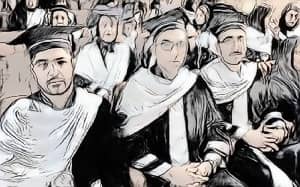
As universities across Iran reopen for the new academic year, the regime is moving quickly to reassert control over campuses. Instead of allowing students and faculty to return to academic life, authorities are reviving disciplinary cases, summoning students before university committees, and tightening an already heavily securitized environment.
The timing is significant. After months of disruption and closures, the reopening of universities provides an opportunity for students from different campuses to reconnect, exchange experiences, and revive networks of solidarity. For Iran’s regime, however, that same environment represents a potential threat.
A report published by the state-run Shargh newspaper on October 1 acknowledged that large numbers of students at Tehran University of Medical Sciences had been summoned to disciplinary committees over various allegations. The report also raised concerns about the way these cases were being handled, including indications that some decisions may have been predetermined.
The pattern suggests that these proceedings are not simply routine disciplinary matters. They function as a preventive mechanism designed to intimidate students before campus life fully resumes.
Trump Says Iran Can Choose the “Hard Way or the Easy Way” as Tehran Debates Hormuz and Negotiations
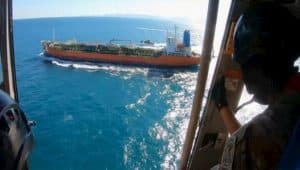
TEHRAN, Oct. 4, 2026 — Donald Trump’s remarks that Iran could choose “the hard way or the easy way” to resolve the dispute have come as two approaches inside the Islamic Republic become increasingly public: Kayhan and aligned outlets say Tehran should not weaken the Strait of Hormuz and other sources of leverage before securing reciprocal concessions, while Arman Emrooz and other moderate and reformist media argue that even amid war and distrust of Washington, the path to negotiations aimed at ending the conflict should remain open. Trump also claimed that Iran has been “severely weakened” and has effectively abandoned any program to acquire nuclear weapons; Tehran has consistently denied seeking to build a nuclear weapon.
The newspaper Arman Emrooz, in an editorial in its Oct. 4 edition titled “Why Negotiate?”, discussed the experience of the United States’ withdrawal from the JCPOA and the return of sanctions, but concluded that distrust of negotiations should not in itself lead to abandoning diplomacy. The newspaper wrote: “Distrust of negotiations does not necessarily mean that negotiations should be abandoned.”
The same edition, in another article titled “Iran Based on Resistance and Negotiation,” described new military threats as part of an effort to alter Tehran’s calculations while also stressing the need to maintain both resistance and dialogue. The simultaneous publication of the two pieces shows that part of the political current close to the reformists does not see the continuation of military capability as incompatible with keeping the diplomatic channel open.
Academics in Exile Hold Winchester Exhibition to Highlight Executions and Human Rights Abuses in Iran
UK, Winchester – October 3, 2026: Members of the Academics in Exile Association in the UK, supporters of the Iranian Resistance (NCRI), held a book table and photo exhibition in Winchester on October 3, drawing public attention to the Iranian regime’s escalating wave of executions, systematic repression, and severe human rights violations.
The event received a strong response from members of the public, with visitors expressing solidarity with the Iranian people’s pursuit of freedom, democracy, justice, and a secular republic. The exhibition focused particular attention on the intensifying use of the death penalty by the Iranian authorities, including the execution of political prisoners and protesters arrested during the January 2026 uprising.
Through photographs, publications, and personal testimonies, the organizers sought to shed light on the human cost of repression in Iran and the suffering endured by ordinary people, while emphasizing their continued determination to reject all forms of dictatorship, whether monarchical or theocratic.
Stockholm: PMOI Supporters Condemn Executions of Protesters and Call for a Democratic Republic in Iran
Stockholm, Sweden – October 3, 2026 — Supporters of the People’s Mojahedin Organization of Iran (PMOI/MEK) held a rally outside Sweden’s Parliament to condemn the Iranian regime’s execution of political prisoners and protesters, including Ali Hemmati and Majid Nikandish, and to call for an end to the death penalty.
The protesters rejected all forms of dictatorship, whether monarchical or theocratic, emphasizing their opposition to both the rule of the Shah and the current mullah-led regime. They called for the establishment of a democratic republic in Iran and expressed support for the National Council of Resistance of Iran (NCRI) as a democratic alternative.