
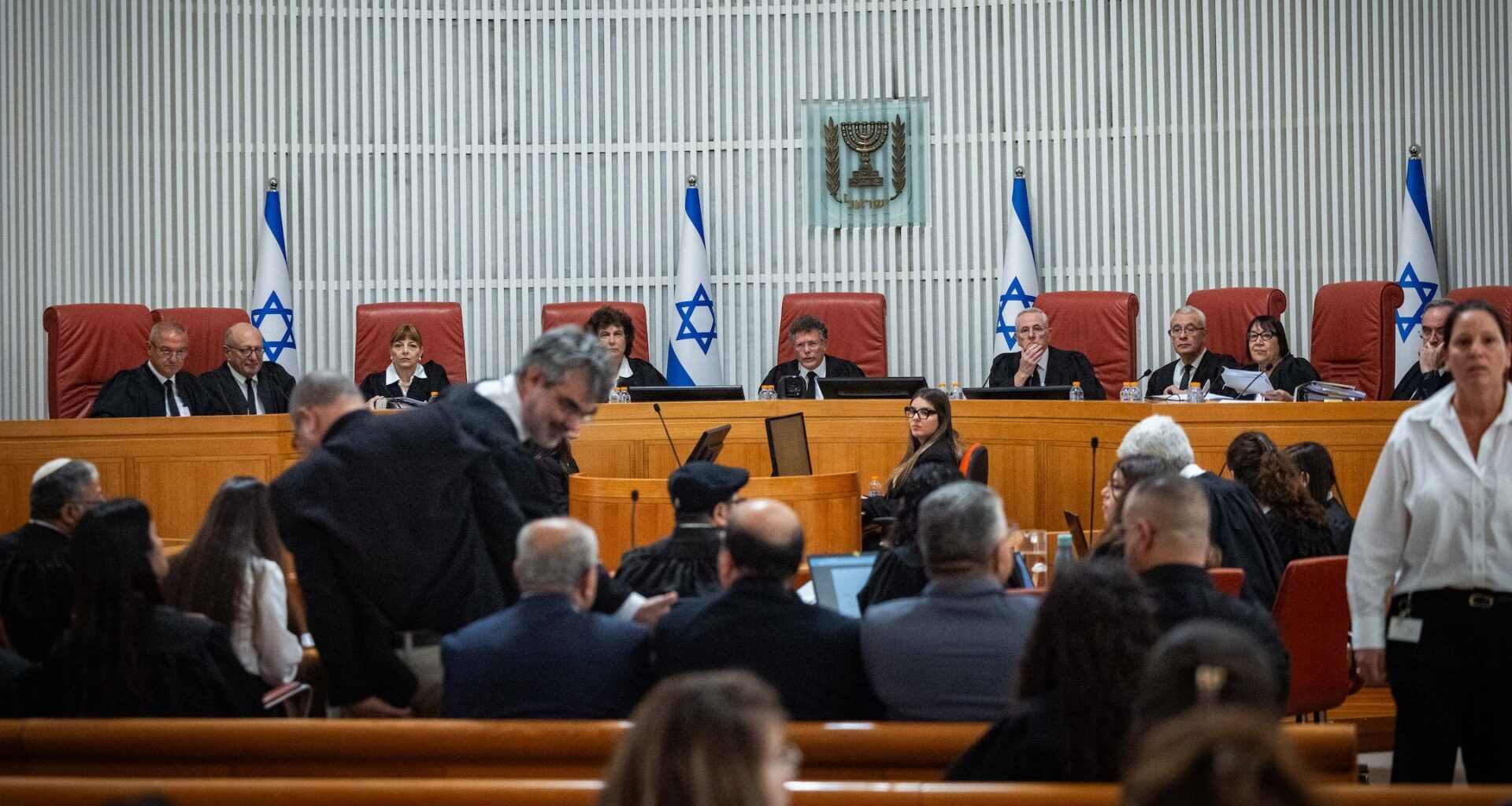
TEL AVIV – Israel’s Supreme Court ruling upholding the right of Arab parties to run in the Oct. 27 election could make it more difficult for Prime Minister Benjamin Netanyahu to form a new coalition after the election.
In a unanimous decision, the Supreme Court ruled on Friday that the Joint Arab List and Ra’am, the two Arab-led political lists competing in Israel’s elections, could run. The ruling overturned a decision by the Central Elections Committee, a largely political body in which parties in Netanyahu’s right-wing coalition hold a majority of the seats, which had voted last month to bar the lists from running.
“The court found that the materials submitted to the Central Elections Committee did not meet the standards established in the case law for disqualifying a list of candidates,” the court said in its ruling, which did not include extensive reasoning.
The decision restored the parties that traditionally represent Israel’s more than 2 million Arab citizens and in doing so helped the opposition block. Now a wide constituency that rejects working with Netanyahu will have a reason to head to the polls rather than stay home.
Most polls have shown that the opposition bloc would need to include the parliamentary seats held by the Ra’am party, led by MK Mansour Abbas, in order to gain the lead over Netanyahu’s coalition. Unlike Ra’am, the Joint Arab List has never sat in an Israeli coalition and there is no expectation that it would join with Zionist Jewish-led parties to do so.
The court also took a number of other steps regarding the upcoming election. It overturned the committee’s decision to disqualify Ofer Cassif, a Jewish lawmaker running as part of the Joint List. In Cassif’s case, the decision was made by a 7-2 majority.
The Supreme Court justices said they “strongly condemn the outrageous statements and actions by Cassif that evoke revulsion.” At the same time, they ruled that “these statements or actions do not meet the stringent tests established” for disqualifying a candidate.
According to the petition seeking Cassif’s disqualification, he had legitimized Palestinian violence during the war, referred to those seeking to attack Israeli soldiers as “freedom fighters” and taken actions against Israel in international legal forums.
The most significant development, however, came in the case of Sami Abu Shehadeh, the leader of Balad, one of the parties that make up the Joint List.
During a Thursday hearing, the Supreme Court took the unusual step of indicating to Abu Shehadeh that a majority of the justices were inclined to disqualify him and recommended that he withdraw his candidacy.
Following internal consultations, Balad announced that Abu Shehadeh would withdraw his candidacy, rendering the court’s expected ruling on his disqualification moot.
“Sami Abu Shehadeh did not retract his positions and did not flee the struggle. Only after the court itself announced its intention to uphold the disqualification did he decide to withdraw his candidacy,” Balad said in an official statement.
A central part of the case against Abu Shehadeh focused on an article he published on Oct. 8, 2023, one day after Hamas’ Oct. 7 attack, in which the terror organization killed 1,200 people in Israel and took another 251 hostage.
In the article, Abu Shehadeh described the Oct. 7 events as an “important historic event” and suggested that lessons could be learned from how Hamas had managed to surprise Israel and carry out its invasion. His comments were cited as evidence that he supports armed struggle against Israel, one of the grounds on which candidates can be disqualified under Israeli law.
In its ruling, the Supreme Court said there was “a consensus that the things said by Mr. Abu Shehadeh are painful, outrageous and revolting.” The decision to disqualify Abu Shehadeh was also supported by the Democrats, Israel’s most left-wing Zionist party.
During the Supreme Court hearing, Abu Shehadeh acknowledged that “this paragraph was not written correctly.” He said, “I have never supported violence in my life,” and said that he knows victims of the Oct. 7 attack.
Balad said Abu Shehadeh would continue to lead the party’s political activities even without serving in the Knesset.
The Joint List sharply criticized the court’s handling of the case. In a statement, the list said that “the heart of the matter” was “preventing an Arab political leader from running in the elections and infringing on our public’s right to choose its representatives.”
The list accused the court of acting “following a campaign of incitement and political persecution led by the fascist and Kahanist right, joined by the leaders of the Zionist opposition parties.”
“The court must bear responsibility for its disgraceful decision before our public and before public opinion in Israel and around the world, for providing judicial cover for political exclusion. This ruling is another link in the chain of persecution of our public.”
Right-wing Israeli politicians also criticized the court for declining to issue a ruling formally disqualifying Abu Shehadeh rather than merely pressing him to withdraw.
National Security Minister Itamar Ben-Gvir, an ultranationalist member of Netanyahu’s government, called the court’s proposal “too merciful” and said it “harms the democracy of the State of Israel.”
As the Year Turns, Support the Journalism You Trust. JTA covers the stories shaping Jewish life around the world — with the depth this moment calls for. As you reflect on the year ahead, consider a gift that keeps independent Jewish journalism strong.
One-time
Monthly
Choose an amount to donate
$72$180$360$500
Support Us