
Tensions between the football teams of Israel and Ireland reached a flashpoint during the second leg of their Nations League fixture in Serbia, bringing an end to a politically charged two weeks.
The League 3 Group B match ended in a 1–1 draw at the TSC Arena in Backa Topola on Sunday, but tempers flared and accusations flew despite the game being held behind closed doors and at a neutral venue.
Recommended Stories list of 4 itemsend of list
It built on the confrontational nature of their first match on September 27, when Ireland defeated Israel 3-0.
Irish players had been under pressure from home – where affinity with Palestinians is strong – to boycott the second match against Israel, although the pressure seemed greater during the first game.
“I felt that pressure growing day by day and it’s getting almost to a breaking limit now,” Ireland coach Heimir Hallgrimsson said at the time.
Here’s a look at the events surrounding the fixture:
What are the spitting allegations against Israel?
Irish media reported that one of Ireland’s coaches, Damien Doyle, had accused an Israeli player of spitting at him after the half-time whistle.
“I was there. I’m not going to comment. It’s something a disciplinary committee will look at,” Ireland coach Heimir Hallgrimsson said when asked by reporters about the incident.
Israel coach Ran Ben-Shimon said he had already left the sideline and did not see what happened.
“Half-time, I was in the dressing room, in my room with my staff; I didn’t see anything. When I’m going to see and check, I will get back to you with the answer,” he told reporters.
Will UEFA take action against Israeli players?
There is no clarity yet on whether European football’s governing body will sanction the players.
UEFA and the Football Association of Ireland (FAI) have not responded to Al Jazeera’s request for comment on whether a disciplinary inquiry has been opened into the incident.
While spitting incidents in football are not uncommon, there have been none previously reported between Irish and Israeli players.
Why did Ireland’s players not shake hands with Israelis?
Ahead of the first fixture, Israel was informed in advance by the FAI that Ireland’s players would not shake hands as a form of silent protest and UEFA accepted the arrangement.
It was one of several protest measures unveiled by David Courell, FAI CEO, at the pre-match news conference. He said there would be no exchange of the customary pennant before the game and that Irish players would wear black armbands in honour of all the victims of Israel’s genocidal war on Gaza, while donating their match fees to charity.
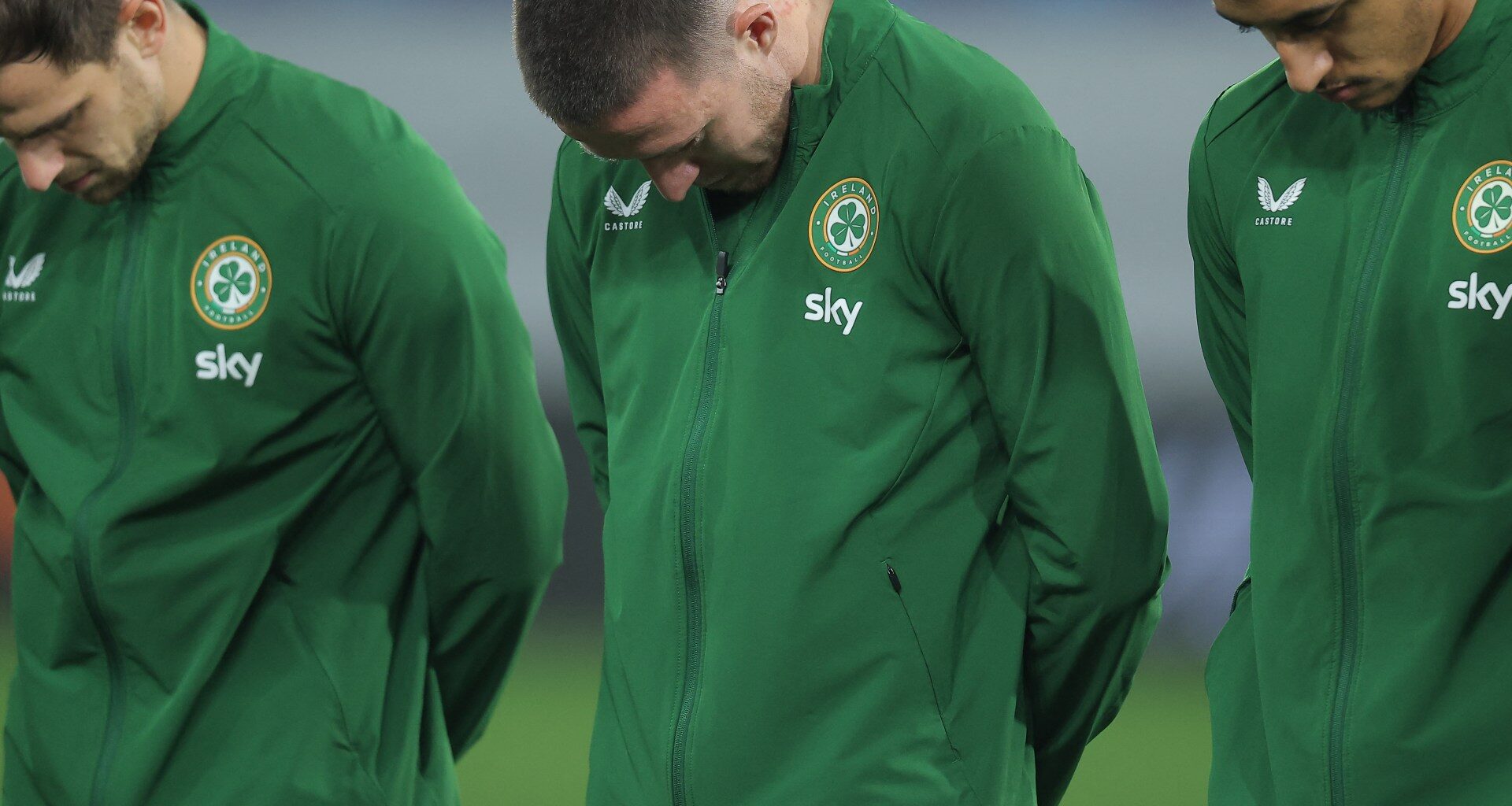
Irish players also bowed their heads while Israel’s national anthem was being played.
Ireland is one of Europe’s most outspoken critics of Israel’s genocidal war on Gaza and the FAI chose to stage Sunday’s match behind closed doors in Serbia amid the pressure to withdraw from the fixtures.
Will Ireland and Israel face each other again?
No, Sunday’s match was the second and final fixture between the two sides in the group stage. They will not face each other again in the current Nations League cycle.
“I’m absolutely delighted this is finished,” Hallgrimsson said after Sunday’s match, according to Ireland’s national broadcaster RTE.
When asked whether Ireland and Israel should be drawn in the same group at such tournaments, he said: “No, we shouldn’t.”
“But that’s not for us to decide. It’s UEFA that decides that.”
The Icelandic coach went on to talk about the toll it took on his players.
“I wouldn’t wish for any national team to go through what we have gone through these two weeks. So maybe UEFA just needs to step in and do something.”
Hallgrimsson underscored the Irish support for Palestine, saying emotions ran high due to the sentiment.
“There’s obviously a big support for Palestine in Ireland. There’s not many countries that support Palestine as much as Ireland does.”
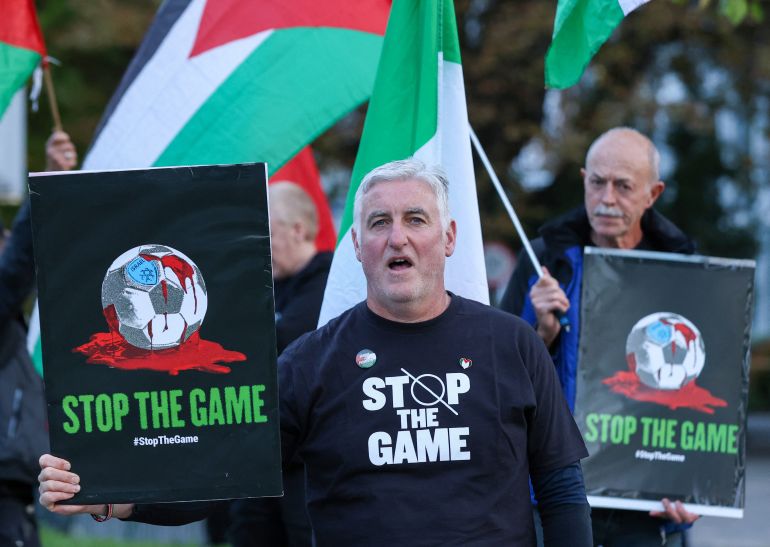 Placards urging Ireland’s football team not to play against Israel [Paul Faith/AFP]Does UEFA separate teams due to political reasons?
Yes, while UEFA uses a computer-generated system to sort the 54 nations into four pots to create groups, it has certain draw conditions in place to keep certain teams apart due to geopolitical or travel restraints.
The only “prohibited clash” in the 2026-27 cycle was between Bosnia and Herzegovina (League B, pot 2) and Kosovo (League B, pot 4).
Other teams that will not be drawn together due to political reasons based on the UEFA Executive Committee’s decision are:
Armenia and Azerbaijan
Gibraltar and Spain
Kosovo and Bosnia and Herzegovina
Kosovo and Serbia
Kosovo and Russia
Ukraine and Russia
Ukraine and Belarus
Why did Ireland’s Finn Azaz not play against Israel?
Ireland player Finn Azaz, whose mother has Israeli heritage, was benched for both fixtures after Hallgrimsson said he “didn’t feel he was ready for the game”.
“Obviously we spoke a lot together and it was just tough on him. I could feel it when I spoke to him,” the Ireland manager told the public broadcaster.
“It tested him more than all of us. So I just felt it was better to leave him out than play him.”
Why were Irish players wearing black armbands?
Ireland players wore black armbands in both fixtures in recognition of Palestinians killed in Gaza.
Israel, meanwhile, wore black armbands featuring “7.10”, a reference to October 7, when armed fighters from Palestinian group Hamas launched attacks in southern Israel, which then launched its genocide against Palestinians in Gaza.
Have other teams worn armbands at international matches before?
Yes, several teams have worn black armbands to commemorate a player or coach who has passed.
Portugal wore black armbands and observed a moment of silence for midfielder Diogo Jota who was killed in a car crash in July 2025. The team then transitioned to longer-term tributes through custom wristbands bearing the name of Jota and the squad when they competed at the 2026 FIFA World Cup.
All Premier League teams and officials honoured Brazilian legend Pele with black armbands and a minute’s applause prior to kickoffs during certain matches the week of Pele’s death in December 2022.
In 2020, AC Milan and Torino wore black armbands in tribute to NBA legend Kobe Bryant, who supported AC Milan and lived in Italy for several years during his childhood.