
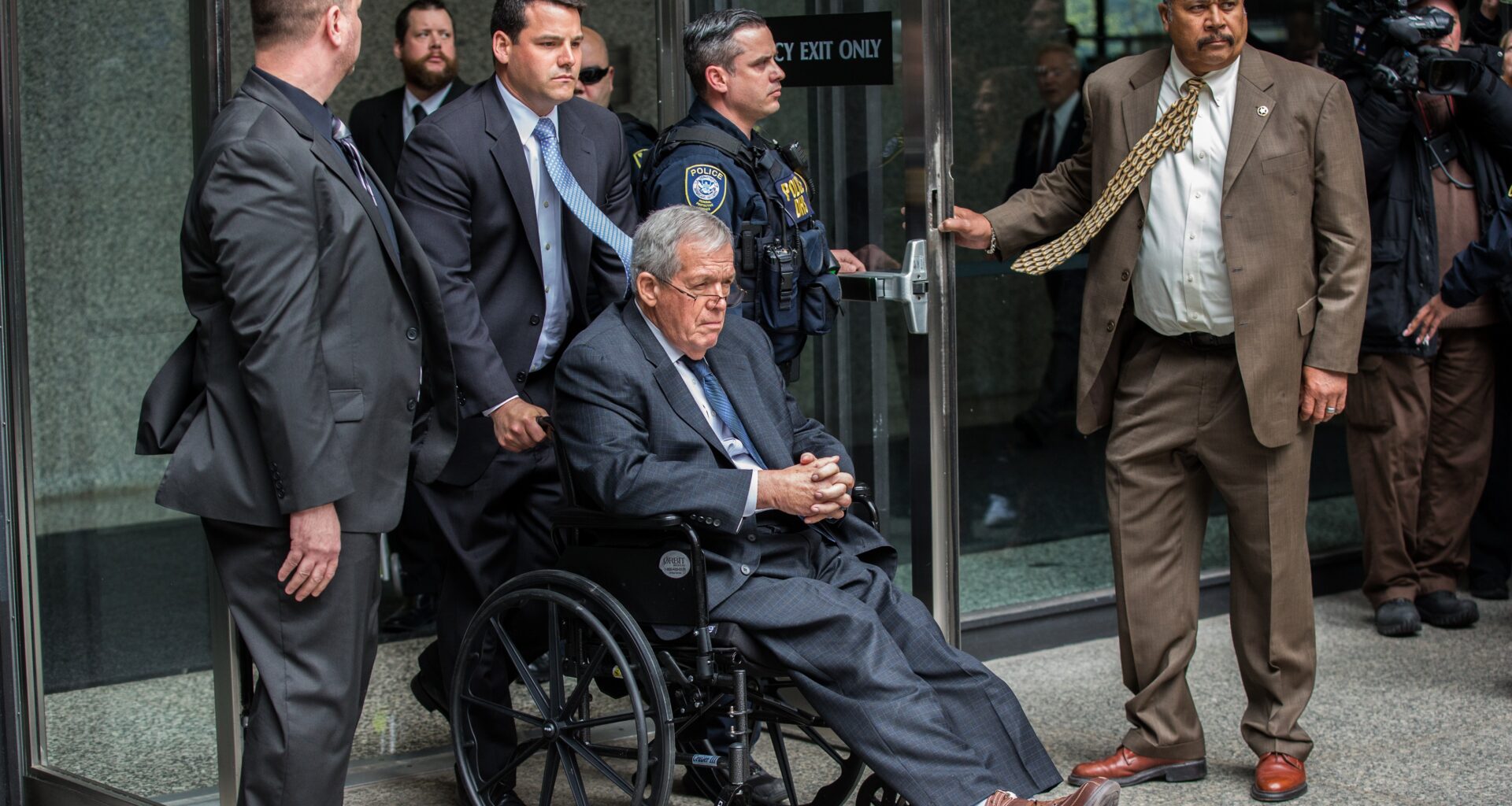
J. Dennis Hastert rose from a rural high school wrestling coach to the heights of power as the longest-serving Republican speaker of the U.S. House before an ignominious fall and imprisonment amid revelations he sexually abused youths he had coached.
Once the third-most-powerful elected official in the country, serving as speaker from 1999 until 2007, Hastert died Sunday of natural causes at his home in Plano while under hospice care, Kendall County Coroner Jacquie Purcell said. He was 84.
His death came a decade after he was sentenced to 15 months in prison for illegally structuring $950,000 in bank withdrawals to evade federal reporting requirements. The money was for hush payments to one of his victims, identified in court only as Individual A.
Hastert’s admission in court that he had sexually abused several boys he coached on the Yorkville High School wrestling team in the 1960s and 1970s left him living a life largely “isolated from society,” one of his attorneys said. Friends who had encouraged his rise in national politics and celebrated him as a local hero shunned him.
It was a stunning fall for a politician hailed across party lines in Illinois, where many colleagues knew him not as “Mr. Speaker” but as “Denny” or simply “Coach.”
For the family of one of his victims, his death brought little relief.
“I thought I would feel more relief and kind of a final closure, and I do, but nothing changes the fact that I lost my brother and I believe he had a lot to do with it,” said Jolene Burdge, whose brother, Stephen Reinboldt, told her Hastert abused him throughout high school. Reinboldt died years before the allegations against Hastert became public.
John Dennis Hastert III’s political career was yet another example of the important role that timing plays in politics.
After serving as a teacher and wrestling coach at Yorkville High School in the mid-1960s, he led the team to a state title in 1976 and earned coach-of-the-year honors. In 1980, he ran for the Illinois House and finished third in a Republican primary challenge to state Rep. Al Schoeberlein. But months later, Schoeberlein became terminally ill, and local party leaders chose Hastert to replace him on the ballot.
Six years later, similar circumstances occurred when U.S. Rep. John Grotberg, who had frequently battled cancer, became incapacitated around the time of the primary election. Hastert’s supporters helped engineer his nomination from among a field of 12, and he headed to Congress.
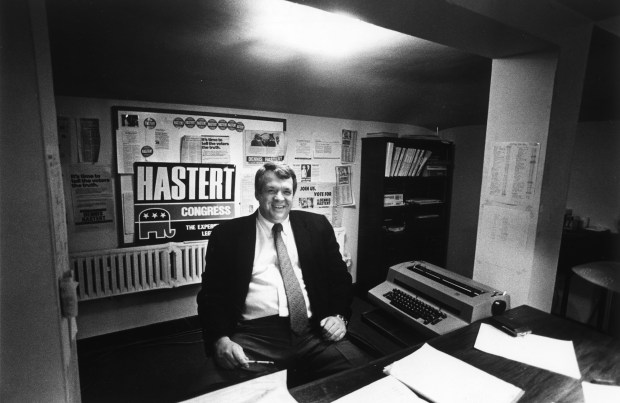 State Rep. Dennis Hastert savors his congressional victory at his campaign office in the Baker Hotel in St. Charles on Nov. 5, 1986. (Don Casper/Chicago Tribune)
A conservative with a strong Christian background from his years attending Wheaton College, Hastert opposed the Equal Rights Amendment and abortion. But as chief deputy whip, he was known for bridging differences between the GOP’s conservative and moderate factions.
That skill proved valuable in 1998, when House Speaker Newt Gingrich stepped down after disappointing Republican losses in the midterm elections. In mid-December, Speaker-designate Robert Livingston of Louisiana took to the floor and made a surprise announcement that he was withdrawing after revelations of his extramarital affairs became public.
Within hours, Hastert secured enough Republican votes to win the post and was dubbed “the accidental speaker.”
As speaker, Hastert strongly supported President George W. Bush’s domestic and foreign agendas. In 2004, he formalized what became known as the Hastert Rule, under which only legislation backed by a majority of House Republicans would get a floor vote.
He also was a strong supporter of “earmarks,” federal projects sought by individual members that were often derided by critics as “pork barrel” spending. The Washington Post found that between 1999 and May 2005, Hastert directed $24 million in grants to groups in Aurora, his birthplace.
Perhaps his most notable earmark was $207 million to start the 37-mile Prairie Parkway project that created a north-south expressway connecting Interstates 88 and 80 in the far west exurbs. Hastert never revealed that the highway’s construction would benefit a land investment he and his wife had made. Months after Bush signed the 2005 highway bill into law, a land sale netted the Hasterts nearly $2 million, but the speaker denied any wrongdoing.
Federal funding for the project, which was opposed by local residents, was rescinded in 2012. In 2018, the Illinois Department of Transportation abolished a protective corridor that had been established for it.
After Republicans lost the House in the 2006 midterm elections, Hastert stepped down from GOP leadership and later resigned his seat in November 2007 to become a consultant and powerful lobbyist.
Five years later, the FBI began looking into Hastert and large cash withdrawals he was making from local banks in amounts just under $10,000, the threshold that triggers reports to federal regulators.
At first, federal investigators said Hastert told them he didn’t trust banks and then said he was a victim of an extortion scheme — lies that led to his prosecution.
Agents then learned he had sexually abused youths he coached, including Scott Cross, the brother of former Illinois House Republican leader Tom Cross. Tom Cross had been a protege of Hastert and a member of his political operation.
Hastert was indicted in May 2015 by a federal grand jury. After a plea agreement, U.S. District Judge Thomas M. Durkin sentenced him in April 2016 to 15 months in prison, repeatedly calling him a “serial child molester.”
“Nothing is more stunning than having the words ‘serial child molester’ and ‘speaker of the House’ in the same sentence,” Durkin said.
In all, five former students came forward to accuse Hastert of sexual abuse. Prosecutors said the abuse occurred in empty locker rooms and motel rooms on summer wrestling trips, often predicated by Hastert offering a massage. Victims also told authorities that Hastert would pull up a reclining chair after practices and watch the boys shower.
Hastert reported to the Federal Medical Center in Rochester, Minnesota, on June 22, 2016, a little over a year after his indictment. He served about 13 months of his 15-month sentence before being placed on supervised release. Because Hastert admitted he abused boys as a wrestling coach, he also was ordered by a judge to take part in a sex-offender treatment program, including any “psychological and physiological testing” recommended by his probation officer.
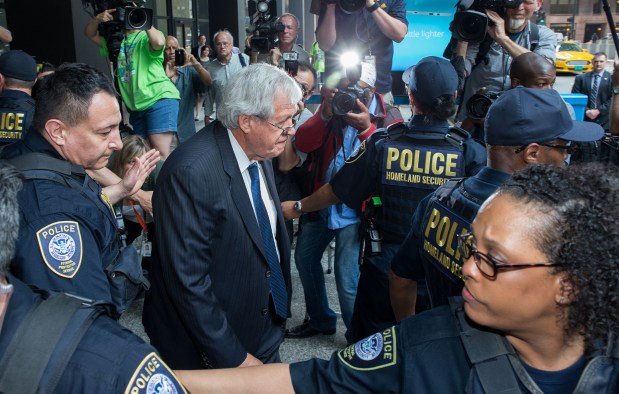 Former U.S. House Speaker Dennis Hastert leaves Chicago’s Dirksen U.S. Courthouse on June 9, 2015, after pleading not guilty to charges that he evaded bank regulations and lied to the FBI. (Zbigniew Bzdak/Chicago Tribune)
In 2021, years after Hastert’s release, a lawsuit filed by the man who was supposed to receive a total of $3.5 million in hush money payments was settled in Kendall County court, just days before it was scheduled to go to trial. The terms of the settlement were never made public, and Individual A was never identified in court.
Hastert’s portrait at the U.S. Capitol was removed from display and sent to storage. The National Wrestling Hall of Fame removed him in 2016. Wheaton College took his name off its public policy center, which still houses the congressional papers he donated.
Reinboldt, the wrestling team’s longtime student equipment manager until his 1971 graduation, died of AIDS in 1995 at age 42.
Burdge, his younger sister, who lives in Billings, Montana, said her brother told her Hastert had abused him “all through high school.” According to a court filing, three other people later came forward to say Reinboldt had also confided in them about the abuse.
At Hastert’s 2016 sentencing hearing, Burdge testified that her brother spent years “running from the pain and turmoil” caused by Hastert’s abuse and was afraid to speak out because he thought no one would believe him.
In an interview with the Tribune on Monday, Burdge said news of Hastert’s death had left her surprisingly emotional, and she had been tearful all day thinking about her brother and how Hastert’s actions ruined his life. She thinks of her brother often, she said, and Hastert’s death brings a finality to the sad saga.
“I believe in forgiveness but there are days when it’s really hard,” she said. “But I have to try to believe in my faith and trust that the Lord’s got it. I feel bad for (Hastert’s) family. I feel bad for the town, but nobody caused this except for him.”