
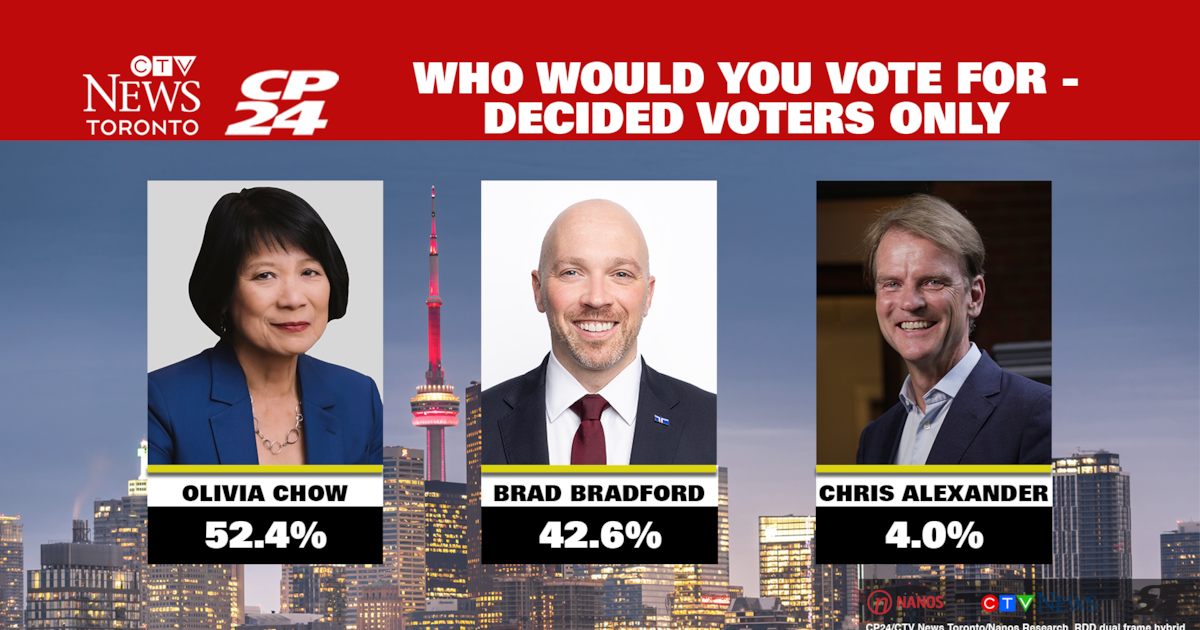
Olivia Chow has a nearly 10-point lead over Brad Bradford among decided voters in the Toronto mayoral race, a new poll conducted exclusively for CP24 and CTV News Toronto shows.
Nanos Polling surveyed 755 randomly selected Toronto residents from Sept. 30 to Oct. 4.
The survey found that 52.4 per cent of decided voters responded that they would vote for Chow if an election were held today, compared to 42.6 per cent for Bradford.
Four per cent of respondents indicated that they would vote for Chris Alexander, however the former federal cabinet minister announced on Tuesday morning that he was suspending his campaign.
About one per cent of respondents said that they would cast a ballot for another candidate. Among all respondents, 22 per cent said that they were still undecided.
In a release prior to Alexander’s withdrawal from the race, Nanos Polling Chief Data Scientist Nik Nanos said the poll suggests that Toronto’s mayoral election is “shaping up as a two-candidate race.”
“Olivia Chow holds a citywide lead over Brad Bradford and draws her strongest support from Toronto-East York, where she exceeds 60 per cent, while also leading in Scarborough,” he said.
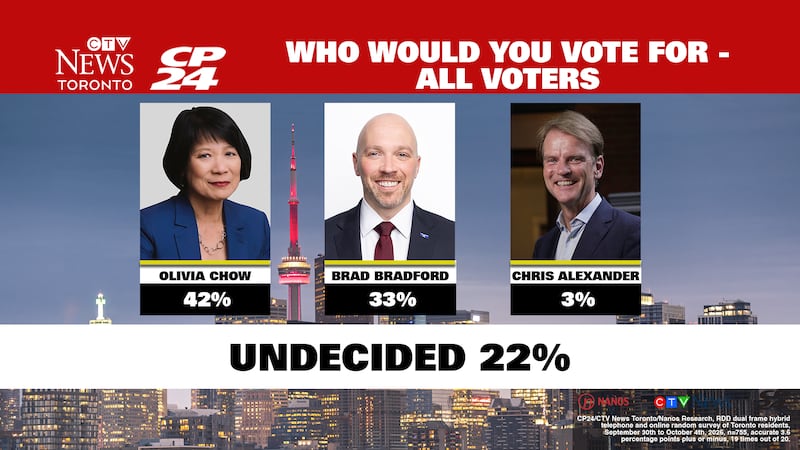 Nanos Polling survey This graphic shows the results of a new Nanos Polling survey on the Toronto mayoral race that was conducted exclusively for CP24 and CTV News Toronto.
Nanos Polling found that Chow had the support of 60.2 per cent of female respondents compared to 35.2 per cent for Bradford and 3.7 per cent for Alexander.
Bradford, meanwhile, had a slight advantage among men (50.7 per cent) when compared to Chow (44 per cent).
Chow led all age groups but saw her support at 59.2 per cent among the youngest demographic (18-34).
Bradford had the support of 34.7 per cent of Toronto residents in that group but performed stronger among those 35 to 54 where he only trailed Chow by 2.8 per cent (46 per cent to 48.8 per cent), which is within the margin of error for the poll.
Nanos Polling also asked respondents how likely they are to vote in the upcoming municipal election.
More than half (53.2 per cent) of those who said that they support Chow indicated that they will “definitely” vote while 43.1 per cent of Bradford supporters offered the same level of confidence.
‘Bare-knuckle politics’
“Scarborough could still be a key battleground. Even though Chow has the advantage among decided voters, that undecided number in Scarborough jumps to 32 per cent, one out of every three,” Nanos said.
“So I’m looking at Scarborough as a place to watch. It seems that Chow has the advantage but there is still a significant portion of voters in that part of the city that are up for grabs.”
He added that while Chow has the advantage among young voters, the impact of that will come down to voter turnout.
“Will young voters come out and vote,” Nanos asked. “It might not be as much as of an advantage when it comes to actual voting day for the mayoral race.”
When it comes to the attitude of residents towards the city, the survey found that most continue to view Toronto positively, despite a campaign that has at times focused on some of the challenges it faces.
Given four statements to choose from, a majority of respondents (52 per cent) said “Toronto has some issues but it’s still where I prefer to live” while another 26 per cent offered that “Toronto is a great city and I wouldn’t want to live anywhere else.”
About 14 per cent of respondents said “Toronto is where I have to live but I would prefer to be somewhere else” while six per cent said that they do not like living in Toronto and are considering leaving.
Nanos said the election campaign is shaping up to be an “interesting race.”
“This is fundamentally a two-way race. Two-way races are not always good for the incumbent because it allows for people who might not be happy with the last number of years or the direction of the city to cast a ballot for Bradford, not because they necessarily like the guy… but because he is the only person today that can stop Olivia Chow,” he said.
“It is going to be ward by ward, block by block, bare-knuckle politics in terms of getting the vote out.”
Methodology
The Nanos Polling survey was conducted exclusively for CP24 and CTV News Toronto. The survey included 755 Toronto residents randomly selected. Interviews were completed online and by telephone. The survey has a margin of error of plus or minus 3.6 percentage points, 19 times out of 20.
Related Stories